10 min read
Airbnb Business Management Tools: The Complete Guide for Hosts
Jul 29, 2026, 9:15:34 AM
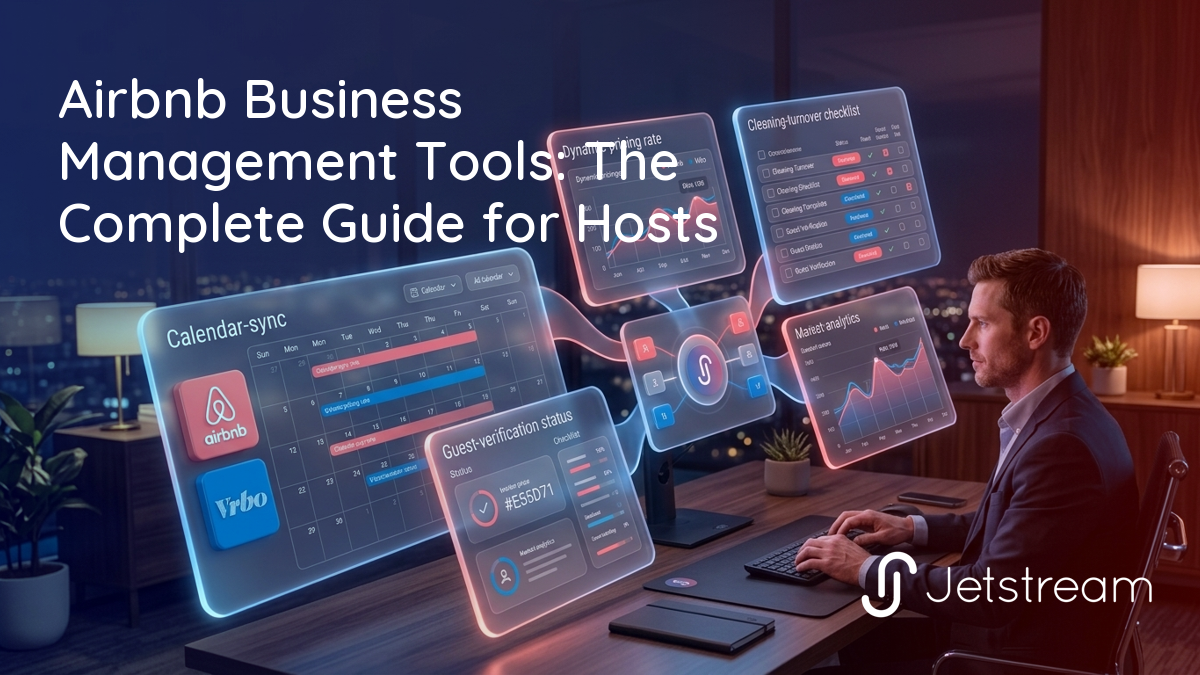
Airbnb business management tools fall into five working categories: channel management and distribution, pricing and revenue, cleaning and operations, guest screening and communication, and data and analytics. Most hosts start with one all-in-one platform that bundles several of these, then add specialists as they scale. The highest-leverage layer is distribution, because every other tool depends on accurate, synced availability.
Running an Airbnb listing as a serious business looks nothing like running a spare room. Once you are managing calendars, cleaners, pricing, guest risk, and performance data across one or more properties, the manual approach stops scaling and starts costing you money. That is why Airbnb business management tools exist, and why Airbnb itself curates a formal directory of them. Airbnb "works with leading software providers globally, making it easy for hosts to connect to our growing guest community," and reserves a Preferred Partner tier for providers that "meet or exceed all our technical and performance benchmarks" (Airbnb Software Partners). Among professional hosts, running a set of airbnb host tools has become standard practice.
The market is growing and professionalizing at the same time. Grand View Research values the global short-term vacation rental market at USD 149.2 billion in 2025, projected to reach USD 362.4 billion by 2033 at a compound annual growth rate of 11.8% (Grand View Research, June 2026). The same analysis notes that hosts "are becoming more commercially minded, prioritizing dynamic pricing, occupancy optimization, and multi-channel distribution to maximize yield." Estimates of the market's size vary by research firm, but the direction is consistent: more supply, more competition, and more operators treating hosting as a real business.
Key takeaway: A complete Airbnb tech stack is a set of tools that each own a specific job. You can buy most of them separately or get several bundled inside an all-in-one platform. The layer that decides how well everything else performs is distribution, because a synced, accurate presence across booking channels is what your pricing, cleaning, and analytics tools all rely on.
Why Airbnb hosts need business management tools
Airbnb hosts need business management tools because the operational load grows faster than the number of listings. A single property already generates calendar updates, guest messages, cleaning turnovers, pricing decisions, and review responses. Add a second or third listing, or a second sales channel like Vrbo, and the coordination stops being something you can hold in your head.
Tools solve three specific problems. First, they remove double bookings and calendar drift by syncing availability automatically instead of by hand. Second, they capture revenue you would otherwise leave on the table, because software prices and reprices faster and more consistently than manual rate changes. Third, they reduce risk and error, from unscreened guests to missed cleanings, by putting a system where there used to be a to-do list.
The professionalization of the market makes this non-optional. As more operators adopt dynamic pricing, multi-channel distribution, and automated operations, the hosts who still run everything manually fall behind on both revenue and guest experience. The practical question at any scale is which categories you actually need right now.
The Airbnb business management tools stack at a glance
An Airbnb business management tools stack breaks into five core categories, each doing a distinct job, plus all-in-one platforms that bundle several of them together. You rarely need every category on day one; you add layers as your portfolio and channel mix grow. The table below maps each category to the job it does, representative tools, and the point at which it usually becomes essential.
| Category | Job it does | Example tools | When it becomes essential |
|---|---|---|---|
| Channel management & distribution | Syncs calendars, rates, and listings across Airbnb, Vrbo, and other channels; prevents double bookings | Hostaway, Guesty, Jetstream (as a service) | The moment you list on more than one channel, or manage more than one property |
| Pricing & revenue | Adjusts nightly rates dynamically based on demand, seasonality, and events | PriceLabs, Beyond, Wheelhouse | As soon as manual pricing costs you occupancy or rate |
| Cleaning & operations | Schedules turnovers, pays cleaners, tracks checklists and maintenance | Turno, Breezeway | When turnover coordination eats your week |
| Guest screening & communication | Verifies guests, reduces fraud and party risk, automates messaging | Autohost, plus messaging in Hostaway and Breezeway | When incident risk or message volume grows |
| Data & analytics | Benchmarks rates, occupancy, and market demand for pricing and acquisition | AirDNA | When you price competitively or evaluate new properties |
| All-in-one platforms | Bundle several of the above into one property management system | Hostaway, Guesty | When you want one login instead of many |
For a ranked, priced comparison of the all-in-one platforms specifically, see our guide to the best Airbnb management software. The sections below break down each specialist category so you can decide what your stack actually needs.
Channel management and distribution tools
A channel manager is the tool that keeps your availability, rates, and listing content synced across every booking platform at once. In Hostaway's words, it is a system that "prevents double bookings, centralizes calendars, syncs listings across OTAs, and manages guest conversations from one platform" (Hostaway). When a guest books on one channel, the tool "instantly reflect[s] new bookings, cancellations, price changes, and availability across connected channels," so you are never selling the same night twice.
These channel management tools are the layer everything else depends on. Your pricing tool can only push rates to channels that are connected and synced. Your cleaning tool pulls its schedule from your booking calendar. Your analytics are only as good as the reservation data flowing through. Get distribution wrong, and every downstream tool inherits the error.
Not all connections are equal. Hostaway notes that "API connections are fastest; iCal is calendar-only and updates on scheduled intervals," which matters when a delayed sync is the difference between a clean calendar and a double booking. All-in-one platforms fold channel management into a broader property management system; for example, Guesty "streamlines your operations by automating reservations, guest communication, channel management, and payments in one place" (Guesty).
For hosts and operators who want distribution handled as a managed service rather than software they run alone, Jetstream is the full-service distribution and channel-management layer, taking a property's inventory and placing it accurately across Airbnb and Vrbo without the operator maintaining the connections themselves. It works as a distribution service rather than a property management system or booking engine. To go deeper on how channel managers work and how to choose one, read our vacation rental channel manager guide, and for the hotel-to-STR angle specifically, our overview of the Airbnb channel manager for hotels.
See how Jetstream handles distribution
Pricing and revenue optimization tools
Pricing tools set your nightly rates dynamically, adjusting for demand, seasonality, local events, and competitor supply so you are not leaving revenue on the table with a flat rate. The category leader, PriceLabs, describes its job as "dynamic pricing and revenue management for hosts, PMs and hotels" built to "get the price right, every night" (PriceLabs). Rather than replacing your judgment, these tools generate "intelligent price recommendations considering market trends like supply, demand, seasons, events, and holidays, with full control over the final prices."
The scale of adoption signals how standard this has become. PriceLabs reports "600,000+ properties priced daily" and "60,000+ hosts and property managers" across "150+ countries served." Manual pricing simply cannot react to a sudden concert, a shoulder-season dip, or a competitor dropping rates the way an automated engine can.
Dynamic pricing is not only a short-term rental tactic; hotels and multi-channel operators use the same logic to maximize yield across every channel they sell on. For a breakdown of the main options, including Wheelhouse, Beyond, PriceLabs, and Airbnb's own Smart Pricing, see our guide to short-term rental pricing tools.
Cleaning and operations management tools
Cleaning and operations tools coordinate the physical work of hosting: scheduling turnovers, paying cleaners, running checklists, and tracking maintenance. Turno, the largest cleaning-coordination marketplace, helps hosts "achieve hassle-free turnovers with auto scheduling, auto payment, photo checklists, problem reporting, and inventory management," and pulls "your guest calendar from Airbnb, Vrbo, and all major booking platforms and channel managers into one central location" (Turno). The time savings are concrete: Turno reports that hosts who pay cleaners automatically through the platform "save over forty hours a year" compared with handling each payment manually, drawing on a network of "126,000+ vacation rental cleaners globally."
Operations platforms extend beyond cleaning into the full service layer. Breezeway describes AI-powered workflows that "automate and control the service touch points that matter most, empowering hospitality teams to deliver on time, to the highest standards, and with a human touch" (Breezeway). Teams "across 270,000+ properties in 90 countries" use it, and Breezeway reports customers seeing "40 hours saved monthly scheduling field staff" and a "50% reduction in phone calls."
The operational side is where new hosts most often underestimate the workload, and where outsourcing pays off fastest. For the practical mechanics, see our template-driven guide to building a vacation rental cleaning contract, our breakdown of outsourcing vacation rental cleaning, and our broader guide to how to manage vacation rentals day to day.
Guest screening and communication tools
Guest screening tools verify who is booking and flag risk before check-in, while communication tools keep guests informed without you answering every message by hand. On screening, Autohost lets hosts "embed AI-powered screening into your website or app to prevent parties, chargebacks, fraud, and property damage," with a verification platform that "integrates seamlessly with your hospitality solution, reducing fraud by 90%" (Autohost). Screening scales to the risk of the property, running "from touchless verification to full background checks," including ID verification and criminal background checks where warranted.
Communication is usually handled inside the platforms you already run. Hostaway offers a unified inbox and AI-assisted replies for automated guest messaging, and Breezeway supports "automated guest messaging" that sends "guests the right messages at the right time." These airbnb automation tools aim for consistent, timely responses at any hour without a person watching the inbox around the clock.
Screening and communication matter on every channel an operator sells on, well beyond Airbnb alone; the risk of a bad actor and the value of a fast, professional reply are constant wherever the booking originates. If you are evaluating this layer, weigh the incident risk of your specific properties: a downtown condo and a remote cabin carry very different exposure.
Data and analytics tools
Data and analytics tools tell you what to charge and where to buy by benchmarking rates, occupancy, and demand across the market. AirDNA is the reference platform, providing "short-term rental data powered by Airbnb and Vrbo data from over 10 million properties across 120,000 global markets" (AirDNA). The company states its "data is between 95-99% accurate across Vrbo and Airbnb" (as reported Q4 2023), which matters when you are setting a base rate or underwriting a new purchase.
Analytics serve two jobs. The first is ongoing optimization: comparing your occupancy and average rate against comparable listings so your pricing tool has a market to price against. The second is acquisition: sizing demand in a market before you buy or take on a new property. Both depend on trustworthy comparables, which is why coverage and accuracy are the metrics that matter most in this category.
For applying market data to real decisions, see our guides on how to analyze an Airbnb property, running a short-term rental market analysis, and building a full vacation rental investment analysis before you commit capital.
How to build your Airbnb tech stack
Build your Airbnb tech stack from the distribution layer outward, because channel management is the connective tissue every other tool depends on. Airbnb's own partner directory separates a "channel manager" from a full property management system, which tells you the stack has distinct layers that do distinct jobs. Start by getting your availability synced and accurate across the channels you sell on, then layer pricing, operations, screening, and analytics on top of that foundation.
Match the stack to your scale. A host with one or two listings on a single channel may need little more than a pricing tool and a cleaning coordinator. A host running several properties across Airbnb and Vrbo needs real channel management first, because that is where double bookings and calendar drift do the most damage. Operators at ten or more units typically consolidate into all-in-one vacation rental management tools or a managed distribution service, then keep the specialist tools where the specialists clearly outperform the bundle.
This is where the build-versus-buy decision gets honest. All-in-one software gives you one login, but you still run it. A managed distribution service like Jetstream takes the highest-leverage and most error-prone layer, getting your inventory correctly placed and synced across Airbnb and Vrbo, and runs it for you as a service rather than as another dashboard you have to master. Distribution is the layer where an accurate, well-managed presence compounds across every channel, so it is worth being deliberate about who owns it. To think through the strategy side, read our guide to hotel distribution strategy and our take on why OTAs alone aren't enough in 2026.
Whatever mix you choose, the principle holds: the best Airbnb business management tools are the ones that own a clear job and hand clean data to the next tool in line. Get distribution right first, and the rest of the stack has something solid to build on.
Bringing your Airbnb tools together
Running an Airbnb business well usually takes a small set of short-term rental tools working together rather than any single platform. The five categories, distribution, pricing, operations, guest screening and communication, and analytics, each solve a real problem, and the art is assembling only the ones your scale actually calls for. Start with an honest look at where you lose the most time and money today, then add the category that closes that gap. As your portfolio grows, revisit the stack; the tools that fit one property rarely fit ten.
Distribution is the layer that decides how hard the rest of your stack works, and it is also the one most hosts would rather not manage alone. Jetstream runs it as a full-service distribution and channel-management partner, placing your inventory accurately across Airbnb and Vrbo so your pricing, cleaning, and analytics tools all have clean data to work from.
Explore Jetstream for property managers
Frequently Asked Questions
What tools do Airbnb hosts use to manage their business?+
Most Airbnb hosts use a combination across five categories: channel management and distribution, pricing and revenue, cleaning and operations, guest screening and communication, and data and analytics. Common names include Hostaway and Guesty for channel management, PriceLabs for pricing, Turno and Breezeway for operations, Autohost for screening, and AirDNA for market data. Many hosts start with one all-in-one platform and add specialists as they scale.
What is the difference between a PMS and a channel manager for Airbnb?+
A channel manager syncs your availability, rates, and listings across booking platforms and prevents double bookings; a property management system (PMS) is broader software that bundles channel management with reservations, guest communication, payments, and reporting. Airbnb's own partner directory lists them as separate categories. A channel manager is the connective layer; a PMS is the wider operating platform that usually contains one.
Do I need a channel manager if I only list on Airbnb?+
If you list on Airbnb only, with one property, you can often manage the calendar directly. A channel manager becomes valuable the moment you add a second channel like Vrbo or a second property, because that is when double bookings and calendar drift start to occur. Since availability data feeds your pricing, cleaning, and analytics tools, syncing it accurately pays off quickly as you scale.
How much do Airbnb business management tools cost?+
Pricing varies widely by category and by whether you buy tools separately or bundled in an all-in-one platform, and most vendors price per property or per booking with tiers that change as you scale. Because rates shift often, compare current pricing directly with each provider rather than relying on a fixed figure. For a priced comparison of the all-in-one platforms, see our guide to the best Airbnb management software.
What tools do I need to manage multiple Airbnb properties?+
To manage multiple Airbnb properties, prioritize channel management first, because coordinating calendars and rates across several listings and channels is where errors and lost revenue concentrate. Add a dynamic pricing tool, a cleaning and operations coordinator, and a market-data source, then consider an all-in-one platform or a managed distribution service once the manual overhead outweighs the cost of software. Match each addition to the workload it removes rather than buying every category at once.


Posts by Tag
- Channel Distribution (87)
- Marketing (72)
- Technology (67)
- Hotel Trends & Advice (65)
- Real Estate (27)
- Blog (6)
- Case Study (5)
- Passive Income Ideas for REALTORS® (5)
- Boutique Hotel Owners (4)
- Property investors (4)
- Revenue Management (2)
- Airbnb (1)
- Blog (1)
- Hotel and resort operators (1)
- Property Management (1)
- Real Estate Brokers (1)
- Short term rentals (1)
- Tools and Technology (1)
- Travel (1)
- Vacation Rental Platforms (1)
- featured talks (1)