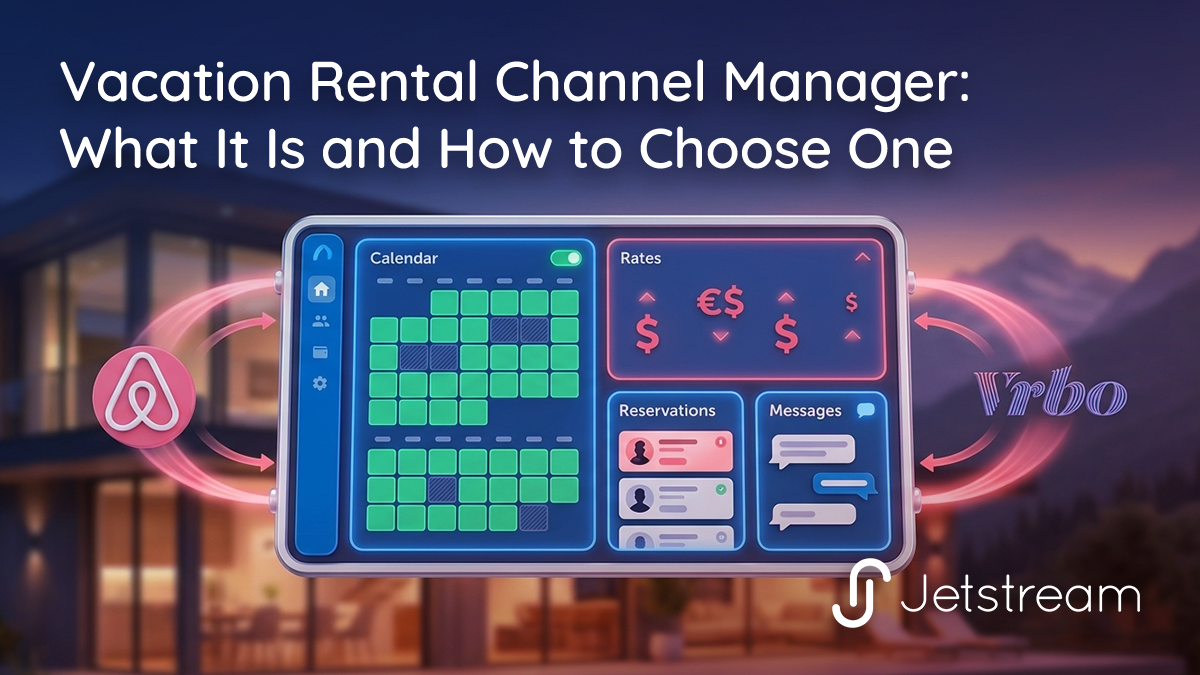
A vacation rental channel manager is a software platform that synchronizes property listings, availability, and rates across multiple booking channels from a single dashboard. For operators managing properties on Airbnb, VRBO, Booking.com, and other online travel agencies, it replaces the manual work of updating calendars and pricing on each platform individually.
The vacation rental market reached $174.84 billion globally in 2025, and 96% of bookings now happen through online platforms. That volume of demand flowing through digital channels makes vacation rental distribution across multiple platforms a practical necessity for most operators, and it makes the risk of manual errors increasingly expensive.
This guide covers how vacation rental channel managers work, when you actually need one, what to evaluate before committing, and which platforms lead the market in 2026. If you operate a hotel or resort exploring STR channels like Airbnb and VRBO, the final section addresses why traditional hotel channel managers often fall short in that space.
What Is a Vacation Rental Channel Manager?
A vacation rental channel manager is middleware that sits between your property management system (or your direct booking calendar) and the online travel agencies where your listings appear. Its core job is to keep availability, rates, and reservation data consistent across every connected channel in real time.
When a guest books a two-night stay through VRBO, the channel manager immediately blocks those dates on Airbnb, Booking.com, and every other connected platform. Rate changes work the same way: adjust your nightly price for a holiday weekend, and the update propagates to all channels within minutes. Cancellations trigger the reverse, reopening inventory across every connected platform simultaneously.
This differs from a hotel channel manager in one important respect. Traditional hotel channel managers, built for the hospitality industry, specialize in connections to hotel OTAs like Expedia, Booking.com (hotel inventory), and GDS networks. Vacation rental channel managers specialize in connections to STR marketplaces: Airbnb, VRBO, Google Vacation Rentals, and a growing list of niche platforms. The two categories overlap on Booking.com (which serves both markets), but their core integrations, pricing models, and feature sets diverge significantly.
For property managers running a portfolio of vacation rental units, a channel manager for vacation rentals is the operational backbone of multi-channel distribution. For hotel operators entering the STR space, understanding this distinction is critical to choosing the right tool.
How Does a Vacation Rental Channel Manager Work?
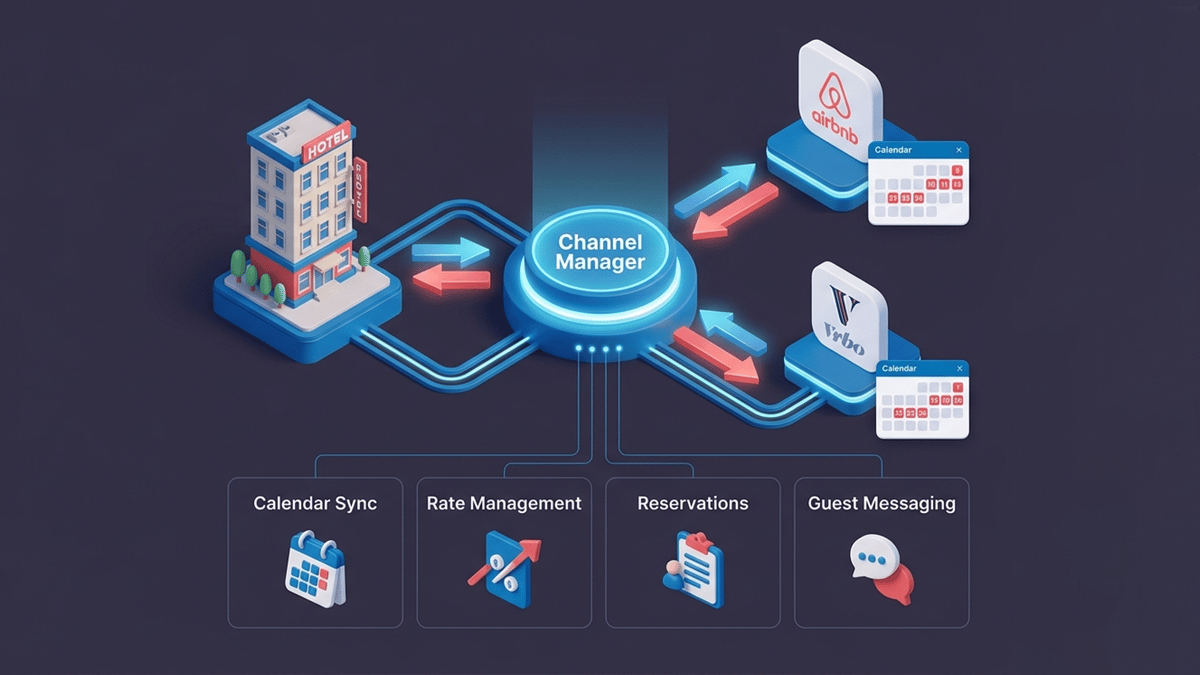
The synchronization happens through API connections between the channel manager and each OTA. When you set up the software, you connect your accounts on Airbnb, VRBO, and any other platforms you list on. From that point forward, the channel manager acts as the central hub for four core functions.
Real-Time Calendar Synchronization
Every booking, cancellation, and date modification on any connected channel triggers an update across all other channels. The speed of this sync varies by provider and by channel (some OTAs process API updates faster than others), but the industry standard is near-instantaneous propagation with most updates completing within two to five minutes.
Centralized Rate Management
Instead of logging into each OTA dashboard separately to adjust pricing, you set rates once in the channel manager. Many platforms support rule-based pricing: weekday versus weekend rates, seasonal adjustments, minimum stay requirements, and last-minute discounts. Some integrate with dynamic pricing tools like PriceLabs or Wheelhouse to automate rate optimization entirely.
Unified Reservation Dashboard
All bookings across all channels appear in a single view. This consolidation eliminates the need to cross-reference multiple inboxes and calendars. Each reservation carries its source channel, guest details, payout information, and communication thread.
Guest Communication Routing
Messages from guests on different platforms flow into one inbox. Automated message templates (booking confirmations, check-in instructions, review requests) can be triggered based on reservation events. For Airbnb specifically, the platform tracks response rate and response time as performance metrics, with the official threshold being 24 hours for booking requests. Properties that respond faster, particularly within one hour, tend to see better search visibility, making centralized communication a competitive advantage rather than just a convenience.
Do You Need a Vacation Rental Channel Manager?
A single-property host listing exclusively on Airbnb can manage availability manually without much risk. The calculus changes as soon as you add a second channel or a second property.
The Tipping Point
The clearest signal that manual management has become unsustainable is when updating availability across platforms starts consuming meaningful operational time. For most operators, that threshold arrives when they manage more than three to five units across two or more channels. At that point, the time spent on manual calendar updates, rate adjustments, and reservation tracking starts competing with higher-value work like guest experience, pricing strategy, and portfolio growth.
The Cost of Getting It Wrong
Double bookings are the most visible consequence of operating without synchronized calendars. Booking.com reports that up to 25% of listings experience a double booking within their first year on the platform. On Airbnb, a host-initiated cancellation due to a double booking triggers a $50 fee if cancelled more than a week before check-in, or $100 if within a week. The financial penalty extends beyond fees: the cancelled guest can still leave a review, and Airbnb posts an automated cancellation notice on the listing. For Superhosts, maintaining a cancellation rate below 1% is a requirement, so even one double booking can jeopardize that status.
The less visible cost is lost revenue from rate inconsistency. Without centralized pricing, rate changes often lag on secondary channels, leading to either underpriced bookings or stale pricing that suppresses demand. An operator who raises weekend rates on Airbnb but forgets to update VRBO may see bookings shift to the lower-priced channel, eroding the revenue gain the price adjustment was supposed to capture. Over a full season, these small gaps compound into meaningful revenue leakage.
When a Channel Manager Pays for Itself
For a portfolio of five units listed on three channels, the math tends to resolve quickly. If automated synchronization prevents even two double bookings per year and saves five to eight hours per week of manual calendar management, the subscription cost (which ranges from roughly $5 to $20 per unit per month across major providers like Lodgify and Hostaway) is recovered many times over. The ROI case strengthens further when you factor in revenue gains from consistent pricing and expanded channel reach.
For Hotels: Why Your Traditional Channel Manager May Not Be Enough

Hotel operators already use channel managers. SiteMinder, D-EDGE, and similar platforms connect hotel PMS systems to Expedia, Booking.com, Hotels.com, and GDS networks. These tools are mature, reliable, and deeply integrated into hotel revenue management workflows.
The gap emerges when a hotel wants to distribute inventory on Airbnb and VRBO. These platforms represent a growing share of travel bookings, particularly for suite-style and extended-stay inventory, and ignoring them means leaving revenue on the table from a guest segment that increasingly books outside traditional hotel OTAs.
Traditional hotel channel managers were built for the hotel distribution ecosystem. Their OTA connections, rate plan structures, and content formats align with how hotel inventory has been sold for decades. STR platforms operate under a fundamentally different model: listing-level inventory (rather than room-type-level), nightly pricing without rate codes, guest communication requirements, review management that directly impacts search ranking, and platform-specific content standards that differ from hotel OTA templates.
A short-term rental channel manager solves the STR side of this equation, but it introduces a different problem for hotels. Platforms like Guesty and Hostaway require hotels to adopt a separate property management workflow for their STR inventory. That means maintaining two parallel systems: the hotel PMS for traditional OTA distribution and a vacation rental PMS for Airbnb and VRBO. For operations teams already managing rate plans, availability controls, and guest data in a centralized hotel system, running a second stack creates friction, data silos, and operational overhead.
The difference between STR and hotel OTAs runs deeper than channel connections. Rate plan translation, tax handling, content formatting, and guest communication protocols all diverge between the two ecosystems. An operator who lists suites or condo-style units on Airbnb needs their existing reservation data, rate structures, and availability rules to flow through to those platforms without manual re-entry.
This is the specific gap that Jetstream addresses. By integrating directly with hotel PMS and CRS platforms (SynXis, TravelClick, Opera, and others), Jetstream enables hotels and resorts to distribute inventory on Airbnb and VRBO through their existing systems. Rate plans translate automatically, availability syncs from the hotel’s source of truth, and the operation stays consolidated rather than fragmented across two technology stacks.
For vacation rental operators without a hotel PMS, the platforms profiled earlier in this guide are purpose-built for your workflow. For hotel operators evaluating STR distribution, the channel manager decision requires a solution that bridges the gap between hotel infrastructure and STR marketplace requirements.
Choosing the Right Fit
The right vacation rental channel manager depends on where your operation sits today and where it is heading. A single-property host growing to five units needs a different tool than a 200-unit professional management company, and both need something different than a hotel exploring Airbnb for the first time.
Start with the channels you want to reach and work backward to the platforms that support those integrations natively. Evaluate the depth of each integration (full content sync versus calendar-only). Test the automation capabilities against your actual operational workflows rather than a feature comparison matrix. And factor in the total cost of the stack: a channel manager that costs $10 per unit per month but requires a separate dynamic pricing tool, a separate guest messaging tool, and a separate direct booking engine may end up costing more than an integrated platform at $20 per unit.
The 91% of property managers interested in adding another OTA signal where the market is moving. Multi-channel distribution is becoming the operational baseline, and the channel manager is the infrastructure that makes it sustainable at scale.
Jetstream helps hotels and resorts distribute inventory on Airbnb and VRBO through their existing PMS, with no second technology stack required. If your property runs on SynXis, TravelClick, or Opera and you want to reach STR travelers without fragmenting your operations, our team can walk you through how the integration works for your specific setup.