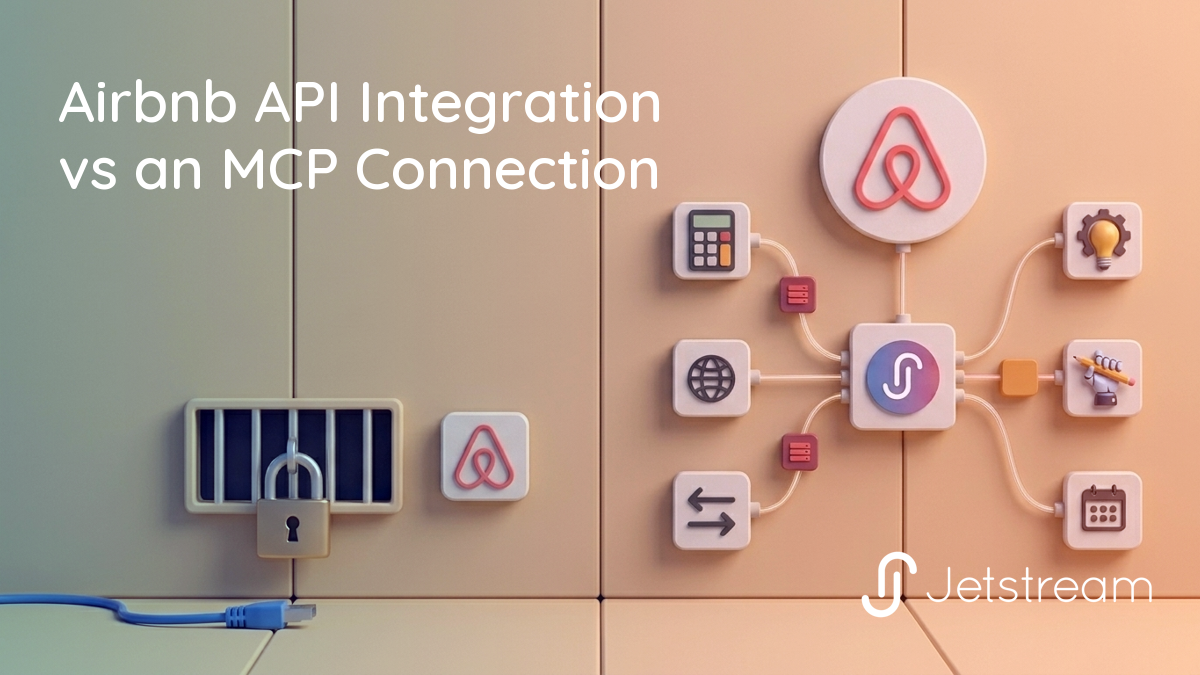
An Airbnb API integration connects software directly to Airbnb's API to manage listings, rates, and reservations through a gated partner program. An MCP connection adds a standard layer on top, so AI agents and AI-built tools can use that same capability without building a separate integration for each one.
If you operate hotels or short-term rentals, connecting to Airbnb usually means working through a channel manager or property management system rather than writing code against Airbnb yourself. If you build software, the questions are different: what access Airbnb actually grants, and whether an AI agent can work with a listing the way it works with any other tool. This post walks through both, and where a newer option, the MCP connection, changes the picture.
Key takeaway: Airbnb has no open, self-serve public API. Operators reach Airbnb through an approved channel manager or software partner, and developers reach it through a gated API program with an NDA and a security review. An MCP connection sits on top of that access, giving AI agents and AI-built tools one consistent way to read and act on distribution data through the connection an operator already holds.
What an Airbnb API integration is, and where it stops
An Airbnb API integration is a direct software connection to Airbnb's API for managing listings, availability, rates, and reservations. Access is not open or self-serve. Airbnb grants it through an API Program that requires a signed NDA, agreement to its API Terms, any partner-specific terms, and a data security review before code touches production.
Airbnb's API Terms of Service describe these API Programs as covering connections to property management, channel management, and operations software, and they list the requirements plainly: an organization must sign Airbnb's mutual NDA, agree to the API Terms, sign any relevant partner-specific terms, pass a data security review, and implement mandatory API features within six months of their release (Airbnb API Terms of Service). The same terms are explicit that any interface not listed on Airbnb's developer site is undocumented and may not be used, and that scraping Airbnb data or building databases from it is prohibited.
For an operator, the practical limit is straightforward: you do not connect to Airbnb by yourself. You connect through an approved channel manager or property management software that already holds that partner access, then authorize it on your Airbnb account and map your listings (Airbnb Channel Manager Partners).
What a channel manager API adds
A channel manager API is the connection layer that keeps your rates, availability, and reservations in sync across every channel you sell on, including Airbnb. Instead of updating each platform by hand, the channel manager pushes a change once and distributes it, then pulls new bookings and cancellations back into your PMS or CRS in real time.
As Cloudbeds describes it, a channel manager updates a property's availability and rates across connected channels in real time, and API connections are the most accurate option for moving that data between systems that may be owned and operated by different companies (Cloudbeds). Airbnb treats channel management as one of its formal API Program categories, which is why hosts connect through the channel managers and property management systems listed in Airbnb's software-partner directory (Airbnb software partners). For most operators, this is the workhorse behind an Airbnb API integration: it holds the partner access, does the syncing, and absorbs the maintenance that direct connectivity demands.
What changes when you connect Airbnb over MCP
MCP, the Model Context Protocol, is an open standard for connecting AI applications to external systems. Connecting Airbnb over MCP means exposing your distribution data and actions through that standard, so an AI agent or an AI-built tool can read and operate them through one consistent interface instead of a separate integration per assistant.
MCP is an open-source standard for connecting AI applications like Claude or ChatGPT to external data, tools, and workflows, built so developers can "build once and integrate everywhere" (Model Context Protocol). Anthropic introduced it in November 2024 as an open standard for secure, two-way connections between data sources and AI-powered tools (Anthropic). The protocol separates reading from acting: Resources provide data an assistant can read, and Tools are executable functions it can invoke, discovered at connection time when the client calls tools/list (MCP architecture).
One caveat matters here. A working MCP connection to Airbnb runs on your side of the connection, through the partner access you already hold, rather than through an agent endpoint Airbnb publishes. No official Airbnb MCP server exists today, and the community-built ones in circulation are largely read-only. Booking actions still require explicit authorization and a confirmation step, so an agent does not complete a reservation on Airbnb on its own.
Airbnb API integration vs an MCP connection, side by side
A direct API integration and an MCP connection sit at different layers. The API integration is how human-operated software connects to Airbnb and stays connected; the MCP connection is how AI agents and AI-built tools use that connection. The table below sets them side by side.
| Dimension |
Direct Airbnb API integration |
MCP connection |
| Built for |
Human-operated software; a developer coding against documented endpoints |
AI applications, agents, and AI-built tools |
| Access model |
Gated API Program: NDA, data security review, partner-specific terms |
Open standard; connect and authenticate, with OAuth recommended |
| Integration effort |
One bespoke integration per system, maintained and versioned per partner |
Build once and integrate everywhere; one server serves every compliant client |
| Discovery |
Static: a developer reads the docs and ships code for each change |
Runtime: the client calls tools/list and new tools appear without a new release |
| Read vs act |
Whatever the API scope grants |
Resources read; Tools act, behind explicit authorization |
Which one you actually want
You want a direct API integration when you run conventional software that manages listings at scale and you have the resources to complete Airbnb's partner program and maintain the connection as Airbnb ships changes. You want an MCP connection when you want an AI agent or an assistant to work with that distribution without writing and shipping a separate integration for every tool.
In practice most operators want both, one layer beneath the other. The partner you already use holds the API integration and does the channel syncing, and the MCP layer on top is what lets AI tools read and act on the same rates, availability, and reservations.
The builder angle: connecting your own PMS or agent
If you are building your own lightweight PMS or an agent with AI coding tools, the hard part is rarely the AI; it is the channel access. Airbnb's partner program, the certifications, and the ongoing maintenance are a real project on their own, and they sit between your code and a single live listing.
A scale barrier lands hardest on small builders. Airbnb grants API access at the organization level and vets each applicant, weighing how many users and listings a partner supports, so the program is built for software that already operates at volume (Airbnb API Terms of Service). In practice a new integration partner is expected to bring inventory at scale, often in the thousands of units, before a direct connection is worth Airbnb's while. A solo developer or a manager with a handful of properties does not clear that bar, which is much of why Airbnb steers smaller operators toward an established channel manager instead of integrating them directly.
An MCP layer that already holds that access lets your own agent connect Airbnb over MCP and operate distribution through the protocol it already speaks. Jetstream runs this as a two-sided MCP server: one side connects the CRS or PMS you already run, the other connects your OTA channels, with production connections that include an official Airbnb API partner integration. Access uses OAuth 2.1 with scoped, revocable tokens, and booking actions require an explicit scope and a confirmation step. If you are building, you can read the docs, grab a free sandbox token, and start without a sales call.
Grab a free sandbox token
Where this leaves you
For most operators, the shortest path to Airbnb is still an approved partner that already holds the API integration and does the syncing. What is new is the layer on top. If you want the detail, what an MCP channel manager actually is covers how that standard layer lets AI tools read and act on your distribution.
If that is on your roadmap for the next couple of quarters, Jetstream's managed MCP channel manager keeps the connector, the channel mappings, and the authorization scopes with a team you can talk to. Book a demo to see it run against your own channels, or if you are building, grab a free sandbox token and start today.
Book a Demo
Frequently Asked Questions
Does Airbnb have an API?+
Yes, but not an open, self-serve public API. Airbnb offers API access through a gated API Program for approved partners such as channel managers and property management software. Individual hosts and operators reach Airbnb through one of those approved partners rather than by requesting direct API access themselves.
How do you get access to the Airbnb API?+
Access is granted at the organization level, not through a public developer signup. Airbnb requires a signed mutual NDA, agreement to its API Terms, any partner-specific terms, and a successful data security review, and partners must implement mandatory API features within six months of release. The program is built for software operating at scale, so a new partner is generally expected to bring inventory in the thousands of units. Most operators and small builders skip the bar entirely by connecting through a partner that already holds access.
What is a channel manager API?+
A channel manager API is the connection that syncs your rates, availability, and reservations across multiple booking channels automatically. When a booking or cancellation happens on one channel, the channel manager updates the others and feeds the reservation back into your PMS or CRS. That real-time sync is what keeps you from overbooking or selling at stale rates.
What is the difference between an Airbnb API integration and an MCP connection?+
An Airbnb API integration is a direct software connection to Airbnb for managing listings, rates, and reservations, built for human-operated software and gated behind Airbnb's partner program. An MCP connection is an open-standard layer on top of that access, built so AI agents and AI-built tools can read and act on the same data without a separate integration for each one.
Can you connect Airbnb to an AI agent over MCP?+
You can, but not through an official Airbnb endpoint, because Airbnb does not publish an MCP server and the community-built ones are largely read-only. A working setup runs on your side of the connection, through a partner that already holds Airbnb API access, and any booking action still requires explicit authorization rather than the agent completing it on its own.