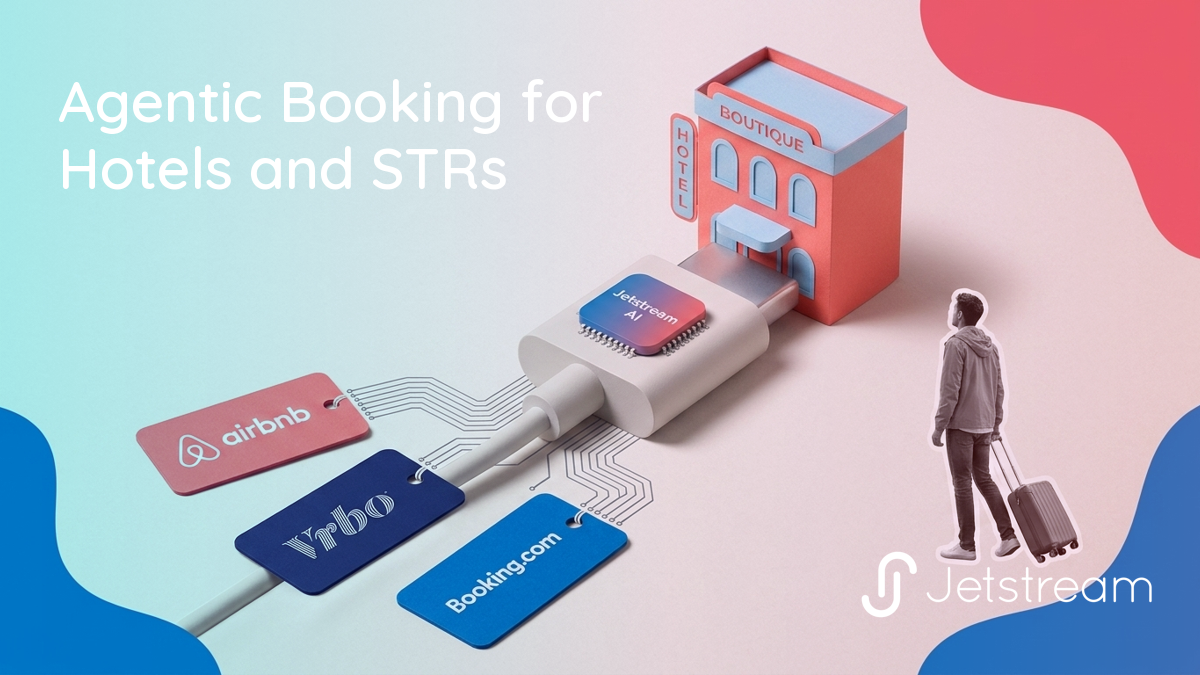
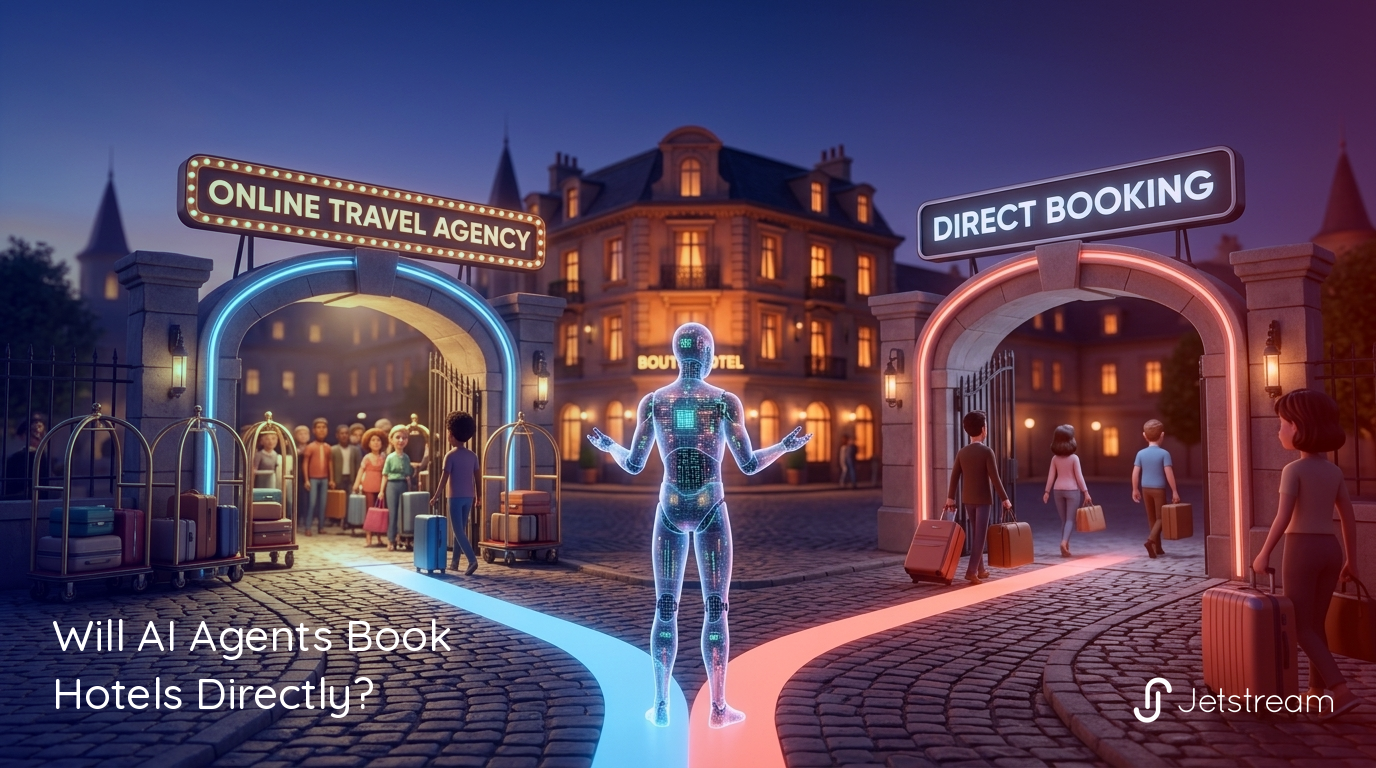
Agentic booking is when an AI agent, acting for a traveler or an operator, searches inventory, compares options, and completes a reservation through machine-readable interfaces instead of a person clicking through a website. For hotels and short-term rentals, being bookable by an agent takes distribution infrastructure that software can read and act on, the kind of structured access that protocols like the Model Context Protocol are built to provide. The discovery side of this is already live, and the booking side is arriving one channel at a time.
Key takeaway: Agents can already plan and shortlist hotels and rentals, and a few can complete a booking through a partner platform, though fully autonomous checkout is still early and gated. The practical move for operators is to make rates, availability, and booking actions readable by software now, well before the checkout layer settles, so a property is reachable the moment an agent tries to book it.
What is agentic booking?
Agentic booking is an AI agent completing a reservation on someone's behalf: it reads live inventory, compares options, narrows them through follow-up questions, and finalizes the booking, rather than handing back a list of links for a person to work through. Google describes its own version in AI Mode as letting a traveler describe what they want, then returning a curated list drawn from multiple reservation platforms so the traveler can finalize the booking through a partner (Google, The Keyword, November 2025).
This is a step past AI trip planning. A planner suggests where to go and what to book; an agent carries out the booking itself. The two usually share the same chat window, so the boundary between them looks blurry from the traveler's seat, and the emerging category of AI agent hotel booking sits right on that line. For an operator the difference is practical. A planner only needs to find your property; an agent needs to be able to transact against it.
The state of play: where agentic booking stands in 2026
As of mid-2026, agentic booking is live for straightforward categories like restaurant tables and event tickets, and it is in limited testing for hotels. For now, agents book through the large distributors rather than around them.
Google shipped agentic booking for restaurants first, then set the direction for travel. In November 2025 it said that "in the future, we'll also make it possible to finish booking flights and hotels directly in AI Mode" (Google, The Keyword, November 2025). The partner list it published is worth reading closely: Booking.com, Choice Hotels International, Expedia, IHG Hotels & Resorts, Marriott International, and Wyndham Hotels & Resorts, every one a large brand or an OTA. In August 2026, Skift reported that Google had begun a limited US test of agentic hotel booking, with Booking Holdings among the first partners and its CEO Glenn Fogel saying "we are one of the first with them" (Skift, August 2026). Google is not the merchant of record in these flows; the partner completes the transaction.
OpenAI opened a second front. In October 2025 it put Booking.com and Expedia inside ChatGPT as two of seven launch partners for apps in ChatGPT, letting a traveler call up a partner in conversation and browse results without leaving the chat (OpenAI, October 2025). Booking.com described its app as a way to "browse listed accommodations directly within ChatGPT, with seamless access to the Booking.com platform" (Booking.com, October 2025).
Expedia, for its part, is building the supply side. In May 2026 it introduced an AI toolkit and what it calls an Intelligent Experience Platform for B2B partners (Expedia Group, May 2026), and its chief product and technology officer told Skift the company is standing up a Model Context Protocol server so agents can reach its inventory "in the coming months" (Skift, May 2026).
The honest part of the picture is that autonomous checkout has been harder than the early demos suggested. In March 2026 Skift reported that OpenAI had stepped back from handling booking directly inside ChatGPT, refocusing on discovery and leaving the transaction to partner apps, a shift that "investors in Expedia and Booking Holdings" welcomed (Skift, March 2026). Gartner adds a broader caution, projecting that "over 40% of agentic AI projects will be canceled by the end of 2027, due to escalating costs, unclear business value or inadequate risk controls" (Gartner, June 2025).
Here is the same landscape at a glance.
| Platform |
What is live now |
What is announced or in testing |
Who transacts |
| Google AI Mode |
Agentic booking for restaurants, tickets, appointments |
Limited US test of hotel booking (reported Aug 2026); flights and hotels "coming" |
The partner (OTA or brand), not Google |
| OpenAI / ChatGPT |
Booking.com and Expedia as browsable apps in ChatGPT |
Checkout inside ChatGPT walked back (Mar 2026); discovery-first |
The partner platform, via its own app |
| Expedia Group |
AI toolkit and Intelligent Experience Platform for B2B partners |
MCP server for agent access "in the coming months" |
Expedia as the supply layer for agents |
| Booking.com |
App in ChatGPT; its own agentic partner tools |
Named Google AI Mode hotel partner; in the Google test |
Booking.com as merchant of record |
The pattern is consistent. Agents discover inventory today, checkout is still maturing, and the large distributors are positioning as the layer those agents transact through. For an independent property, that raises a plain question of hotel distribution strategy before it is a technical one, which is whether your inventory is reachable by an agent at all.
What an AI agent actually needs to book your property
To book a property, an agent needs three things it can act on programmatically: machine-readable rates, machine-readable availability, and callable booking actions such as hold, confirm, and cancel. Behind those sits a fourth requirement, a trusted way to authorize and settle payment on the traveler's behalf.
Machine-readable rates means a real, current price the agent can read as data, not a number rendered on a web page for human eyes. Machine-readable availability means bookable inventory with dates, occupancy, and restrictions in structured form. Booking actions means the agent can do something, not just look: create a reservation, modify it, cancel it. The payment layer is separate, and it is being built by the card networks and the model providers rather than by operators, through standards like the Agentic Commerce Protocol from OpenAI and Stripe and Google's Agent Payments Protocol. What an operator inherits from that layer is the ability to accept an agent-authorized payment; what an operator owns is the accuracy of the data on the other three.
These requirements are why agentic commerce runs on shared standards rather than one integration per assistant. An agent that has to learn a different interface for every property will book none of them at scale.
| Layer |
What it does |
Who provides it |
| Read |
Exposes rates, availability, and listing content as structured data |
Operator, through a channel manager or connector |
| Act |
Lets an agent create, change, or cancel a reservation |
Operator, through a channel manager or connector |
| Pay |
Authorizes and settles payment with accountability |
Card networks and model providers (ACP, AP2) |
See What Agent-Ready Distribution Looks Like
Where the Model Context Protocol fits in agentic booking
The Model Context Protocol is the layer that lets an agent read your data and take actions on it through one standard interface, without a custom integration per assistant. It handles the read and the act; the payment protocols handle the pay. MCP is "an open standard that enables developers to build secure, two-way connections between their data sources and AI-powered tools," introduced by Anthropic in November 2024 (Anthropic, November 2024). Expedia adopting an MCP server to expose its inventory to agents is the same idea applied at OTA scale.
The read-and-act layer behind MCP hotel booking is this protocol, and the pay layer is a different standard entirely. Conflating the two is the most common mistake in this space, so it is worth keeping straight: an assistant uses MCP to see your rates and make the reservation, then a commerce protocol authorizes the money. If you want the mechanics, we cover how an MCP connection differs from a traditional API and what a MCP channel manager actually is in two companion pieces. The short version is that one MCP connector can serve whichever assistant a traveler happens to use, rather than a separate build for each.
What hotel and STR operators should do now
The no-regret move is to make your inventory legible to software today: accurate rates, clean availability, and structured listing content an agent can read and trust, reachable through the channels you already sell on. None of that is speculative work. It is the same distribution hygiene that improves your standing on Airbnb and Vrbo right now, and it is what makes a property bookable by an agent later.
A few things are worth doing in order. Get your rates and availability flowing accurately through a channel manager, because an agent can only book what it can see, and stale inventory is worse than no inventory when software is transacting against it. Keep your listing content structured and honest, since policies, fees, and cancellation terms are exactly what an agent has to trust before it commits a guest's money. Then think about reach: today that means being present and accurate on the OTA surfaces agents are testing against, and increasingly it will mean a connector on your side of the relationship that can act across every channel you sell on. Being reachable by agents is becoming part of agentic distribution the same way OTA connectivity became part of ordinary distribution a decade ago.
Independents have the most reason to start early here. Every partner Google named in its hotel test is a large brand or an OTA, and waiting mostly means being unreachable when the first agent tries to book you. The practical response is to make sure your inventory is reachable through the channels and connectors agents actually use, so a booking can find you even when the named partners are big brands. This is the transaction side of the same story our AI for hotels coverage tells on the discovery side, where the goal is getting cited by AI assistants when a traveler asks for a recommendation.
The window to get ready is open now
Agentic booking will not arrive as a single switch. Discovery is already here, and checkout is maturing one channel at a time while the distributors position to be the layer agents transact through. The properties that do well in that world are the ones whose rates, availability, and booking actions are already readable and already accurate, because an agent can only book what it can see and trust. That work pays off today in cleaner distribution, and it is the same work that makes a property bookable by an agent tomorrow.
Getting a property agent-ready is mostly distribution work: accurate rates, clean availability, and a connector someone keeps running across the channels you sell on. That is the layer Jetstream operates as a managed MCP channel manager, keeping the connector, the channel mappings, and the authorization scopes with a team. If agentic booking is on your roadmap for the next couple of quarters, that is the conversation worth starting now.
Talk to Jetstream About Agent-Ready Distribution
Frequently Asked Questions
What is agentic booking?+
Agentic booking is an AI agent completing a reservation for a traveler, from search through to confirmation, using interfaces it can read and act on rather than a website a person clicks through. It goes further than an AI trip planner, which only suggests options. For lodging, it means an agent can read a property's rates and availability and, when authorized, book it.
Can AI agents book hotels right now?+
Partly. As of mid-2026, agents can complete bookings for simple categories like restaurants and event tickets, and hotel booking is in limited testing. Google began a limited US test of agentic hotel booking in 2026, with the partner platform completing the transaction rather than Google. Fully autonomous hotel checkout across the board is still early and gated.
How is agentic booking different from AI trip planning?+
An AI trip planner recommends destinations, stays, and itineraries; an agent carries out the booking. Planning needs your property to be findable, and booking needs it to be transactable, meaning an agent can read your live rates and availability and complete a reservation. Many assistants blend both in one conversation, which is why the two are easy to confuse.
Do I need an MCP server to be bookable by AI agents?+
Not necessarily one of your own. What an agent needs is machine-readable rates, availability, and booking actions, reachable somewhere it looks. Today that can be through the OTA surfaces agents test against, and increasingly through a Model Context Protocol connector on your side of the relationship. The requirement is structured, accurate, actionable inventory, whoever runs the connector.
Will agentic booking replace OTAs?+
There is no sign of that. The major OTAs are positioning as the layer agents book through, from Booking.com and Expedia appearing inside ChatGPT to Expedia building an MCP server for agent access. For operators, the takeaway is that reaching agents still runs largely through the channels you already use, so keeping those channels accurate matters more, not less.