Top Channel Managers for Hotels in 2026
The table below compares five widely used hotel channel managers across the dimensions hotels actually evaluate during a procurement decision. The product details are drawn from each vendor's published documentation and help center as of April 2026; pricing is intentionally omitted because every vendor publishes a "request a quote" model and quoted prices vary significantly by property size, integration scope, and contract length.
|
Product |
OTA breadth |
PMS / CRS connectivity |
Airbnb & VRBO native? |
Best fit for |
|---|---|---|---|---|
|
Independent hotels and small chains looking for the broadest OTA reach |
||||
|
Native PMS plus open API connections to other systems |
All-in-one users (PMS + channel manager + booking engine on one platform) |
|||
|
Connects to OTAs through partner channel managers via Mews Marketplace |
Native PMS; integrates with dedicated channel managers via API |
No native direct Airbnb connection; partner channel managers required |
Boutique and lifestyle hotels prioritizing modern PMS UX |
|
|
Connects to leading OTAs including Expedia, Hotels.com, Booking.com, Agoda, Airbnb, and VRBO |
Native PMS plus integrations with major systems |
B&Bs, small hotels, and mixed-inventory properties |
||
|
Focused on STR distribution rather than broad OTA coverage |
Connects to PMS and CRS systems including SynXis, TravelClick, IHG CRS, and D-Edge |
Yes; Airbnb and VRBO are the primary distribution targets, with full listing management and 24/7 guest services |
Hotels and resorts adding Airbnb and VRBO to an existing OTA distribution mix |
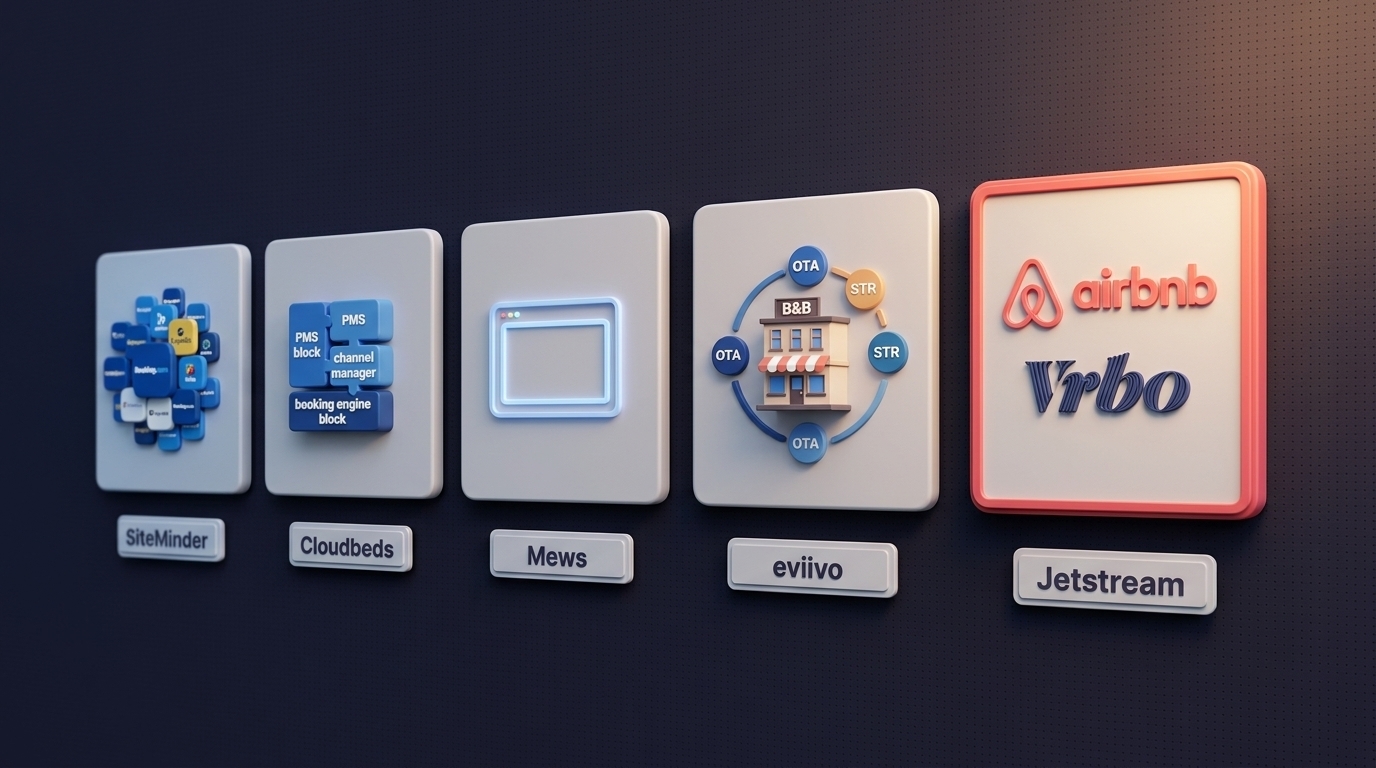
The list is intentionally not exhaustive. Beds24, RoomRaccoon, RateGain, D-Edge, and a long tail of regional vendors are all credible choices for specific use cases. The five above are the products that come up most often in evaluations for hotel-to-STR distribution and broad OTA management, which is the slice of the market this comparison is built around.
How to Read the Comparison
Two dimensions deserve more weight than the others. The first is whether the channel manager natively connects to Airbnb and VRBO with full listing-level support, not just a pass-through API. The second is whether the PMS or CRS the property already runs is on the channel manager's first-tier integration list, because second-tier integrations tend to be flat-file or partial-sync arrangements that introduce manual work.
Pricing is a real factor, but it is rarely the deciding one. The cost of a wrong channel manager (overbookings, parity violations, missed STR demand) is much larger than the difference between two quotes.
Traditional OTA Channel Managers vs STR-Capable Channel Managers
Most existing comparison guides treat the channel manager market as a single category and rank vendors by OTA count. That framing misses the structural shift that has happened over the last five years: the market has split into two categories, and a hotel's choice of category matters more than the choice of vendor inside a category.
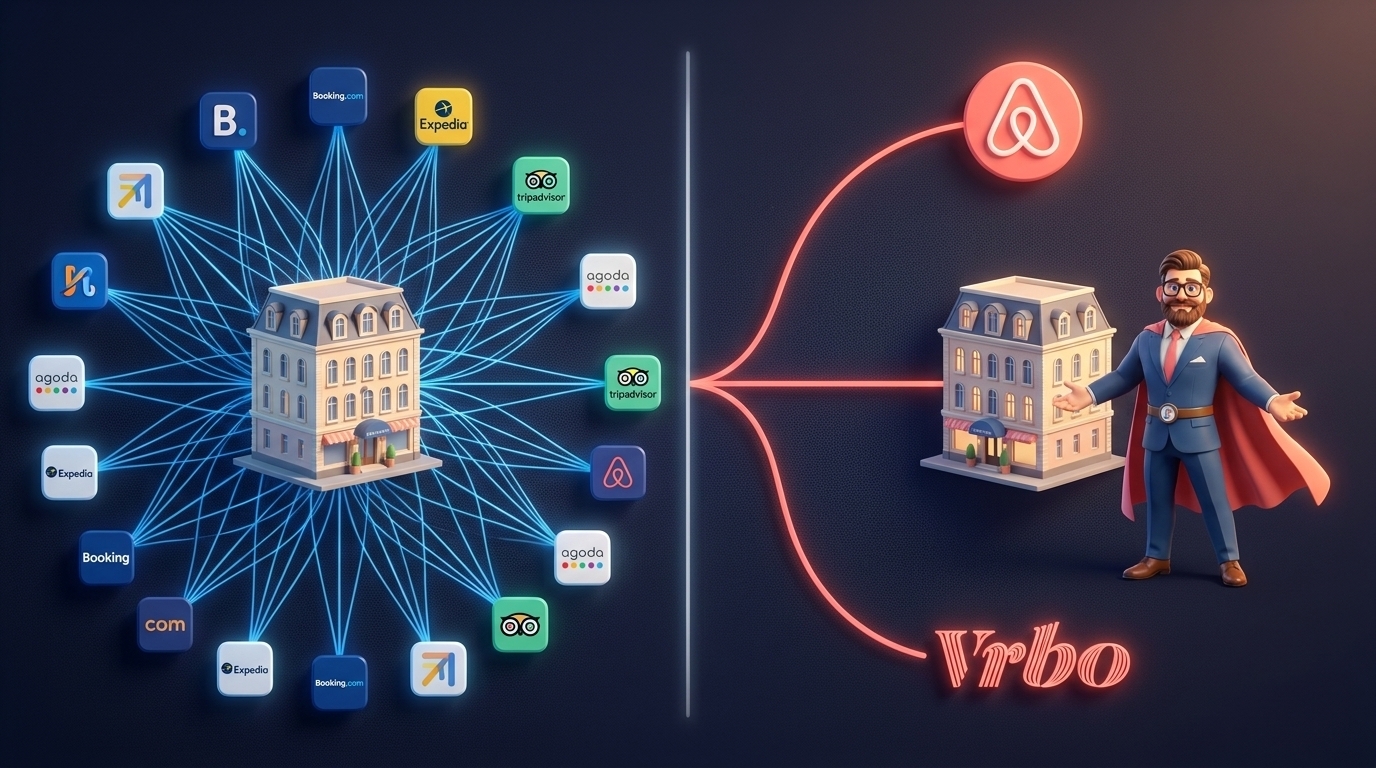 OTA channel managers with STR-capable channel managers that distribute hotels to Airbnb and VRBO.
Traditional OTA channel managers were built for a world where hotel distribution meant Booking.com, Expedia, Hotels.com, regional OTAs, GDS, and the hotel's direct booking engine. Their core architecture assumes room-type-level inventory, traditional rate plans, and a content model that fits an OTA listing page. SiteMinder, Cloudbeds, RateGain, and most of the legacy vendors fall into this category. Their breadth on OTAs is enormous; their handling of Airbnb and VRBO ranges from "supported as another channel" to "supported with caveats around content depth and pricing logic."
STR-capable channel managers were built with Airbnb and VRBO as primary distribution endpoints, not as additional channels grafted onto an OTA-first architecture. They handle unit-level listings, richer content requirements, platform-specific pricing logic, and the operational reality that STR guests behave differently than OTA guests. Some are pure STR platforms (Hostaway, Guesty, Beds24) that are now used by mixed-inventory properties. Others are hotel-specific bridges (Jetstream) that connect a hotel's existing PMS or CRS to Airbnb and VRBO as a deliberate distribution layer.
The right way to think about the split is to start with the hotel's distribution mix today and where the team wants it in 24 months. A hotel with 95% of revenue running through Booking.com and Expedia and no STR ambition is well served by a traditional OTA channel manager with deep PMS integration. A hotel with kitchen-equipped suites, condo-style inventory, or a leisure mix that is already losing demand to Airbnb is in a different conversation. For that property, the question is which channel manager treats Airbnb and VRBO as first-class destinations rather than as ports added to an OTA-first product.
What Hotels Lose When They Choose OTA-Only
The most common failure mode in channel manager procurement is selecting an OTA-first product, listing on Airbnb and VRBO through whatever pass-through the vendor offers, and then concluding "STR doesn't work for our property" when the listings underperform. In most of those cases, the listings underperform because the channel manager was not built for the platform. Content is thin, pricing logic is borrowed from OTA rate plans rather than tuned to STR demand patterns, and operational requirements (response time, review handling, cancellation policies) are not built into the workflow.
The right comparison is between a channel manager's STR capability and the alternative of running Airbnb and VRBO manually or through a separate dedicated tool. If the channel manager's STR support is functionally equivalent to a manual workflow, the hotel is paying for an integration without benefiting from one.
How to Choose the Right Channel Manager for Your Hotel
Choosing a channel manager is a decision that should follow the property's distribution strategy, not lead it. The framework below mirrors how revenue management teams approach the procurement in practice.
Start with the distribution goals. Where is revenue today, by channel? Where does the team want it in 24 months? If the goal is to defend OTA share and improve sync reliability, the comparison is among traditional OTA channel managers. If the goal is to add Airbnb and VRBO as a meaningful share of revenue, an STR-capable channel manager has to be on the shortlist. The wider conversation about how to structure that mix is covered in our hotel distribution strategy guide, which sets out the channel categories and how they fit together.
Evaluate integration depth, not just integration presence. Every channel manager will say it integrates with the property's PMS. The question is whether the integration is two-way, real-time, and at the rate plan level, or whether it is a flat file synced overnight. The answer is usually in the channel manager's developer documentation rather than in the sales pitch.
Test rate parity and sync reliability under load. A 30-day sandbox with real rate changes across multiple channels surfaces sync issues and parity violations that no demo will reveal. Most reputable vendors will support a structured trial; the ones that will not are vendors to be cautious about.
Consider the support model. Hotel channel management is not a fire-and-forget product. Rate plan logic, content updates, channel-specific issues, and platform policy changes all create tickets. The vendor's support availability, escalation path, and response time on weekends are part of the product, not extras.
Read the contract. The pricing model varies more than vendors disclose in marketing materials. Some price per channel, some per room, some per booking, some on a hybrid model. Multi-year commitments, channel-add fees, and integration setup fees can swing the total cost meaningfully.
The Missing Piece: STR Distribution for Hotels
The reason this comparison reframes the market into two categories rather than ranking vendors on a single list is that the dominant evaluation question has changed. Comparing OTA connection counts has been a solved problem for a decade, with well-known answers across the major vendors. What hotels are now trying to evaluate is whether the channel manager treats Airbnb and VRBO as first-class destinations, with full listing management, accurate content, platform-tuned pricing, and the operational support to run them well.
Most channel managers handle the OTA side competently. Few handle Airbnb and VRBO at the same level. Hotels that run their OTAs through one tool and their STR distribution through another spend significant operational time keeping the two in sync; hotels that try to run STR through an OTA-first tool tend to underperform on the platforms guests are actually booking on. The gap is real, and it is the most important consideration in a 2026 channel manager comparison.
Hotels with the right inventory, including condo-style suites, full-kitchen units, and larger rooms suitable for longer stays, are already discovering that listing on Airbnb and VRBO opens a demand channel that traditional OTAs do not capture. The channel manager decision determines whether the property captures that demand cleanly or fights the tooling at every step.
Where to Take a Hotel Channel Manager Comparison from Here
The right channel manager for a hotel in 2026 is the one that fits the property's actual distribution mix and the mix the team wants 24 months from now. For most properties, that means evaluating both a strong OTA channel manager and a credible STR-capable option, then deciding which category leads the mix. The choice of vendor inside a category is real, and the choice of category itself usually drives the bigger revenue outcome.
For hotels and resorts looking specifically at the STR side of the mix, adding Airbnb and VRBO without taking on the operational and content burden, Jetstream is built for that exact bridge. We connect to your existing PMS or CRS, distribute your room and rate data accurately to Airbnb and VRBO with full listing management, and run 24/7 guest services so the channels operate the way the platforms expect. You can see how it works on our hotel revenue management page.
If your channel manager evaluation is really an STR distribution evaluation in disguise, Jetstream is the bridge. We plug into your existing PMS or CRS, run your Airbnb and VRBO listings as full distribution channels, and operate 24/7 guest services on your behalf, with a shared-success commercial model that aligns the work with your revenue.