How Airbnb Differs from Traditional OTA Distribution
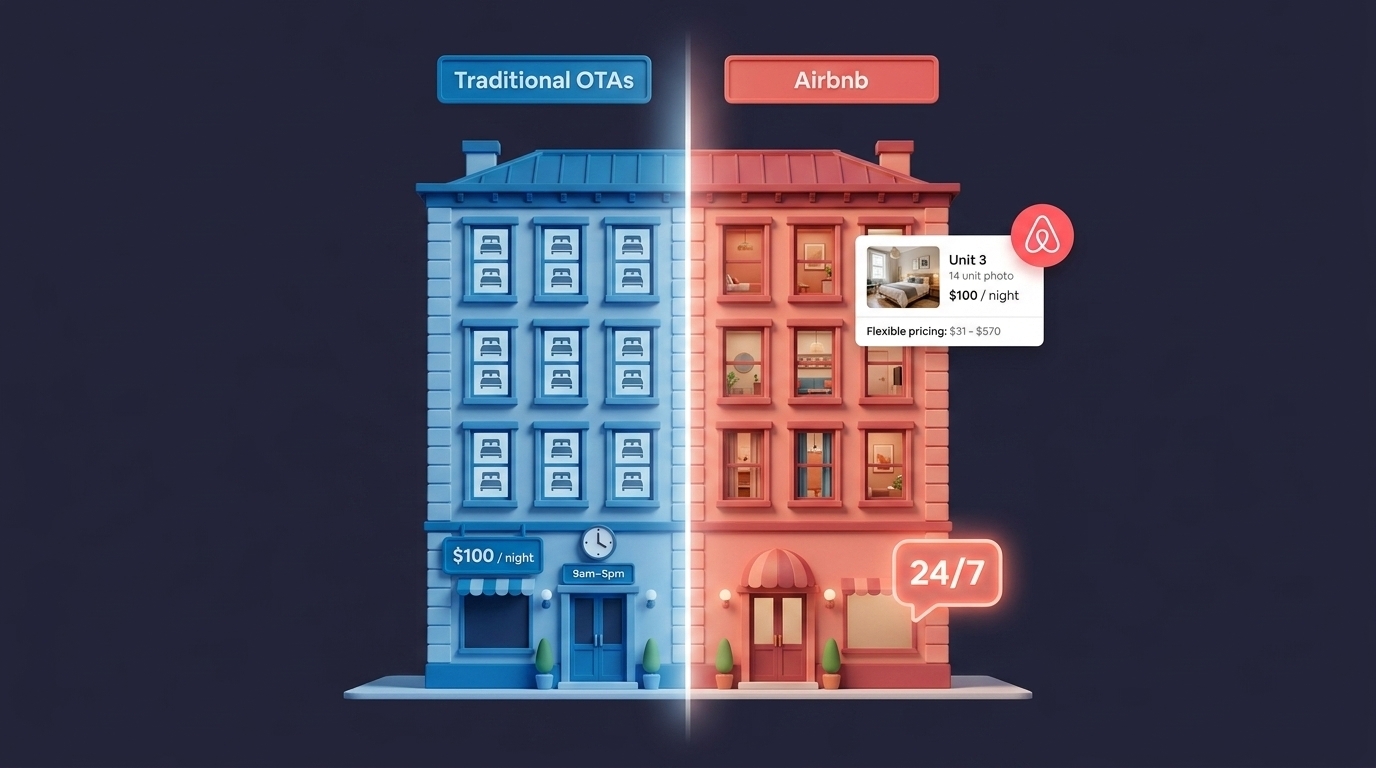
Before evaluating a channel manager, it is worth being explicit about what makes Airbnb different. The differences shape every feature you should be looking for.
Booking model. Booking.com and Expedia run on a relatively standardized hotel-room booking model: nightly rate, room type, fees, taxes, cancellation policy. Airbnb is closer to a vacation rental model, with nightly rate flexibility, length-of-stay discounts, cleaning fees treated separately, and a different fee structure on both sides of the transaction. A channel manager has to translate your hotel rate plans into something Airbnb can render correctly.
Listing content. OTAs ship structured data: room type names, amenity tags, photo galleries with format conventions. Airbnb listings are richer and more narrative. Property descriptions matter more, photo selection matters more, and the listing itself has space for things like neighborhood guides and house rules that OTAs do not surface. The channel manager you choose either populates this content automatically or hands the work back to your team.
Guest expectations. Airbnb guests expect personal communication and faster response times than the average OTA guest. Airbnb's official requirement is that hosts respond to messages within 24 hours, and response rate is one of the metrics the platform tracks for search visibility. Third-party analyses suggest that responding within an hour correlates with better search performance, but that is a competitive best practice rather than a documented platform rule. Either way, the operational expectation is meaningfully different from a typical OTA inbox.
Reviews and ranking. Airbnb's search algorithm weights reviews, response rate, and host responsiveness more heavily than most hotel OTAs do. A hotel that ports its OTA-style guest communication patterns directly to Airbnb often underperforms in search not because the property is wrong, but because the operations are wrong for the platform.
No off-platform contact. Airbnb prohibits including external websites, phone numbers, email addresses, or social profiles in listing descriptions or in pre-booking messages. Hotels used to running cross-channel marketing campaigns through their direct booking system have to adapt. Brand and review presence can still be referenced (mentioning awards, citing Google or Tripadvisor reviews by name), but direct contact details belong off the platform.
A channel manager designed for Airbnb either knows about each of these differences and handles them, or it forces your team to handle them manually. The point of using technology is to remove the second option.
Key Features to Look for in an Airbnb Channel Manager
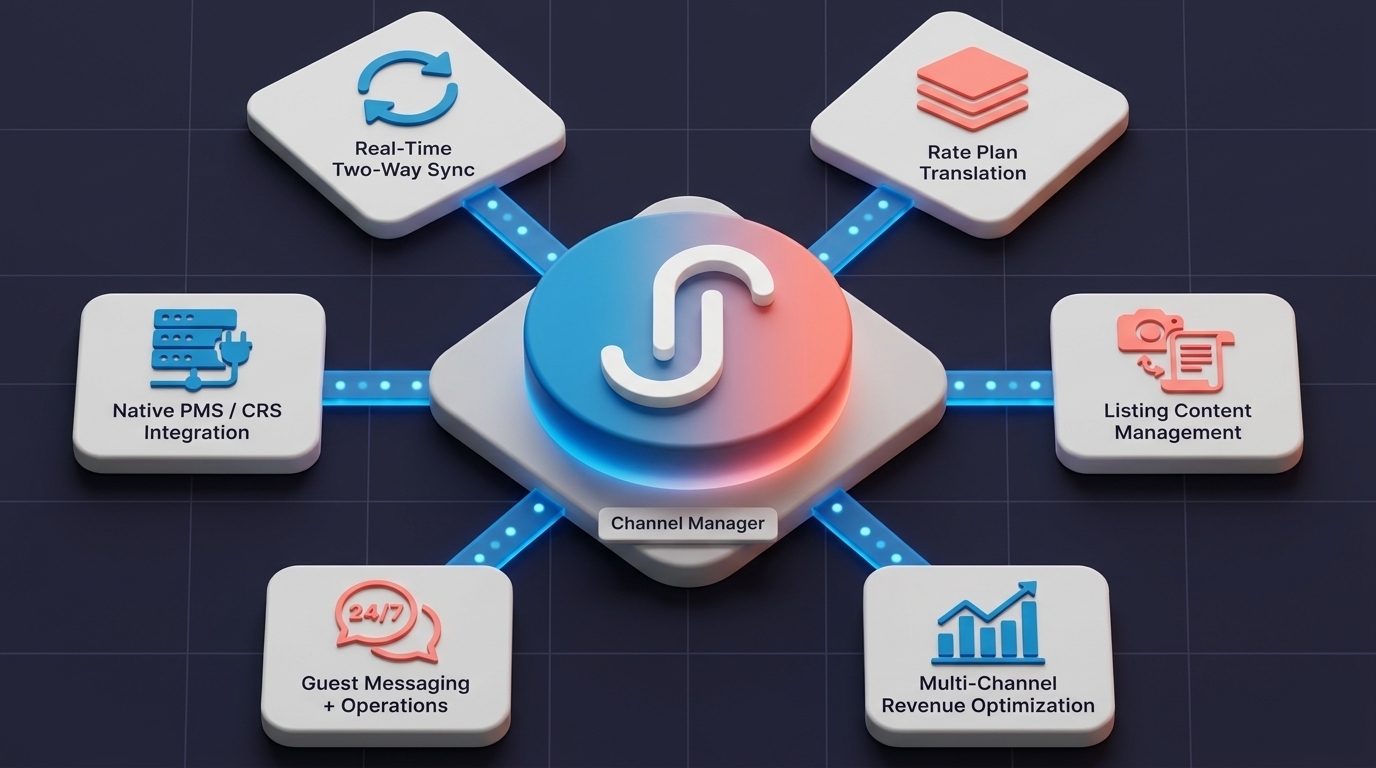
Once you understand the platform mechanics, the feature evaluation gets easier. The list below is not exhaustive, but it covers the points where channel managers vary most.
Real-time two-way sync. Availability, rates, and inventory should flow from the PMS or CRS to Airbnb in close to real time, with bookings pushed back automatically. Anything slower introduces overbooking risk. "Two-way" matters: a connection that pushes ARI but does not pull bookings is not a channel manager, it is a rate publisher.
Rate plan translation. Hotels run multiple rate plans with multiple modifiers. The channel manager needs to translate that rate structure into Airbnb's pricing model without breaking parity with your OTA channels. We covered the underlying mechanics in hotel rate plans are failing on Airbnb, and the same logic governs whether your channel manager actually solves the problem or just exposes it.
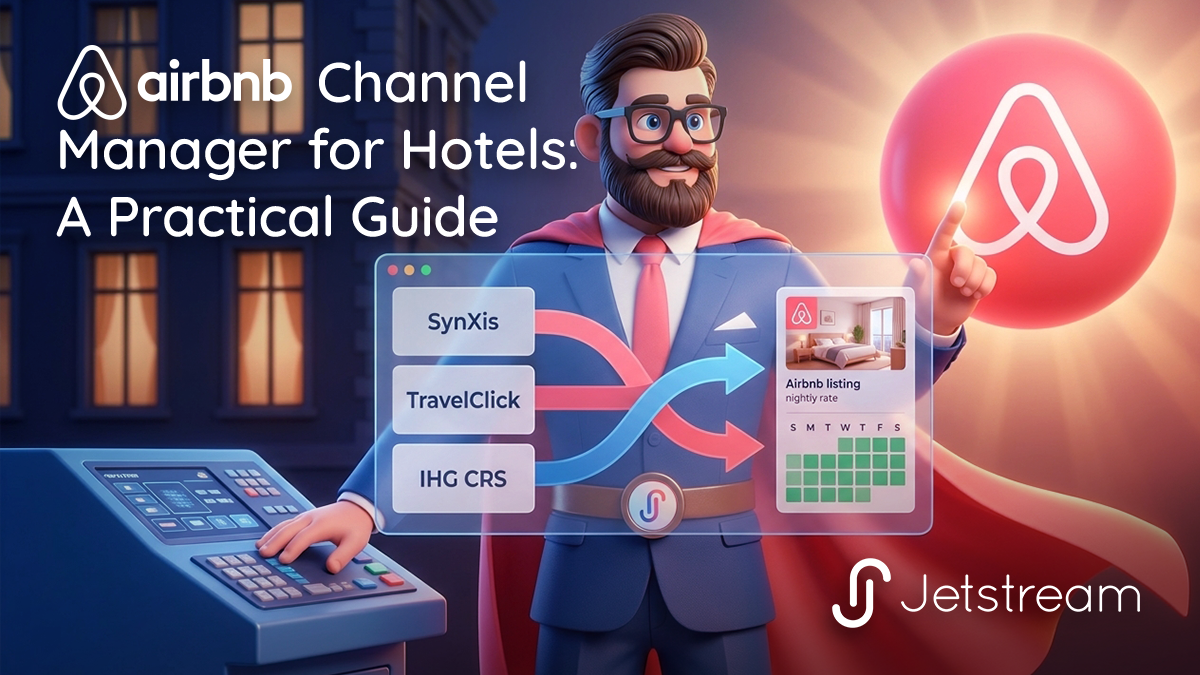
Native PMS or CRS integration. A channel manager that connects to your existing system through a maintained integration is dramatically easier to operate than one that requires a custom middleware build. Look for purpose-built integrations to the platforms hotels actually run on: SynXis, TravelClick (Amadeus), D-Edge, IHG CRS, YieldPlanet, Inntopia, Resalys, Dingus. The depth of those integrations matters more than the count.
Listing content management. Photography, descriptions, and amenity tags are part of conversion on Airbnb. The channel manager either pushes content from a central source, gives your team a workflow to manage it natively, or expects you to manage it on Airbnb directly. Each is workable, but the choice should match how your team actually operates.
Guest messaging and operations. Airbnb's communication expectations require a system or a team that can respond around the clock, not just during the property's front desk hours. Some channel managers include automated messaging, some integrate with separate guest communication tools, and some expect you to handle messaging directly on the platform. This is not a feature to gloss over: it directly affects search visibility on Airbnb.
Multi-channel revenue optimization. A channel manager is the layer where hotels can actually see Airbnb performance against the rest of the distribution stack. Reporting that breaks down RevPAR, ADR (gross and net), length of stay, and lead time by channel is what lets revenue managers make rebalancing decisions. Without it, Airbnb either gets too much inventory or too little.
Operational support. This one is not a software feature, but it matters. Airbnb is operationally heavier than the OTAs your team already runs. Some channel managers ship as software only, leaving the work of running the channel to your team. Others come with a managed service component. Both can be the right answer; the question is which one matches your staffing reality.
Common Challenges Hotels Face on Airbnb (and How a Channel Manager Solves Them)
A few problems show up consistently when hotels start managing Airbnb at scale. A good channel manager addresses each of them directly.
Pricing strategy across channels. Airbnb attracts a different segment than OTAs do, often booking longer stays at higher daily rates than the same unit earns on Booking.com. Hotels that mirror their OTA prices onto Airbnb leave revenue on the table. A channel manager with rate plan translation lets the team set Airbnb-specific pricing logic without violating parity with the OTA contracts. The depth of the connection determines whether this works in practice or in theory.
Overbooking risk. Hotels with multiple distribution channels live with overbooking risk every day. Adding Airbnb increases the surface area unless the channel manager handles bookings instantly and bidirectionally. The right setup decrements availability on all other connected channels the moment an Airbnb reservation arrives, and routes the new booking back into the PMS so the front office sees it without a manual sync step.
Guest communication standards. Hotels typically run guest comms during business hours; Airbnb operates around the clock. Channel managers that include 24/7 multilingual guest service, or integrate cleanly with a service that does, remove the operational burden. The hotel still owns the guest relationship; the technology just covers the hours and languages the front desk cannot.
Listing optimization and reviews. A listing that performs in search needs photography, copy, and review history that match Airbnb's expectations. Channel managers that include listing optimization (or partner with teams that do) shorten the time to results meaningfully. The properties that win on Airbnb are the ones whose listings look like they belong on Airbnb, not like an OTA description pasted into a different layout.
Rate parity governance. Major OTAs include rate parity clauses in their contracts. Adding Airbnb does not remove those obligations, but Airbnb's pricing flexibility (length-of-stay discounts, weekend pricing, last-minute rates) can create unintended violations if the channel manager does not enforce parity rules. This is a place to ask vendors directly how their system handles the conflict.
How to Evaluate Your Airbnb Channel Manager Options
The market for channel managers is crowded. The market for channel managers that handle hotel-to-Airbnb distribution well is not. A short list of evaluation questions cuts through the noise.
What hotel systems do you integrate with natively? Listen for specific named integrations to your PMS or CRS, not generic API-availability claims. "We can connect to anything" usually means "you will pay for the integration build."
How does your system translate hotel rate plans into Airbnb pricing? A vendor that has not thought about this question deeply will give a vague answer. A vendor with a real product will explain how negotiated, package, and loyalty rate structures get handled.
What is included in your service vs. left to my team? Especially around listing content, photography, guest messaging, and reviews. Hotels evaluating a software-only channel manager need to know what operational headcount they will have to add.
What does the rate parity governance look like? A specific answer about how parity violations are detected and prevented is more useful than a general assurance.
How do you charge? Commission models, subscription models, and hybrid models all exist. Each has tradeoffs depending on your ADR, occupancy, and channel mix. The "right" model is the one that aligns the vendor's incentives with yours.
What do partner outcomes look like in your portfolio? Specific case studies with property type, before/after metrics, and named partners are a stronger signal than testimonial quotes. Be skeptical of any vendor whose case studies are anonymous.
If a vendor cannot answer most of those questions clearly, the conversation is over. Hotels evaluating Airbnb distribution are betting real revenue on the system they choose, and a vague pitch is the best predictor of a vague implementation.
Where Hotels Should Go from Here
Adding Airbnb to a hotel's distribution mix is not the same task as adding another OTA. The platform mechanics are different, the operational expectations are different, and the technology stack underneath has to actually understand both halves of the bridge. A channel manager that was bolted onto a hotel system as an afterthought rarely does. A channel manager that was built for the bridge usually does.
The honest evaluation question is not "which Airbnb channel manager is the best." It is "which Airbnb channel manager is built for hotels with our PMS, our rate plan structure, and our distribution priorities, and which one comes with the operational support our team actually needs." That filter narrows the field quickly.
Jetstream sits squarely in the hotel-to-Airbnb category. We connect to existing hotel systems (SynXis, TravelClick, D-Edge, IHG CRS, and others), translate hotel rate structures into Airbnb-native pricing, manage listing content, and run 24/7 guest services on the partner's behalf, with a shared-success commercial model so partners only pay when they get paid. The fit matters more than the feature list. If you are evaluating Airbnb distribution and want to see how the hotel-specific approach works, our hotel revenue management page walks through the full setup. For the strategic case behind why hotels are adding Airbnb in the first place, Airbnb for hotels covers the demand, economics, and operational considerations before you get into channel-manager specifics.
If your channel manager evaluation is real, Jetstream will give you a straight answer on whether we are the right fit. We connect to your existing PMS or CRS, run the listing content and 24/7 guest services, and bill on a shared-success commission so you only pay when you get paid.