Most short term rental marketing advice starts with photography and captions. Those things matter, but they only pay off once enough of the right travelers actually see your listing. That makes distribution the biggest lever in short term rental marketing: how many high-intent travelers can find and book your property across the platforms they already use. Before you optimize a single listing, it is worth deciding where that listing will appear and how large an audience it can reach.
This guide walks through the full picture of vacation rental marketing, from listing fundamentals to paid acquisition to the metrics that tell you what is working. The thesis running through all of it is that being visible and bookable on more of the right channels is the highest-leverage marketing move most operators can make.
Key takeaway: Short term rental marketing is the work of generating demand for your property and converting it into bookings. The single highest-leverage move is distribution, putting your inventory in front of the millions of travelers who search Airbnb, Vrbo, and Booking.com first. Strong listings, pricing, and direct-booking efforts all matter, and they work best when they build on top of broad reach.
What Short-Term Rental Marketing Actually Means in 2026
Short term rental marketing is everything you do to generate demand for your property and turn that demand into confirmed, profitable bookings. It spans where your listing appears, how it presents itself, what you charge, how you advertise, and how you keep guests coming back. In 2026, the operators who do best tend to treat reach as the foundation for everything else they do.
The timing matters. According to AirDNA's 2026 U.S. Short-Term Rental Outlook Report, "2026 is shaping up to be the most compelling year to invest in short-term rentals (STRs) since 2021." AirDNA notes that the industry is "entering a new phase that is marked by improving returns, stabilizing mortgage rates, and demand recovery that accelerates into 2027." Supply is expected to reaccelerate as interest rates ease, which means more competition for the same travelers. Demand growth is projected to slow slightly in 2026 before recovering in 2027, with occupancy dipping modestly and average daily rates rising slowly but positively. In a market like that, visibility is how you defend occupancy as supply grows around you.
Many operators stall at exactly this point. They put all their effort into a single listing on a single platform and keep refining it, while bookings stay flat because the audience itself has not grown. A beautifully photographed two-bedroom condo still reaches only a fraction of active travelers if it lives on one channel. In most cases, expanding the audience moves bookings more than further polishing of the same listing.
The Foundation: Your Listings Are Your Storefront
Your listing is the storefront, and like any storefront, it has to convert the traffic it receives. Strong photography, an honest and specific title, a description that answers real questions, and a steady stream of recent reviews are the basics that turn a click into a booking. These elements do not generate demand on their own; they determine how much of your existing demand turns into bookings. Jetstream's own breakdown of why optimized listings outperform generic ones frames this as the PRP framework, Photos, Reviews, and Pricing, and shows how professional content optimization can lift booking performance several times over.
Photography does the heaviest lifting. Travelers scan dozens of options in seconds, and the lead image decides whether they stop. Use bright, well-composed shots that show the actual space, lead with the strongest room, and include the details guests care about: the kitchen, the view, the bed, the bathroom. Titles should be specific and benefit-led rather than generic. "Walkable downtown loft with parking and fast Wi-Fi" beats "Cozy apartment" every time.
Reviews are both a trust signal and a ranking input. Airbnb's search algorithm weighs review volume, rating, and host responsiveness, so the work of earning and responding to reviews is also marketing work. A few practical rules for operators setting up on Airbnb specifically: do not include external websites, phone numbers, or email addresses in your listing description, because the platform prohibits off-platform contact. You can still reference your brand and your presence on other review sites by name so guests can search independently. And respond to booking requests within Airbnb's 24-hour requirement; responding faster, within an hour, is a competitive best practice that correlates with better visibility, though it is not an official ranking rule.
Channel Strategy: Distribution Is Your Biggest Marketing Lever
Distribution is the highest-leverage move in short term rental marketing because it expands the audience that can find you without requiring ad spend. Listing across Airbnb, Vrbo, Booking.com, and the right niche channels puts your property in front of millions of travelers who are already searching, comparing, and ready to book. Every additional well-managed channel is a new front door.
Consider the scale. Airbnb reported "over 8 million active listings" as of Q3 2024, and the company ended 2024 with "over 491 million Nights and Experiences Booked and nearly $82 billion of GBV," per its Q4 2024 results. In its Q4 2025 results, Airbnb reported that "Gross Booking Value grew 16 percent year-over-year, our highest-growth quarter in more than two years." Every channel decision determines how much of that demand pool you actually reach. Vrbo adds a distinct audience that skews toward whole-home, family-oriented stays, and Booking.com lists vacation rentals and homes alongside hotels, reaching a global travel audience that may never open the Airbnb app.
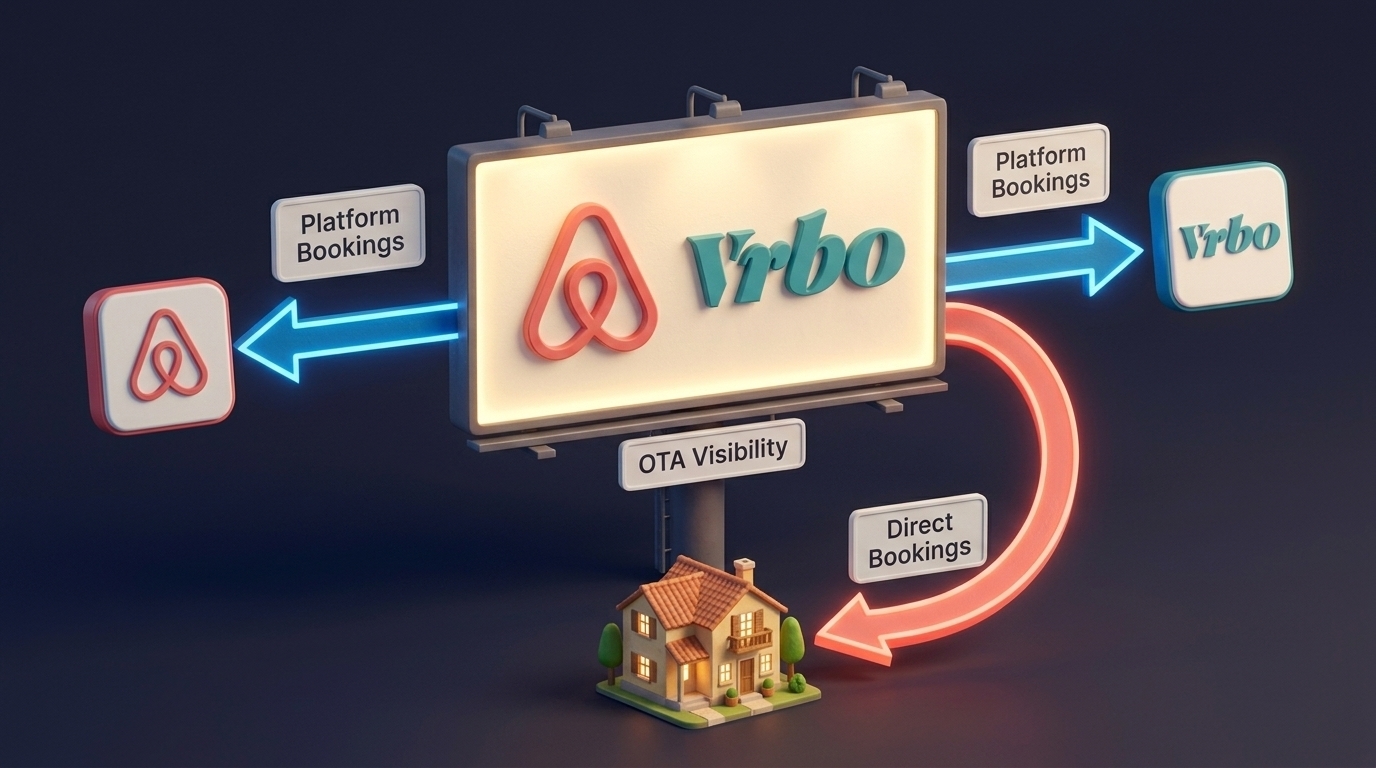
There is a compounding benefit here that operators often miss. Being present on a major platform raises your visibility everywhere, including on the channels you already use and your own direct bookings. This is the billboard effect: the major OTAs function as a billboard for your property, and travelers who discover you there often come back to book through other channels. Jetstream's own analysis of why hotels and resorts should list on Airbnb and Vrbo covers this billboard effect on direct bookings, and why the channel does not cannibalize existing OTA revenue. That new demand is incremental, since the travelers who discover you on a major platform are largely ones your other channels would never have reached.
The catch is operational. Managing rates, availability, and content across several platforms by hand is where most operators give up, because a missed calendar sync turns into a double booking and a refund. This is the gap a channel manager fills, keeping every channel in real-time sync from one place. It is also where Jetstream operates: connecting inventory to the major short-term rental marketplaces, optimizing listings, and managing the channels so the reach scales without the operational burden scaling with it.
| Channel | Audience strength | Best for | Marketing role |
|---|---|---|---|
| Airbnb | Over 8 million active listings; the default search for most travelers | Broad demand, experiences, urban and leisure stays | Primary reach and the billboard effect |
| Vrbo | Whole-home focused, part of Expedia Group | Families and longer group stays | Higher-value, longer bookings |
| Booking.com | Global travel audience, hotels and rentals together | International and cross-over hotel shoppers | Reach beyond the STR-native audience |
| Niche and regional channels | Smaller, targeted audiences | Specific destinations or traveler types | Incremental demand at the margins |
| Direct booking | Your own audience and repeat guests | Loyal and returning travelers | Highest margin, fed by OTA visibility |
Paid Acquisition for STR Operators
Paid acquisition is worth it for short term rental advertising when you have a specific gap to fill: a slow season, a new property with no review history, or a high-value date range that is not booking organically. Platform-native promotions and search ads can accelerate bookings, and they deliver the most when strong distribution is already in place.
Start with the levers inside the platforms themselves. Airbnb and Vrbo offer promotional tools, discounts for new listings, and visibility boosts that cost nothing but a margin trade. These are the lowest-friction form of short term rental advertising because they reach travelers who are already on the platform with booking intent. Use them to seed reviews on a new listing or to move inventory during a soft window.
Beyond the platforms, Google and social ads can drive travelers to your listings or, better, to your direct booking channel where you keep the full margin. Social media has become a serious acquisition channel: a 2025 Sprinklr roundup reports that "83% of marketers say that social media has become their primary customer acquisition channel." The discipline with paid is to measure cost per booking against the lifetime value of the guest, and to turn off anything that does not clear that bar.
Owned Channels: Direct Bookings and Repeat Guests
Owned channels are the marketing assets you control outright: your guest email list, your direct booking page, and the relationships that turn a one-time stay into a repeat one. They carry the highest margin because there is no platform commission, and they are fed by the visibility your OTA presence generates. The long game is converting platform-sourced guests into direct, returning guests.
Email is the workhorse. A guest who stayed once and had a good experience is the cheapest booking you will ever earn, and a simple post-stay sequence inviting them back, with a reason to return, outperforms almost any cold acquisition channel. Build the list from every stay, segment by trip type, and send sparingly enough that opens stay high.
Influencer and content marketing have matured into a credible piece of the owned and earned mix. According to the Influencer Marketing Hub 2026 Benchmark Report, over 70% of marketers plan to increase their influencer marketing budgets by 50% or more, a signal of how much weight the channel now carries. For a short term rental, that often looks less like paid celebrity endorsements and more like partnering with local travel creators who can showcase the property and the destination to an engaged regional audience.
Measuring What Works: The STR Marketing Metrics That Matter
The metrics that matter in short term rental marketing tie spending to bookings and bookings to profit. The core set is occupancy rate, average daily rate (ADR), revenue per available room or night (RevPAR), channel mix, and cost per booking. Together they tell you whether your marketing is generating profitable demand or just activity.
Occupancy and ADR are the two halves of revenue, and RevPAR combines them into a single number that lets you compare performance across properties and time periods. Watch them together, because a high occupancy bought with deep discounts can hide a falling ADR. Channel mix tells you where your bookings actually come from, which is the data you need to decide where to invest next. If one platform delivers most of your demand, that is both a strength and a concentration risk worth diversifying. Cost per booking, finally, is the discipline metric for all paid activity: if a channel costs more to acquire a booking than the booking is worth over the guest relationship, it does not belong in the plan.
Dynamic pricing tools help here by adjusting rates to demand automatically. Tools such as PriceLabs, Wheelhouse, and Beyond each take a different approach, from granular customization to flat-fee simplicity, and they free operators from guessing at nightly rates. The point is the same as the rest of this guide: capture the demand you have worked to generate, at the right price, on every channel.

Building Your STR Marketing Plan: A Step-by-Step Framework
A short term rental marketing plan turns the pieces above into a sequence. Start with reach, then conversion, then retention, and measure at every step. The order matters because each layer compounds on the one beneath it.
The framework, in plain terms: first, get your inventory onto the channels where travelers are already searching, and keep those channels in real-time sync so reach scales without operational chaos. Second, make every listing convert with strong photography, specific titles, and active review management. Third, price dynamically so you capture demand at the right rate across all channels. Fourth, layer in paid promotions only where there is a measurable gap to fill. Fifth, build owned channels, email and direct booking, to convert platform guests into repeat, higher-margin ones. Throughout, watch occupancy, ADR, RevPAR, channel mix, and cost per booking so you know what is working.
For operators who want the reach without building the multi-channel operation themselves, this is exactly what Jetstream does. Jetstream connects your inventory to the world's largest short-term rental marketplaces, optimizes the listings, and manages the channels with real-time calendar sync, so you get new demand and longer stays without the operational burden. You can see how this works for larger properties on the Hotels and Resorts solutions page.