9 min read
Channel Manager for Hotels: The Complete Guide
Aug 14, 2026, 9:15:39 AM
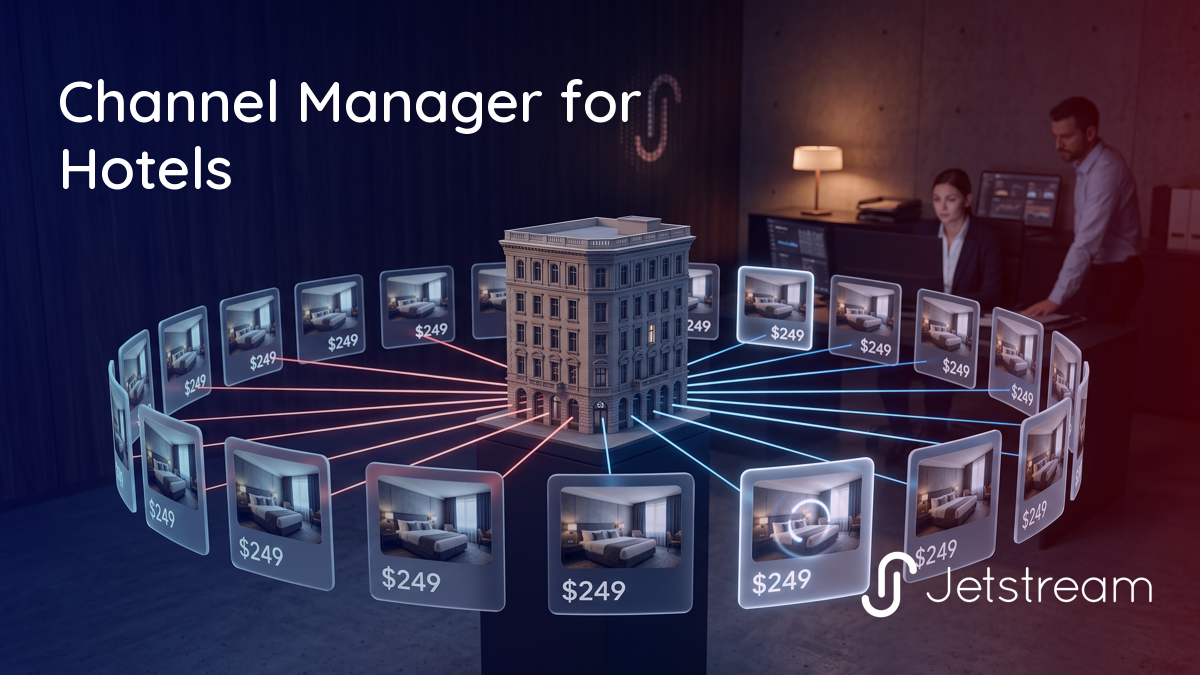
A channel manager for hotels is software that updates your rooms, rates, and availability across every booking channel you sell on, from one place, so the same room can never be sold twice. Booking.com describes it as "a service provider that links the property management system (PMS) you use to manage your rooms and prices with online platforms". SiteMinder frames it as "a system that enables your hotel to list room inventory on all connected booking channels at the same time and prevent the risk of double-bookings". Both definitions describe the same job: one source of truth for inventory, pushed everywhere you sell.
Key takeaway: A channel manager keeps one set of rooms, rates, and availability accurate across every channel you sell on, and most established platforms handle that part reliably. The decision that tends to matter more for an independent hotel is operational: whether you have someone whose job is to run distribution day to day, or whether you would rather hand that work to a partner. That choice usually shapes revenue more than a feature comparison does.
What is a channel manager for a hotel?
A channel manager for a hotel is the connective layer between your inventory and the places travellers book. Your PMS holds the reservations and the guest records. The channel manager takes availability, rates, and inventory from that system and pushes it out to your booking channels, then pulls reservations back in.
Mews draws the line between the two systems cleanly: "A property management system (PMS) manages daily hotel operations like reservations, guest profiles, payments and check-ins. A channel manager focuses on distribution, syncing rates and availability across OTAs and booking channels. When integrated, the PMS serves as the central source of truth, while the channel manager updates external platforms in real time to prevent overbookings and pricing errors."
That distinction is worth holding onto, because properties that blur it tend to either buy a second system duplicating what they already own, or expect their PMS to deliver distribution reach it was never built for.
How a hotel channel manager works
The mechanism is less mysterious than the category makes it sound. Cloudbeds describes the technical path: "a channel manager uses two-way sync via XML to connect to each individual channel's extranet. It then pushes ARI updates to that channel and, for two-way sync, it imports reservations/cancellations into your channel manager, PMS, and/or CRS dashboard." ARI stands for availability, rates, and inventory, the three things every channel needs from you.
The word doing the work in that sentence is "two-way." A one-way connection sends your availability out but does not bring bookings back, which means you are still updating your calendar by hand every time a reservation lands. Cloudbeds notes plainly that with one-way sync, "reservations or cancellations will not be imported." Calendar-based connections using iCal tend to be one-way or limited, and they can typically only connect one room type at a time, which is why they suit a single vacation rental better than a hotel with eight room categories.
Pooled inventory is what actually prevents double bookings
The specific feature that stops you selling the same room twice is pooled inventory. Rather than allocating five rooms to one channel and five to another, every channel sees the same live pool. Cloudbeds explains the model: "This functionality aggregates inventory into a single place so that all bookings are pulled from one 'pool' that's based on real-time availability updates to/from the property management system. By putting all inventory into a single place, hotel rooms are never overbooked because the same room can't be booked by two different websites."
Without pooling, you are choosing between splitting inventory, which caps your own occupancy, and keeping everything open everywhere, which leaves you exposed to double bookings. The cost of the second option is concrete. Booking.com charges commission on an overbooked room and asks the property to cover the guest's relocation, per its partner commission documentation, though it waives that commission if your property has been live for under 30 days or has had fewer than five overbookings in the previous 12 months.
Pooling also works in your favour on cancellations, which is not a small category. SiteMinder's analysis of more than 135 million reservations put the global cancellation rate at 19.15% in 2025. Booking.com notes that a channel manager "automatically puts that room back online immediately, giving you the best chance of rebooking that room." Roughly one booking in five coming back into inventory the moment it cancels is meaningful recovered revenue over a year.
See how Jetstream handles hotel distribution
What rate parity means for your channel manager in 2026
Rate parity clauses required hotels to offer OTAs the same rate they offered elsewhere. In the European Economic Area, those clauses are gone. Booking.com states it directly: "we no longer use parity clauses with our partners in the European Economic Area (EEA)", and attributes the change to compliance with the EU's Digital Markets Act.
It is worth being precise about the legal history, because it is widely reported incorrectly. The European Court of Justice ruling of 19 September 2024 did not outlaw parity clauses. The Court ruled that parity clauses "do not fall outside the scope of that provision on the ground that they are ancillary to those agreements," which means they must be assessed case by case under competition law rather than assumed to be permitted. The removal of the clauses in the EEA came from the Digital Markets Act, not from that judgment.
Two practical notes for operators. First, everything above applies to the EEA. No equivalent change has been verified for the United States, United Kingdom, Canada, or Asia-Pacific, so if you operate outside Europe you should assume your contractual position is unchanged and read your own agreement. Second, parity remains a live operational feature regardless of its legal status: vendors still sell parity monitoring, and inconsistent rates across channels still confuse travellers and depress conversion. Our guide to hotel rate parity in a multi-channel distribution world covers the strategy side in more depth.
What to look for in a channel manager for hotels
Vendor feature lists run long. These are the questions that actually change the outcome for a 25 to 200 room independent property.
- Does it connect two-way to the channels you care about, by API rather than calendar? Ask specifically about the channels you plan to add next year, not just the ones you sell on today.
- Does it use pooled inventory? If the answer involves allocating rooms per channel, you are capping your own occupancy.
- Does it integrate with your existing PMS, and who owns that integration? Cloudbeds is candid about the two-vendor arrangement: "You'll have two support teams and two contracts, so coordination is key when issues arise." When rates stop flowing on a Friday afternoon, one throat to choke matters more than a feature comparison.
- How does pricing scale with your room count? Published entry pricing is usually quoted for very small properties. SiteMinder's public pricing page listed plans from $135 per month at the time of writing, with the explicit footnote that the price "is based on room count" and reflects "an independent property with 5 rooms." A 60 room hotel will pay materially more, and that number is generally not published. Mews notes that subscription fees range from a few hundred dollars a month for small properties to several thousand for larger hotels, and that some vendors charge commission or implementation fees instead.
- What compliance standards does it meet? PCI DSS and GDPR are the baseline questions when a system handles rates and guest data.
- Who does the work? Software gives you the ability to manage distribution. It does not manage distribution. Someone on your team still maps room types, writes listing content, monitors channel performance, and fixes connectivity when it breaks.
For a side-by-side of specific platforms, see our hotel channel manager comparison.
Software you run, or distribution someone runs for you
Almost every option on a typical shortlist is software you operate yourself. SiteMinder's breakdown of the market lists five deployment types, and all five are products: a standalone channel manager, an all-in-one commerce platform, a PMS with a channel manager module, a CRS or GDS-driven platform, and entry-level tools. A sixth model exists that software comparison pages have less reason to cover, which is handing distribution to a partner who runs it as a service.
Neither model is universally correct; they suit different properties, and the deciding variable is usually whether you have someone whose actual job is distribution.
| Consideration | Channel manager software you run | Managed distribution partner |
|---|---|---|
| Who does the daily work | Your team maps rooms, writes content, monitors channels, resolves errors | The partner's team, as part of the service |
| Cost model | Subscription scaling with room count, plus staff time | Typically performance-linked, tied to bookings delivered |
| Control | Full and direct, including the ability to make mistakes quickly | Shared, with the partner accountable for channel performance |
| Adding a new channel | Your project: onboarding, content, mapping, testing | Handled by the partner |
| Best suited to | Properties with dedicated revenue or distribution staff | Properties where distribution is one job among many |
The pattern we see most often is a property that bought capable software, used it well for the two or three channels it already knew, and never got to the fourth, because nobody had the hours to onboard another channel properly.
Compare running it in-house vs a managed partner
Extending hotel distribution to Airbnb
Channel mix, not channel count, is where the revenue difference shows up. SiteMinder's 2025 dataset found that hotel websites generated an average of US$516 per booking, against US$312 for OTAs, with wholesalers at US$445 and GDS at US$392. Every channel carries a different cost and a different guest. Adding channels blindly is not a strategy, which is the argument our hotel distribution strategy guide makes at length.
One channel is worth calling out specifically because most hotel channel manager guides skip it. Airbnb formally supports hotel inventory. Its help documentation for professional hospitality businesses names the eligible property types explicitly, including "Boutique hotel," "Hotel," "Bed & breakfast," "Serviced apartment," "Aparthotel," and "Resort", and describes a featured hotels program where "Guests searching for featured hotels can choose from multiple room types within a single property page." That last detail matters technically: it means the platform can represent a hotel's room-type structure rather than forcing whole-property listings.
Connectivity runs through Airbnb's official partner program. Airbnb states that it "works with leading software providers globally" and reserves Preferred tiers for partners that "meet or exceed all our technical and performance benchmarks." The platform has also been open about wanting more hotel supply. In August 2025, Airbnb CEO Brian Chesky told analysts the company was going "significantly more aggressively into hotels", as reported by Skift.
A note on Vrbo, since the two platforms are usually named in the same breath. Vrbo's published policy does not establish hotel rooms as an eligible property type, and its shared-spaces policy states that it "does not allow vacation rental properties with shared spaces between a host or other guests to be listed on our platform." The policy allows narrow exceptions such as community pools or hallways, which does not extend to a hotel's shared lobbies or restaurants. If your property includes standalone units such as villas or cottages with private entrances, that inventory is a different conversation from your guest rooms. Our practical walkthrough of listing hotel inventory on Airbnb covers the room-type mapping in detail.
Choosing a channel manager for your hotel
A channel manager for hotels solves a narrow problem completely: it keeps one set of numbers accurate everywhere you sell, and it stops you selling a room you do not have. That part of the category is mature, and most credible platforms will do it competently. The decisions that still carry real weight are which channels genuinely earn their place in your mix, whether your PMS and your distribution layer are going to cooperate, and who is going to do the daily work of keeping it all current. Of those three, the last one is usually what determines how well the rest of it goes.
If you would rather not run distribution in-house, Jetstream operates it as a managed distribution service for hotels and resorts, including the channels most systems treat as an afterthought.
See how Jetstream manages hotel distribution
Frequently Asked Questions
What is a channel manager for a hotel?+
A channel manager for a hotel is a system that holds one live set of rooms, rates, and availability and pushes it to every channel you sell on, then pulls reservations back into your PMS. Booking.com describes it as a service provider linking your property management system to online platforms. Its core function is preventing double bookings while removing the need to update each channel's extranet by hand.
What is the difference between a PMS and a channel manager?+
A PMS runs hotel operations: reservations, guest profiles, payments, and check-ins. A channel manager runs distribution: syncing rates and availability out to booking channels and bringing reservations back. When the two are integrated, the PMS acts as the source of truth and the channel manager keeps external platforms current. They solve different problems and most hotels need both.
How much does a hotel channel manager cost?+
Published pricing is usually quoted for very small properties and scales with room count. SiteMinder lists plans from $135 per month for a five-room property. Mews notes that subscription fees run from a few hundred dollars a month for small properties to several thousand for larger hotels, with some vendors charging commission or setup fees instead. Vendors generally do not publish a rate for a 25 to 200 room hotel, so expect to request a quote.
Do small hotels need a channel manager?+
Small and independent properties benefit from centralised distribution for the same reason larger groups do: the alternative is logging into each channel's extranet and updating availability by hand, several times a day. The threshold is less about room count than about how many channels you sell on. One channel and a direct site can be managed manually. Three or more cannot be, reliably.
Can a hotel list on Airbnb?+
Yes. Airbnb's standards documentation for professional hospitality businesses names hotels, boutique hotels, aparthotels, and resorts among eligible property types, and its featured hotels program lets guests select from multiple room types within one property page. Connection is made through Airbnb's software partner program. Hotels are expected to hold applicable business licences and to be authorised to sell rooms directly to the public.
Does a channel manager handle rate parity?+
A channel manager keeps your rates consistent across connected channels, which is the mechanical part of parity. Whether you are contractually required to maintain parity depends on your agreements and your market. In the European Economic Area, Booking.com has removed parity clauses under the Digital Markets Act. Outside the EEA, no equivalent change has been established, so check your own contract.



Posts by Tag
- Channel Distribution (88)
- Marketing (72)
- Technology (66)
- Hotel Trends & Advice (65)
- Real Estate (27)
- Blog (6)
- Case Study (5)
- Passive Income Ideas for REALTORS® (5)
- Boutique Hotel Owners (4)
- Property investors (4)
- Revenue Management (2)
- Airbnb (1)
- Blog (1)
- Hotel and resort operators (1)
- Property Management (1)
- Real Estate Brokers (1)
- Short term rentals (1)
- Tools and Technology (1)
- Travel (1)
- Vacation Rental Platforms (1)
- featured talks (1)