Most guides on Airbnb calendar sync are written for someone with one cabin and a Google Calendar, but a hotel operates differently: your availability doesn't live on Airbnb, it lives in a PMS or CRS that already manages room types, rate plans, group blocks, and a revenue strategy. Airbnb is one more place that inventory needs to appear, accurately, without becoming a second source of truth that fights the first. That changes how you should sync, and it's why the standard iCal advice can quietly put a hotel at risk.
This guide is the hotel version: how Airbnb calendar sync actually works, why the iCal method most hosts use isn't enough once a hotel's systems are involved, and how to connect your PMS or CRS so your inventory stays accurate across Airbnb, Booking.com, and your direct channel without manual juggling.
Key takeaway: Airbnb's iCal calendars refresh only every 3 hours, which is fine for a single rental but too slow for a hotel selling the same room across multiple channels. Hotels should connect through an API-based channel manager that keeps the PMS or CRS as the authoritative source for rates and availability while pushing confirmed Airbnb bookings back into that system in real time. iCal carries availability only; rates, room-type mapping, and real-time updates require an API connection.
Why hotels need Airbnb calendar sync differently than STR operators
Where a vacation rental host manages availability in Airbnb first and syncs outward, a hotel runs the relationship in reverse: the PMS or CRS is the system of record, holding the rate plans, the occupancy forecast, the group blocks, and the revenue rules, and every channel should read from it rather than write to it. Airbnb is a distribution endpoint, not a place where pricing decisions originate.
That hierarchy is the whole reason hotel sync is a different problem. When an independent host edits a date on Airbnb, that's the master calendar changing. When a hotel's front desk edits a date on Airbnb directly, it has just created a conflicting version of the truth that the CRS doesn't know about. The sync a hotel needs has to respect one rule: rates and availability authority flows outward from the hotel system to Airbnb, while confirmed bookings flow back the other way to decrement inventory. What a hotel must avoid is a symmetric merge where manual Airbnb-side edits can overwrite the CRS rate logic that your revenue team depends on.
Three things break when a hotel tries to run that relationship on iCal or manual updates: rates never sync at all (iCal carries availability only), inventory lags behind real bookings, and that lag turns into double bookings on high-demand dates. The next sections take each in turn.
iCal vs API: what hotels need to know
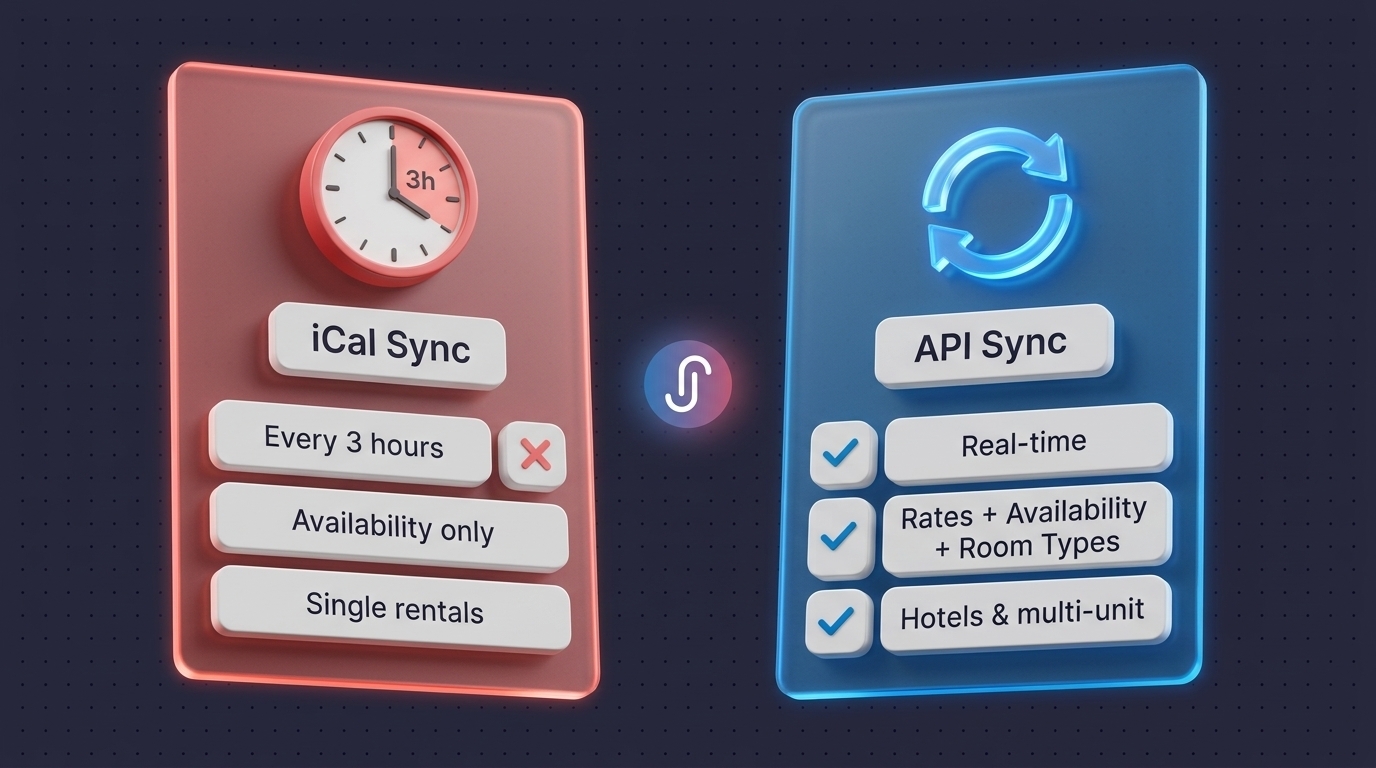
The two ways to connect a calendar to Airbnb are iCal and API, and the difference decides your double-booking exposure.
iCal is a file-based link. You export a URL ending in .ics from one system and paste it into another, and the platforms read each other's calendars on a schedule. It's free and takes minutes to set up. It also carries three limits that matter to a hotel: it moves availability only (no rates, no restrictions), it refreshes slowly, and it can't represent a hotel's room-type and rate-plan structure. On the speed point, Airbnb is specific in its own documentation: a connected calendar "automatically updates every 3 hours" (Airbnb Help Center). Many competing guides quote everything from 30 minutes to 24 hours; the documented figure is 3 hours, and on a busy Saturday that's enough time for the same room to sell twice.
API is a live, programmatic connection, the kind a channel manager or PMS integration uses. Airbnb describes the payoff in its channel manager documentation: "increased booking conversion due to accurate and real time pricing and availability" and "reduced pricing and availability discrepancies between various online channels." An API connection moves rates and restrictions as well as availability, updates continuously rather than on a 3-hour cycle, and can map a hotel's room types to Airbnb listings properly.
| Factor | iCal sync | API sync (channel manager) |
|---|---|---|
| Setup | Minutes, self-serve | Requires a channel manager or integration |
| Refresh speed | Every 3 hours (Airbnb) | Continuous / real time |
| What syncs | Availability only | Availability, rates, restrictions, bookings |
| Room-type mapping | No | Yes |
| Double-booking risk | Real, grows with volume | Minimized by real-time updates |
| Right for | A single rental | A hotel with multiple room types |
On which hotel systems connect to Airbnb: Airbnb itself names SynXis, Guesty, and SiteMinder among its preferred channel manager partners. Beyond that named set, many enterprise hotel CRS and PMS platforms were built for traditional OTA, GDS, and direct distribution, and commonly reach STR platforms like Airbnb through a connectivity partner rather than a built-in Airbnb integration. Airbnb's own guidance reflects this: it tells hotels to "reach out to your Channel Manager provider for exact steps and documentation."
How to sync your hotel PMS with Airbnb, step by step
For a single listing, connecting an iCal feed in Airbnb is a six-step path under Calendar, Availability, Connect calendars. A hotel's process is different because the work happens in your distribution layer, not in Airbnb's calendar screen. Here's the sequence that prevents problems rather than creating them:
- Audit your PMS or CRS connection options. Determine whether your system reaches Airbnb through a named channel manager partner or needs a connectivity provider to bridge it. This decides everything downstream, so confirm it before you list anything.
- Select which room types go to Airbnb. Not all inventory belongs on STR channels. Choose the room types that suit short-term rental demand and decide how many units of each you'll expose, rather than opening the whole house.
- Configure room-type mapping. Match each hotel room category to its Airbnb listing in the channel manager. This is the step iCal can't do, and getting it wrong is a leading cause of sync errors.
- Set rate-plan rules. Decide which hotel rates publish to Airbnb and how any platform adjustments are handled. Because the CRS stays authoritative, these rules live in your system and flow outward.
- Test before going live. Push a test booking through the full path and confirm it decrements availability in the CRS and across the other channels. Verify the booking appears in your PMS, not just on Airbnb.
- Monitor sync health. Set alerts for failed updates. A feed that silently stops looks exactly like a quiet sales day until a double booking reveals it.
Managing Booking.com and Airbnb calendars from one system
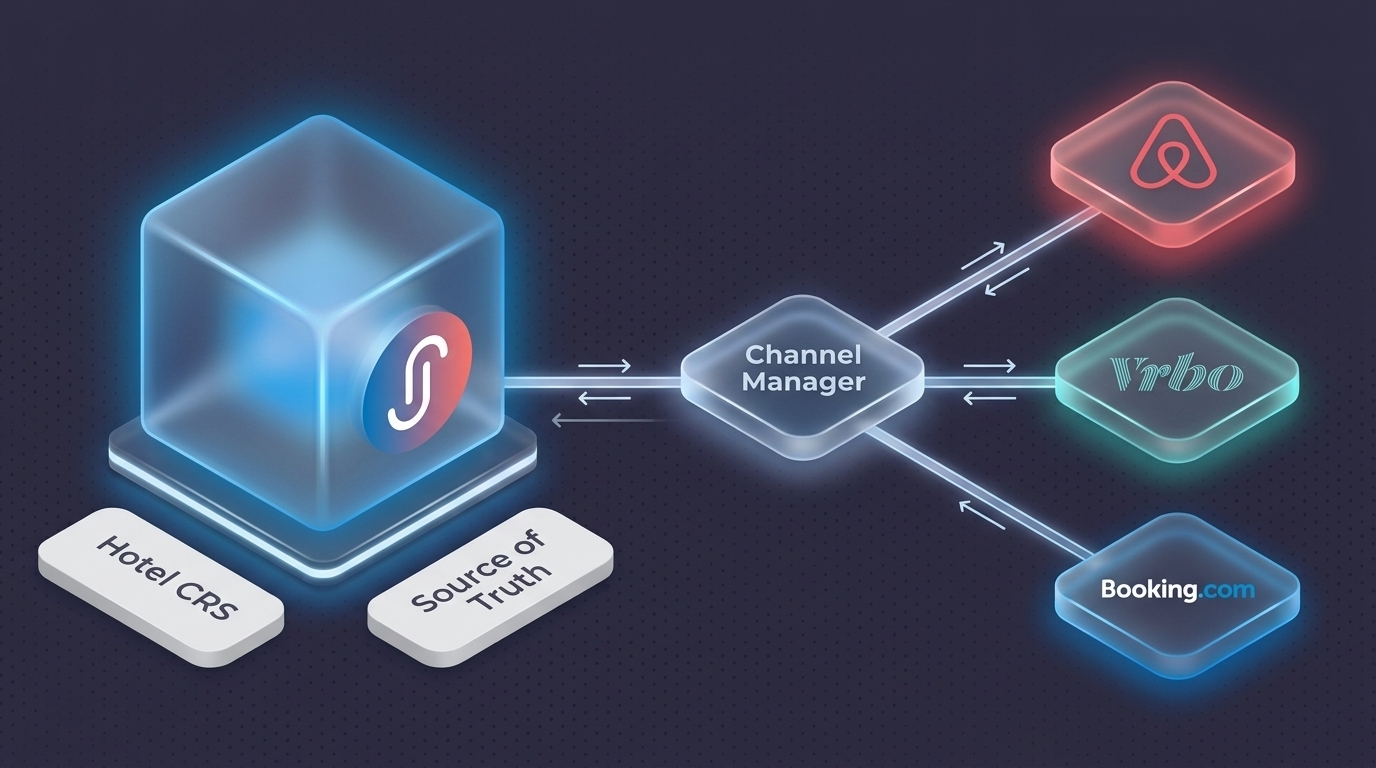
The moment a hotel runs more than one OTA, managing each platform's calendar independently becomes a sync conflict waiting to happen. A room sold on Booking.com has to disappear from Airbnb before the next guest finds it, and on a 3-hour iCal cycle it won't.
The fix is to let one system, your channel manager fed by the CRS, act as the single source of truth for every platform's calendar. Booking.com's own connectivity documentation describes the same model from its side: you "manage your property's Rates & Availability through your connectivity provider's platform" and "manage your reservations on our platform through your connectivity provider's platform." When the CRS is the hub, a booking on any channel decrements availability everywhere at once, rate parity is enforced from one place rather than reconciled by hand, and inventory allocation between platforms stops being a manual chore. This is also where the secondary search every hotelier runs, how to sync Booking.com and Airbnb, gets its real answer: not by linking the two OTAs directly to each other, but by making both read from the hotel's system.