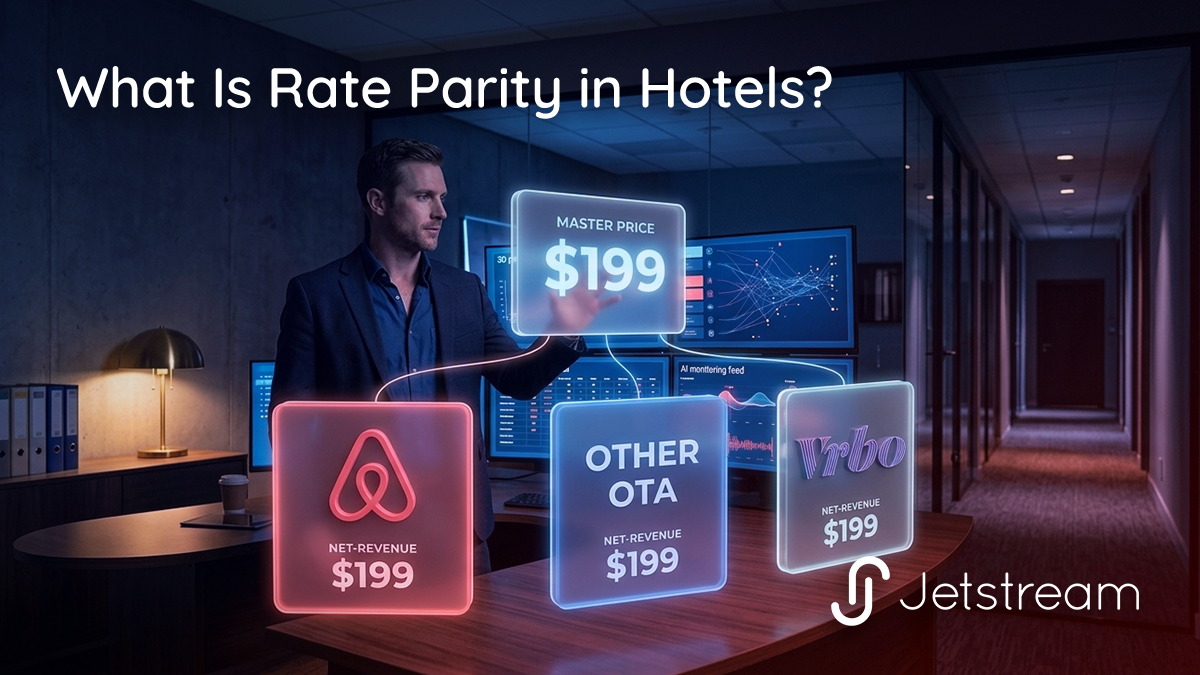
If you sell rooms through more than one channel, rate parity is one of the rules quietly shaping your pricing. So what is rate parity in a hotel context? In short, it is the practice of keeping the price for the same room type consistent across every channel a guest can book through, including online travel agencies, metasearch sites, and your own direct website. Mews defines it as "the policy by which hotels maintain consistent rates across all distribution channels, including their own direct channels."
For revenue managers, parity is less a feature than a constraint. It governs whether you can discount your direct channel, how OTAs treat your listings, and increasingly, what regulators in your market will allow. The rules around it have shifted significantly since 2024, and the picture changes again once a hotel starts distributing on short-term rental platforms like Airbnb and VRBO. This guide walks through all of it.
Key takeaway: Rate parity means charging the same rate for the same room type across all booking channels, a condition OTAs have traditionally written into their contracts to protect their booking volume. There are two strengths of the clause: wide parity, which restricts your rate everywhere, and narrow parity, which only restricts your own website. European regulators have largely dismantled both since 2024, while rate parity remains common in North America. On short-term rental platforms, where hosts set their own prices, the real target is consistent net revenue rather than an identical headline number, and a channel manager fed by your PMS or CRS is what keeps every channel aligned.
What rate parity means and why OTAs enforce it
Rate parity is a contractual condition, not a law of the market. As AltexSoft explains, parity "is usually negotiated in a contract between an OTA and a supplier. Having set a price for the OTA for a particular room type, the hotel can no longer sell the same inventory for less on other publicly available online platforms." Little Hotelier frames it the same way: a "contractual agreement between a hotel or B&B and its distribution agents that its room rates will remain the same across all booking channels, including the property's own website."
The reason OTAs care so much comes down to economics. A single OTA commission commonly runs from roughly 15% to 25% per booking (Mews), so a reservation that flows through an agency costs the hotel a meaningful slice of the rate, while a direct booking keeps that margin in house. If a hotel could undercut the OTA on its own website, guests would shop the OTA and then book direct, and the OTA would lose the volume it invests heavily to generate. Parity removes that incentive. In Mews's words, hotels "are often obligated by OTAs to offer the same rates on all booking platforms in order to prohibit them from providing discounts, which would take business away from the OTAs."
Breaking parity carries consequences. According to Mews, undercutting an OTA "can lead to reduced visibility in OTA search results and may even result in the termination of the partnership." Treat that as an industry observation about how OTAs respond rather than a published penalty schedule; the exact mechanics vary by platform and contract.
Wide rate parity vs narrow rate parity
Not every parity clause is equally strict. The distinction between wide and narrow parity is the one that matters most, both for your pricing freedom and for understanding the regulatory changes covered later.
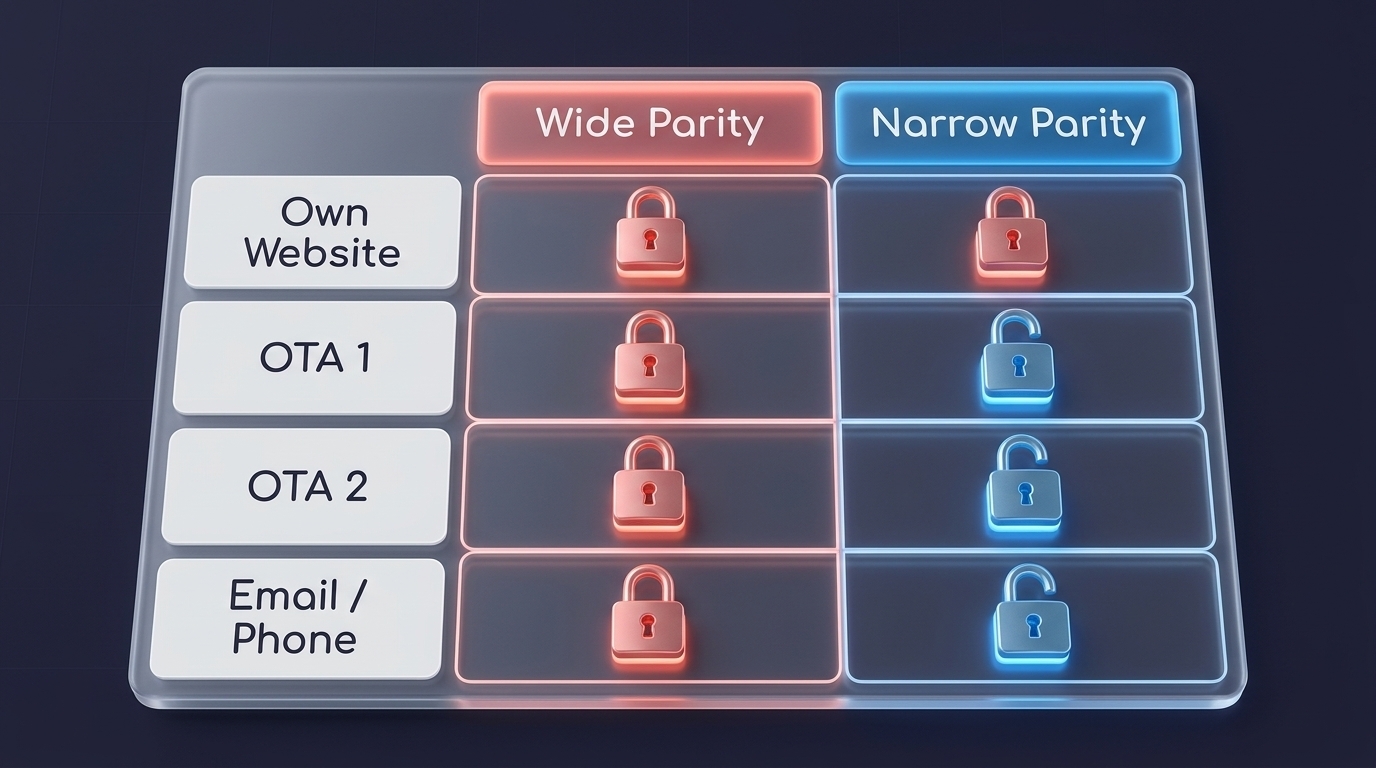
A wide rate parity clause is the most restrictive. Under it, the hotel cannot sell its rooms cheaper or on better terms on any channel, including its own website and other OTAs, than on the OTA partner's channel. AltexSoft calls wide parity "the most rigid type of parity," where "the hotel is not allowed to sell its rooms on any channel, including its own website, cheaper or on more favorable terms than on the OTA partner's channel."
A narrow rate parity clause loosens that grip. It only restricts the rate a hotel publishes on its own website; it leaves the hotel free to offer lower rates on other OTAs. As Little Hotelier puts it, narrow clauses "allow hotels to offer lower rates than other OTAs, but not publicly through their own websites." Crucially, narrow parity still leaves room to offer better rates through indirect channels: email, phone bookings, and loyalty programs.
| Aspect | Wide rate parity | Narrow rate parity |
|---|---|---|
| What it restricts | Your rate on every channel, including your own site and other OTAs | Only your own public website rate |
| Lower rates on other OTAs? | Not allowed | Allowed |
| Lower direct rates publicly? | Not allowed | Not allowed |
| Lower rates via email, phone, loyalty? | Restricted | Allowed |
| Strictness | Most rigid | More permissive |
This wide-versus-narrow axis is exactly where regulators drew their lines. As Legal Dive reported, most platforms had already narrowed their clauses voluntarily, "so the biggest impact of the investigations was to so-called wide clauses, which restrict prices on both the hotel's website and other third-party sites." That regulatory shift is worth understanding in detail.
Where rate parity stands legally in 2026
The legal ground under parity clauses has moved substantially, and the direction is toward fewer restrictions, led by Europe.
The largest change came through the EU's Digital Markets Act. Booking Holdings was designated a DMA gatekeeper on 13 May 2024, with Booking.com as its sole designated core platform service. To comply by the DMA deadline of 13 November 2024, Booking.com, in its own words, "removed all parity requirements throughout the EEA," so that partners "no longer have to provide the same or better rates and conditions to Booking.com for their EEA inventory than those that they make available on any online or offline channel." For existing accommodation partners, the change took effect on 2 December 2024.
Separately, the EU's top court weighed in. On 19 September 2024, the Court of Justice ruled, as reported by Legal Dive, that "it has not been established that price parity clauses, whether wide or narrow," are "objectively necessary" or "proportionate." This was a reference ruling arising from a German case, which national courts then apply to the facts, rather than a single self-executing ban; its practical effect is that parity clauses, wide or narrow, are very hard to justify in the EU.
Some member states acted earlier. Between 2015 and 2018, France, Austria, Italy and Belgium adopted laws banning wide and narrow retail parity clauses by OTAs, according to the European Commission, with other markets imposing restrictions of their own.
The picture is different elsewhere. The United States has no federal ban on rate parity, and in North America the agreements remain common, though scrutiny is increasing. If you operate in or distribute to multiple regions, the practical implication is that your parity obligations may differ market by market, so it is worth confirming what applies to your contracts where you actually sell.
Rate parity on Airbnb and VRBO is a different problem
Most parity guidance assumes you are dealing with traditional OTAs like Booking.com and Expedia. Once a hotel starts distributing on short-term rental platforms, the question changes shape, and this is the angle most rate parity coverage misses entirely.
Start with how the platforms differ. Airbnb does not publish or impose a rate parity clause; hosts set and control their own prices. Airbnb's own help documentation states that the price is "based on the nightly price set by the host" (Airbnb Help Center), and that as a host "you're always in charge of your prices" (Airbnb Help Center). VRBO, like Airbnb, runs on a host-set-price model; an explicit VRBO parity clause is not published, and we could not confirm one from a primary source. So on the STR side, no contract is forcing your hand the way an OTA clause traditionally would.
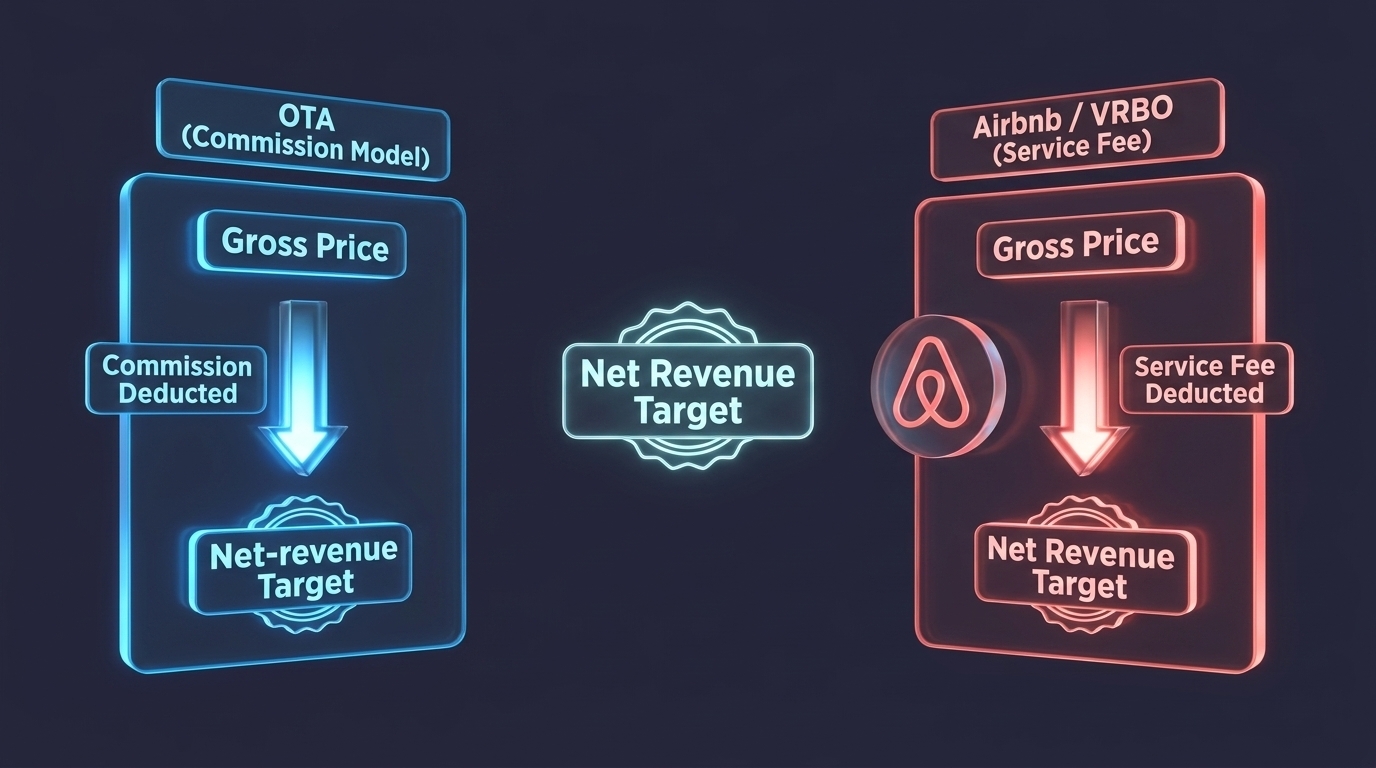
The more interesting difference is structural, and it is why "identical price everywhere" is the wrong goal across these channels. Booking.com and Airbnb monetize differently. As PriceLabs describes it, "Booking.com typically uses a commission model where you set the price the guest sees, and the platform takes its fee out of your payout. Airbnb often adds a service fee on top of your base rate, which guests only see at the end of the checkout process." Because the fee structures don't match, the same headline rate produces different net revenue depending on the channel.
In Jetstream's view, that makes consistent net revenue, not an identical posted number, the real parity target for a hotel running OTA and STR channels at the same time. PriceLabs reaches the same conclusion: "Consistent pricing doesn't always mean the exact same number, it means consistent net revenue." The practical move is to set rates per channel so each one clears the same amount after fees, rather than forcing a single price across systems built on different economics. A hotel extending into STR distribution is solving a problem no traditional parity playbook was written for, which is precisely why the architecture underneath, your source of truth and how rates flow outward, matters more than any single clause.
How a channel manager keeps rates in sync across channels
Whatever your parity obligations are, you can only honor them if every channel reflects the same current rate and availability. That coordination is the job of a channel manager.
A channel manager lets a hotel push one set of rates and inventory to every connected channel from a single place. Little Hotelier describes the mechanic: "It's as simple as updating your rates in one place, and the changes are instantly reflected across all your connected OTAs. No more manual updates on each platform." Update once, and every channel sees the change, which is what keeps rates aligned without anyone reconciling spreadsheets by hand. For a fuller treatment of what these systems do, see our guide to what a hotel channel manager is.
The same single-source-of-truth model also prevents the timing failures that quietly break parity and availability. PriceLabs notes that many operators "rely on iCal feeds to sync calendars, but these can lag by several hours or even a whole day," opening a window for a date to sell twice. The fix, in their words, is to "set your rate once in the channel manager, and it pushes that update to all platforms simultaneously." When the channel manager reads from your property system in real time, a rate change or a new booking propagates everywhere at once rather than on a delay.
That real-time, system-of-record approach is the layer Jetstream provides. Jetstream connects to a hotel or resort's existing PMS or CRS, including SynXis, D-Edge, TravelClick, and IHG CRS, reads availability, rates, and inventory in real time, and distributes to Airbnb and VRBO with two-way sync so that bookings push back into your system automatically. Your team keeps full control of pricing and availability in your own system; Jetstream distributes your rates rather than setting them. Its proprietary Jetstream Synchronous Mapping translates complex hotel rate plans into formats the STR platforms accept, so the pricing logic your revenue team built stays intact as rates flow outward to every channel.