SynXis Channel Manager Guide for Hotels: Adding STR Distribution
Your hotel runs on SynXis. It's Aven Hospitality's central reservation system. It manages rates, inventory, and your traditional OTA connections. Booking.com, Expedia, GDS systems. It does that job well. But connecting to Airbnb or Vrbo takes more than a channel connector. Those are short-term rental platforms with different listing models, commission structures, and guest expectations. If you're a hotel considering STR distribution as revenue expansion, you'll need a dedicated STR partner to bridge the operational gap between your SynXis system and STR platforms.
This guide explains what SynXis handles, what it doesn't, and how to evaluate an STR partner that can work alongside your CRS.
What SynXis Does (and Does Well)
SynXis Central Reservations is Aven Hospitality's reservation and distribution backbone for hotels. It's built for the traditional hotel market. Hotels with 50+ rooms, mature revenue management, and multi-property operations depend on it. For a broader primer on how hotel channel managers work, see our complete guide to channel managers for hotels.
Core SynXis functions:
- Rate and inventory management across properties
- Direct booking engine (your website)
- Distribution to traditional OTAs (Booking.com, Expedia, Hotels.com)
- Global distribution systems (GDS) like Amadeus and Travelport for travel agents
- Commission and parity rules
- Automated syndication to channel partners
SynXis is a property-level system. It manages room types, rate plans, restrictions, and availability across connected booking channels. Everything is managed per property, per room type, per rate plan. This architecture works perfectly for hotels because the granularity matches how hotels operate.
How SynXis Handles Hotel Distribution Today
Your hotel's rate and inventory live in SynXis. When you set rates in your PMS or rate management tool, that data flows to SynXis. From SynXis, rates and availability sync to all your connected channels. Booking.com sees your rates. Expedia sees your rates. Your website sees your rates.
The connection model is API-based. Aven Hospitality maintains integrations with hundreds of OTA and GDS partners. Each partner has a connector that speaks to SynXis in their own language. Booking.com's connector pulls your rates and availability at intervals throughout the day. Expedia's connector does the same. The system is built to handle dozens of these connections reliably.
Commission management is part of the deal. SynXis knows that Booking.com takes 15-18%, Expedia takes 15-20%, your direct website takes 0%. It can route bookings correctly and calculate your net revenue accordingly.
This distribution model is bulletproof for OTAs and GDS. It scales across thousands of hotels. The problem is: it only works for hotel-style distribution.
The Gap: Why a Channel Connector Isn't Enough for STR Platforms
Airbnb and Vrbo are not OTAs. They're listing platforms with a unit-level model. That is the fundamental difference.
On Booking.com, you list your hotel. You set rates per room type, per date. The platform displays that hotel listing alongside thousands of others.
On Airbnb, you list a property. Not a hotel, a property. Think of it as a residential home or apartment, even if it's part of a 200-room hotel. Airbnb's listing interface mirrors vacation rental software, not hotel software. You upload photos of the interior. You set house rules. You respond to inquiries. You configure the exact cancellation policy. You craft a property description that sells the lifestyle, not the hotel amenities.
A hotel with five room types becomes five Airbnb listings, one per room type. Each listing represents the room type as a whole, with multiple similar rooms behind it. Each has its own photos, description, review history, and calendar, all built around the room type rather than the hotel brand.
Why this breaks the SynXis model:
- Listing content is per room type. SynXis manages properties as a single entity. Airbnb expects individual listings. Each room type in SynXis becomes a separate Airbnb listing with its own content, photos, and identity.
- Photos are critical. Airbnb's ranking algorithm prioritizes photo quality. Hotels typically have standard hotel-room photos. STR platforms want lifestyle imagery, empty space, amenity close-ups, and outdoor areas.
- Review identity is listing-specific. Your reviews on Airbnb are tied to that specific listing. A 5-star property on Airbnb doesn't carry weight to a different Airbnb listing for rooms in the same hotel.
- Commission models are different. Airbnb charges a 15.5% host-only service fee deducted from payouts, with no separate guest fee at checkout. This replaced the older split-fee model (where hosts paid 3% and guests paid 6-12%) in late 2025. The fee is calculated on the total booking value, not just room revenue. SynXis doesn't understand that structure.
- Guest services are part of the rental. Airbnb guests expect host responses within 24 hours. Direct messaging is the primary communication channel. That's not how hotel operations work.
- Inventory allocation requires discipline. You need to decide how many units of each room type go to Airbnb versus traditional OTAs. If you allocate ten Standard rooms to Airbnb, those ten can't simultaneously sell on Booking.com. Your inventory strategy has to account for that split across channels.
SynXis does offer a native Airbnb integration through its Channel Connect platform. But connectivity alone doesn't solve the operational gap. A channel connector can push rates and pull reservations. It doesn't create optimized listings per room type, write descriptions that convert on STR platforms, manage guest messaging, handle reviews, or provide 24/7 guest services. Those layers sit outside the CRS, and they're what determine whether your Airbnb presence actually performs.
How Hotels Bridge SynXis to Airbnb and Vrbo
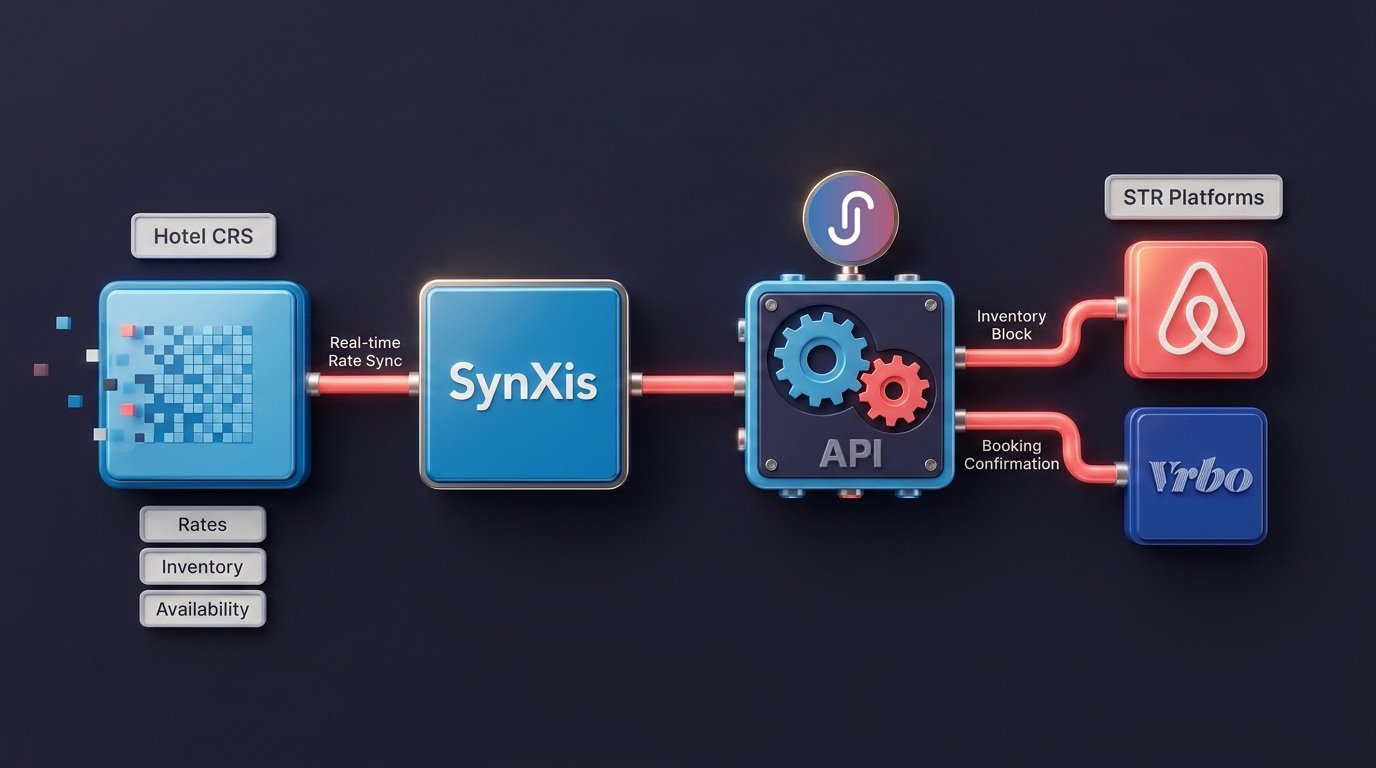
If you want to expand into STR distribution, you need a dedicated channel manager that understands both SynXis and STR platforms.
A good STR partner does three things:
1. Speaks SynXis and Airbnb. It connects to your SynXis system via API, pulls your rates and availability, and translates that data into Airbnb and Vrbo listings. The translation layer handles the differences: room types become individual listings, rate plans become booking values, and availability becomes calendar updates per listing.
2. Manages the listing layer. It handles all the STR-specific work that SynXis doesn't. Photography guidance. Description writing. Review responses. Guest communication. Pricing optimization specific to each STR platform.
3. Handles guest services. It responds to guest inquiries, screens bookings, manages check-in instructions, and handles post-stay communication. This is the 24/7 guest services layer that hotel operations expect but STR platforms require.
Most importantly, the partner handles rate and inventory sync. When you update rates in SynXis, the partner fetches that update and pushes it to your Airbnb and Vrbo listings (with some logic for how much inventory you want to allocate to each channel).
Let's map an example. You're a 200-room hotel using SynXis with three room types: Standard, Deluxe, and Suite. You decide to allocate inventory from each room type to Airbnb, keeping the rest on your traditional channels (Booking.com, Expedia, direct).
Your STR partner connects to SynXis and learns your room type architecture, rate plans, and availability. The partner then creates one Airbnb listing per room type, not per individual room. Your Standard becomes one Airbnb listing. Your Deluxe becomes another. Your Suite becomes a third. Each listing gets its own photos, description, pricing, and calendar, all tailored to the STR audience.
The partner's system watches your SynXis inventory in real time. When Airbnb sells a night in your Standard room type, the partner decrements that room type's availability in SynXis, preventing it from being double-sold on Booking.com. You control how many units of each room type are allocated to STR channels versus traditional OTAs.
When you adjust rates in SynXis (say, a weekend rate increase), the partner reads that change and applies it to your Airbnb listings (with any adjustments for Airbnb's booking structure and fee model).
This is how hotels extend their SynXis distribution to Airbnb and Vrbo. SynXis provides the data foundation, but it's a specialized partner handling the listing creation, guest operations, and room-type-level distribution that makes STR channels actually perform.
What to Look For in an STR Channel Manager
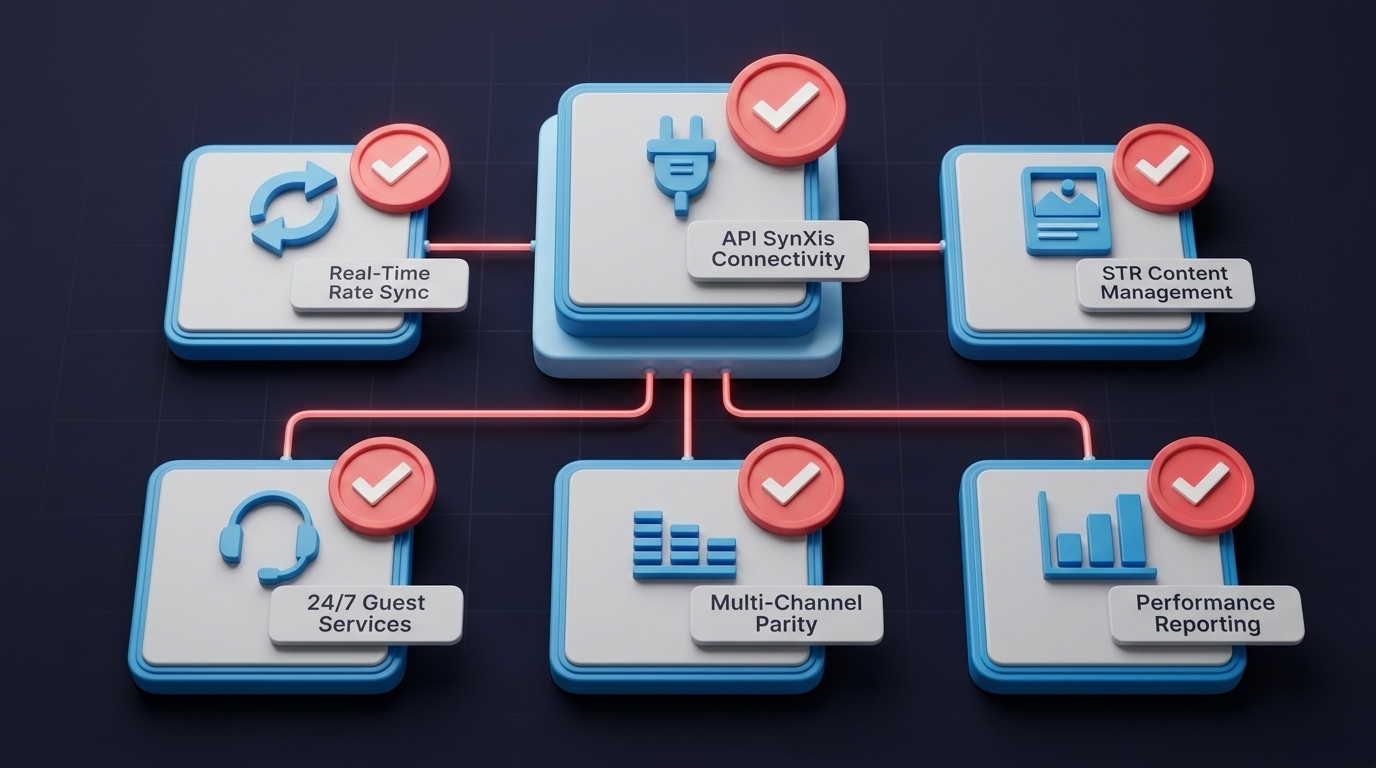
If you're evaluating partners to extend SynXis to STR, here's what matters.
API connectivity to SynXis. The partner must have an Aven Hospitality integration or a certified SynXis connector. API-based is non-negotiable. You don't want daily manual uploads or manual syncs. The connection should be bidirectional: the partner reads your rates and inventory from SynXis, and when you block a date for an Airbnb booking, SynXis gets updated automatically.
Real-time rate and inventory sync. When you change a rate in your PMS, that change should appear on Airbnb within hours. When a guest books through an Airbnb listing, that room type's availability should decrement in SynXis immediately. Lag time is money lost. (If a Standard room sells on Airbnb but SynXis still shows full availability for 12 hours, you risk an overbooking.)
Multi-channel parity management. The partner should handle rules like: "This room goes to Airbnb Mon-Fri and Booking.com Sat-Sun" or "This rate plan is 10% higher on Vrbo than Booking.com." You want flexibility in how you allocate inventory and pricing without manual management.
STR-specific features. Photography upload and guidance. Listing optimization. Description writing. Review management. Guest communication. These are table stakes. If the partner only handles rate sync and doesn't touch the listing content, you're doing half the work.
24/7 guest services. If a guest books your Airbnb room and messages at 2 AM with questions, who responds? Your front desk is asleep. A good partner has 24/7 availability via phone, email, and messaging. This isn't a nice-to-have if you're running a 50+ room operation. It's essential.
Reporting on performance. You want visibility: which rooms performed best on Airbnb? Which did worse? Revenue by channel, occupancy by channel, guest quality by channel. The partner should provide dashboards and data exports so you can see where the profit is coming from.
Pricing integration. Some partners handle dynamic pricing: adjusting your Airbnb rates based on demand, seasonality, and local events. If you want that, it should work within your revenue management discipline (respecting your target ADR and occupancy goals from SynXis).
The gold standard is a partner that handles Airbnb distribution end-to-end while staying synchronized with your SynXis system. That partner becomes your bridge between two very different worlds.