A bad review stings twice. Once when you read it, and again every time a potential guest does. So the first question every host asks is whether they can remove an Airbnb review, and the honest answer is: sometimes, under specific conditions, with evidence. This guide covers the entire Airbnb review removal process: which reviews qualify, how the dispute flow works step by step, what to do inside the 30-day window for reviews you wrote, and what your real options are when removal is off the table.
Everything below is sourced from Airbnb's current Help Center documentation. That matters more than it sounds: while researching this guide we found that the top-ranking articles on this topic contradict Airbnb's own policy on points as basic as deadlines and removal methods. Where the rules come from Airbnb, we link the exact policy page so you can verify them yourself.
Key takeaway: Airbnb removes reviews only when they violate its Reviews Policy: fake, irrelevant, extortionate, retaliatory, competitively biased, or in breach of its content rules. You file a dispute through a self-serve flow, Airbnb emails a decision usually within 48 hours, and you get a maximum of two requests per review. A review you wrote yourself can be removed within 30 days, no justification needed. An honest negative review is not removable, and your recovery play there is a calm public response plus a steady stream of better reviews.
Can you remove an Airbnb review? The decision table
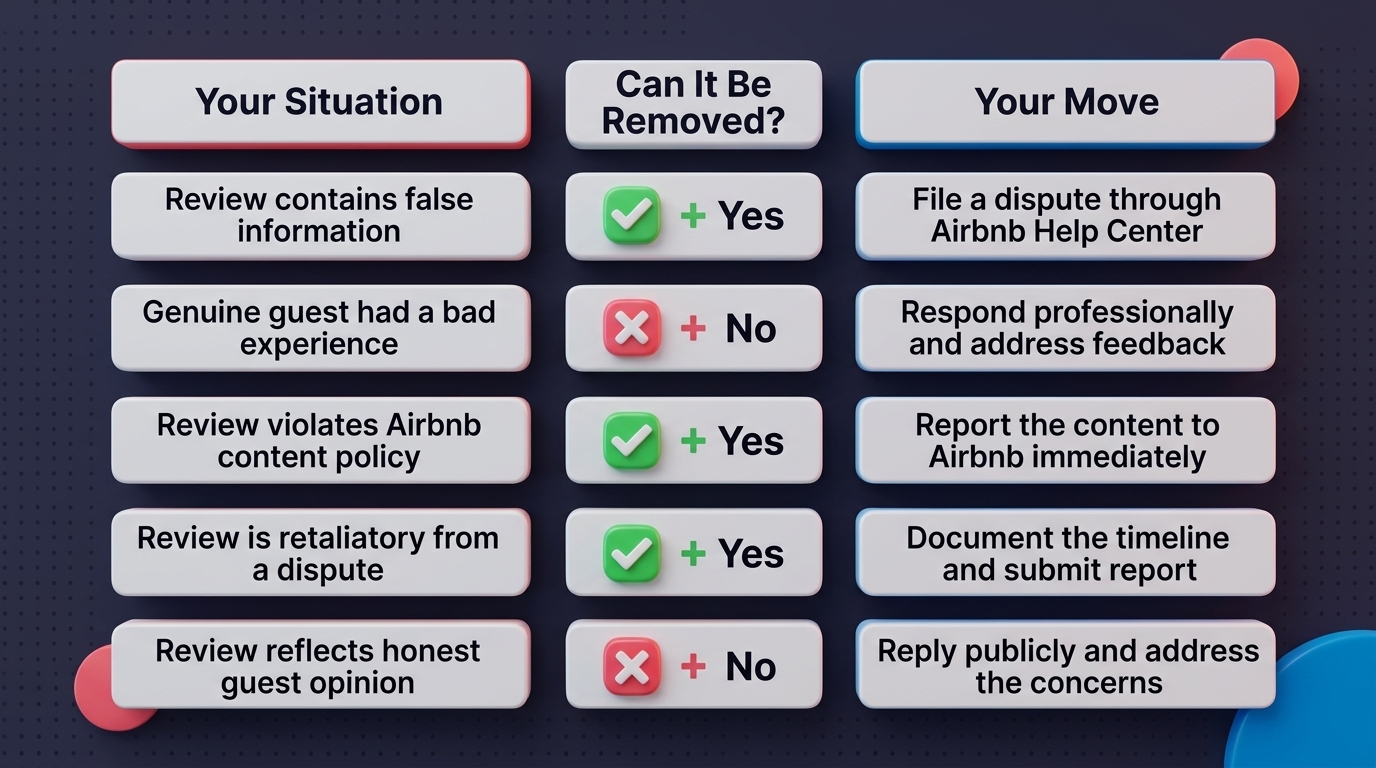
Some Airbnb reviews can be removed and most cannot: a review that violates one of Airbnb's six policy grounds qualifies for a dispute, a review you wrote yourself can be removed within 30 days, and an honest negative review can only be answered, never erased. Match your situation to the row below, and the rest of the guide gives you the steps.
| Your situation | Can it be removed? | Your move |
|---|---|---|
| The review violates a policy ground (fake, irrelevant, extortion, retaliation, competitor bias, prohibited content) | Yes, by dispute | File a review dispute with evidence, any time |
| You wrote the review yourself | Yes, within 30 days of publication | Use the self-serve Remove Review button |
| You submitted your review first and the guest hasn't submitted theirs | Editable, not removable | Edit it within the 14-day window |
| The review is negative but honest, or you disagree with the star rating | No | Post a public response, then out-earn it with new reviews |
| The review mentions things outside your control (neighborhood noise, weather) | Usually no | Public response with context for future guests |
What Airbnb's review policy actually allows
The Airbnb review policy permits removal in six situations, and only six. The policy states that "reviews may only be removed from our platform in limited circumstances," and Airbnb is explicit that it "generally [doesn't] mediate disputes concerning review accuracy" (Reviews Policy). Here are the grounds, as Airbnb defines them:
- Irrelevant. The review isn't a first-hand account of the reservation. Airbnb's example: if a guest never arrived, or canceled for reasons unrelated to the property, their review is considered irrelevant because it "isn't based on first-hand experience of the offering."
- Fake. The review isn't tied to a real reservation by someone who participated in it.
- Extortion, incentives, or pressure. Guests "may not threaten a negative review as a means to obtain unwarranted compensation, refund, or other incentive," and reviews can't be traded for discounts, refunds, or reciprocal praise.
- Competitive bias. Hosts and guests "may not leave reviews of listings with which they are directly affiliated or in direct competition."
- Retaliation. The narrowest ground, covered in its own section below.
- Content Policy violations. Explicit, discriminatory, harmful, or illegal content, including personal information (Content Policy).
Just as important is what does not qualify. Airbnb spells out three situations that will not get a review removed: disagreement with the star rating (its example is a guest who writes "Nice home and great stay" and leaves 3 stars), reviews mentioning factors outside the host's control, and subjective opinions like "the kitchen was small and cramped." If your complaint is that the review is unfair rather than that it breaks a rule, skip ahead to the public response section, because a dispute will not go your way.
One more mechanic worth knowing: Airbnb does not moderate reviews before they publish. Everything posts first and gets evaluated only if someone disputes it.
How to remove a review you wrote on Airbnb
This is the one unconditional removal Airbnb offers. Per Airbnb's removal article, "you have up to 30 days from the date it's published to remove it from the Airbnb platform." You don't need a reason. On desktop:
- Click Today, then Profile
- Click Show reviews I've written
- Go to the review you'd like to remove
- Click Remove Review and follow the prompts
If the Remove Review button isn't there, Airbnb says the 30-day window has passed. Airbnb's documentation offers no path around it.
How to edit an Airbnb review
Editing is tighter than removal. Per Airbnb's editing rules, you can edit a review of a home stay only if you submitted yours first, and only "anytime within the 14-day review period, up until the other party submits their review." The moment both reviews are in, or the window closes, both publish automatically and editing is over for good. Reviews for Airbnb services and experiences can't be edited at all once submitted.
You also can't request edits to a review someone wrote about you, with one narrow exception: Airbnb may, on request, change the gender pronoun a review uses to describe you.
So the realistic edit scenario is regret about your own review during the blind window: edit it before the guest submits, or remove it within 30 days of publication.
How to dispute an Airbnb review you received
Most ranking guides get this deadline wrong. If you believe a review of your listing violates one of Airbnb's six policy grounds, you can dispute it at any time. There is no 30-day deadline on disputing a review you received; that deadline only applies to removing reviews you wrote. (At least one top-ranking article claims your "chances drop to near zero" after 30 days. Airbnb's documentation says no such thing.)
First, confirm you're eligible to file. Airbnb limits review disputes to the listing owner, full-access co-hosts, broad-permission pro hosts or hosting team members, team owners, members of team guest management, and the guest who booked.
Then file through the self-serve flow:
- Open Airbnb's review dispute flow (the Get started link in the removal article)
- Select the review you want removed. Airbnb's own tip: search using words from the review text, since searching the reviewer's name "may not work"
- Select the reason (the policy ground) for removal
- Provide details about why the review violates that ground
- Upload supporting documentation
- Submit
Three documented rules will shape your filing:
- Decisions arrive by email, usually within 48 hours. If the review violates policy, Airbnb removes it and notifies the reviewer, who can contest the decision with new information.
- You get a maximum of two removal requests per review. Two attempts, total. Make the first one count: lead with your strongest policy ground and your clearest evidence rather than firing off a quick emotional complaint.
- Leave out sensitive personal information. Airbnb states that government IDs, health data, and details about children or criminal history "won't be considered." Including them weakens nothing except your filing.
On evidence, the principle that follows from the policy itself: match the proof to the ground. An extortion claim lives or dies on the message thread where the guest connected money to the review, so screenshots of the exact exchange are the core exhibit. An irrelevance claim needs the reservation record showing the guest never arrived. A retaliation claim needs the timeline: your report of their violation, then their review.
Kirsten Collins, Jetstream's Director of Global Guest Services, whose team files these disputes daily for our partners, adds a layer the policy pages don't. Airbnb isn't weighing whether a review is fair; it's checking whether the review breaks a content rule. A dispute argued on unfairness draws a templated rejection almost every time. What changes the outcome is a specific policy hook backed by records that live inside Airbnb's own messaging system: a message log showing the guest raised no complaint during the stay, timestamped photos of the property's condition at or after checkout, and booking records that directly contradict the review's specific claims. As Collins puts it, "if your communications happened over text or phone, you have nothing to submit."
Two realities temper expectations. Success is selective: disputing every bad review produces a low removal rate, while reserving disputes for the ones with a genuine policy case raises it meaningfully. And the documented 48-hour decision is the best case, not the norm Collins's team sees. In practice, an initial response often takes one to two weeks and frequently lands as a template. That first answer isn't the end of the road; a calm, evidence-backed follow-up on your second request sometimes reverses it.
Retaliatory reviews: the narrowest path, precisely defined
"Retaliatory" is the most misused word in host forums, so here is Airbnb's actual definition, verbatim from the Reviews Policy: "A review will only be considered retaliatory if the reviewer committed a policy violation, was notified of that violation, and then left a biased review because their own violation was reported."
Three conditions, in sequence: the guest broke a rule, you reported it, and the review followed as payback. A guest who is simply unhappy, or who disputes your damage claim, doesn't meet the bar. Airbnb adds that a review "discussing the facts or legitimacy of a Resolution Center or AirCover claim isn't automatically considered retaliatory."
The practical implication runs in your favor when you operate by the book. If a guest violates a house rule, document and report it during the stay, before checkout, through Airbnb's official channels. That timestamped report is what turns a later negative review into a provable retaliation case instead of a he-said-she-said.
Collins's team has had exactly this kind of review removed, and the reason it stuck was the sequence. The guest raised no complaint at any point during the stay; the team identified damage at checkout and followed the standard process to document and charge for it; a one-star review that referenced nothing about the actual stay appeared within hours of that notification. "That sequence is what makes a retaliatory case," Collins notes: a complaint-free message log followed immediately by a damaging review after an action you took. Airbnb can see the timing, and when the pattern is that clear it has a policy basis to act. The lesson generalizes to every ground: documentation wins these cases, arguments don't.
What happens after removal, and the quiet Superhost caveat
Two documented mechanics make removal worth pursuing when you have a real case. First, removed reviews are excluded from both your listing and host rating calculations, so a successful dispute genuinely repairs your numbers rather than just hiding text. Second, per the same Airbnb page, a listing's rating appears in search results once it "receives at least three reviews," which is why protecting every tenth of a point matters early.
One caveat comes straight from Airbnb's Superhost criteria page: Airbnb "may suspend or withhold Superhost status for hosts with high review removal rates." Filing legitimate disputes is exactly what the system is for. Carpet-bombing every negative review with removal requests is a pattern Airbnb watches for, and it can cost you the badge you're trying to protect. One more reason the two-request limit rewards picking your battles.
How Airbnb compares with VRBO and Booking.com
If you list on multiple channels, the remediation rules change at each door.
| Platform | Removal path | What qualifies | Documented timeline |
|---|---|---|---|
| Airbnb | Self-serve dispute flow, any time | Six policy grounds (fake, irrelevant, extortion, retaliation, competitor bias, content violations) | Decision email usually within 48 hours; 2 requests max per review |
| VRBO | None for compliant reviews | Only content-guideline violations; VRBO's documented remedy is the owner response | None documented |
| Booking.com | Support-mediated request via the Extranet | A closed list of conditions: canceled stays, no-shows, wrong property, invalid card cancellations, or evidenced blackmail | None documented; score may persist even when text is removed |
Across all three platforms, documented evidence of blackmail or fraud is the only complaint that consistently qualifies for removal; a complaint that the guest was unfair doesn't qualify anywhere. Build your documentation habits for the strictest platform and you're covered on all three.
When to stop fighting and respond instead
Most negative reviews don't violate any policy. They're just bad days in writing, and the dispute flow is the wrong tool for them. Airbnb's own framing points the way: it doesn't mediate accuracy disputes, but "users can post responses to reviews."
A public response posts immediately and appears on your listing alongside the original review, where every future guest can see it. That audience is who you're writing for, not the reviewer. Keep it short, factual, and unbothered: acknowledge the specific issue, state what changed, and stop. A composed two-sentence response under an unreasonable review tells future guests more about you than the review does. We keep a full set of review and response templates you can adapt, including response wording for difficult situations.
Then play the long game: a steady flow of strong reviews dilutes one bad one, especially while your listing is young and the review count is low. Our guides on improving your Airbnb ranking and earning Superhost status cover that recovery engine in detail.
The remediation playbook from a 24/7 guest services team
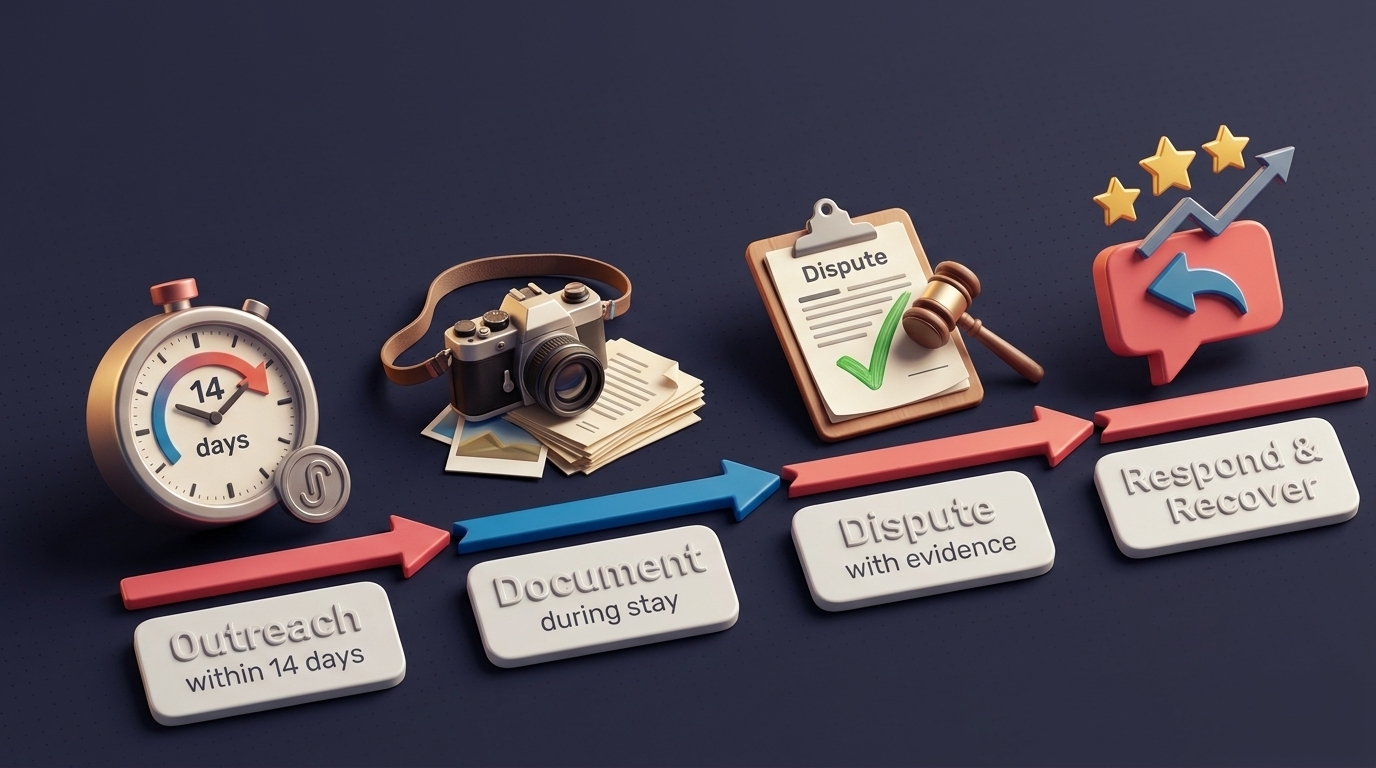
Jetstream's guest services team handles guest communications around the clock for property management partners, and review remediation is part of that work: heading off bad reviews before they're written, assembling dispute evidence, and writing the public responses when removal isn't on the table. A few principles from that practice that any host can apply:
The 14-day window is your intervention window. A dissatisfied guest hasn't reviewed you yet; the review clock runs for 14 days after checkout. A prompt, personal follow-up that acknowledges the problem and offers a concrete fix reaches the guest while the review is still unwritten. Hosts who only discover problems by reading the review have already lost the cheapest remediation move available.
Document during the stay, not after it. Every workable dispute is built on records created in real time: the house-rule violation reported through Airbnb's channels when it happened, the dated photos, the message thread kept on platform. A case assembled only after the bad review arrives carries far less weight than one documented as the stay unfolded.
Stay on platform. Off-platform conversations don't exist as far as a dispute reviewer is concerned. Keep the paper trail where Airbnb can see it.
Two more principles from Collins's team reframe the problem entirely.
The review window opens at check-in, not checkout. By the time a guest is typing a one-star review, the chance to change the outcome has already passed. Collins's team treats any stay that goes sideways as something to resolve before the guest leaves: fast acknowledgement, a real fix, and a compensation gesture only where it's warranted. What actually de-escalates is rarely the size of that gesture; it's speed and the feeling of being heard. As Collins puts it: "Guests who feel ignored post reviews. Guests who feel responded to, even when the problem wasn't fully solved, very often don't."
Be deliberate about who you ask for a review. Most hosts request a review from every guest by default. Collins's team doesn't: a guest who complained, triggered a damage situation, or had friction during the stay does not get a review request. Knowing who to ask and who to leave alone is one of the largest pre-emptive levers in review management, and almost no one talks about it.
When a review does land, the team writes the public response first, even when it's also filing a dispute. A thoughtful public response does more for future bookings than a successful removal, because the guests who matter most are reading before they book, not after, and they're judging how you handled the review as much as the review itself. The dispute gets dropped the moment there's no clear policy violation to point to; from there the energy goes to what you can actually control: generating more strong reviews, including converting happy Airbnb guests into reviews on other platforms. At portfolio scale, velocity beats any single removal: a listing with 200 five-star reviews and one disputed one-star reads completely differently from one with twelve reviews and one bad one.
The mistakes Collins's team sees hosts repeat are consistent: arguing that a review is unfair instead of naming a policy violation; posting a public response while still angry, where it lives permanently on the listing and often does more damage than the review itself; disputing every bad review instead of saving the effort for the one well-evidenced case that can actually win; communicating off-platform and then having no message log when it's needed; and treating review management as something that begins when the review lands, by which point the window has almost always already closed.