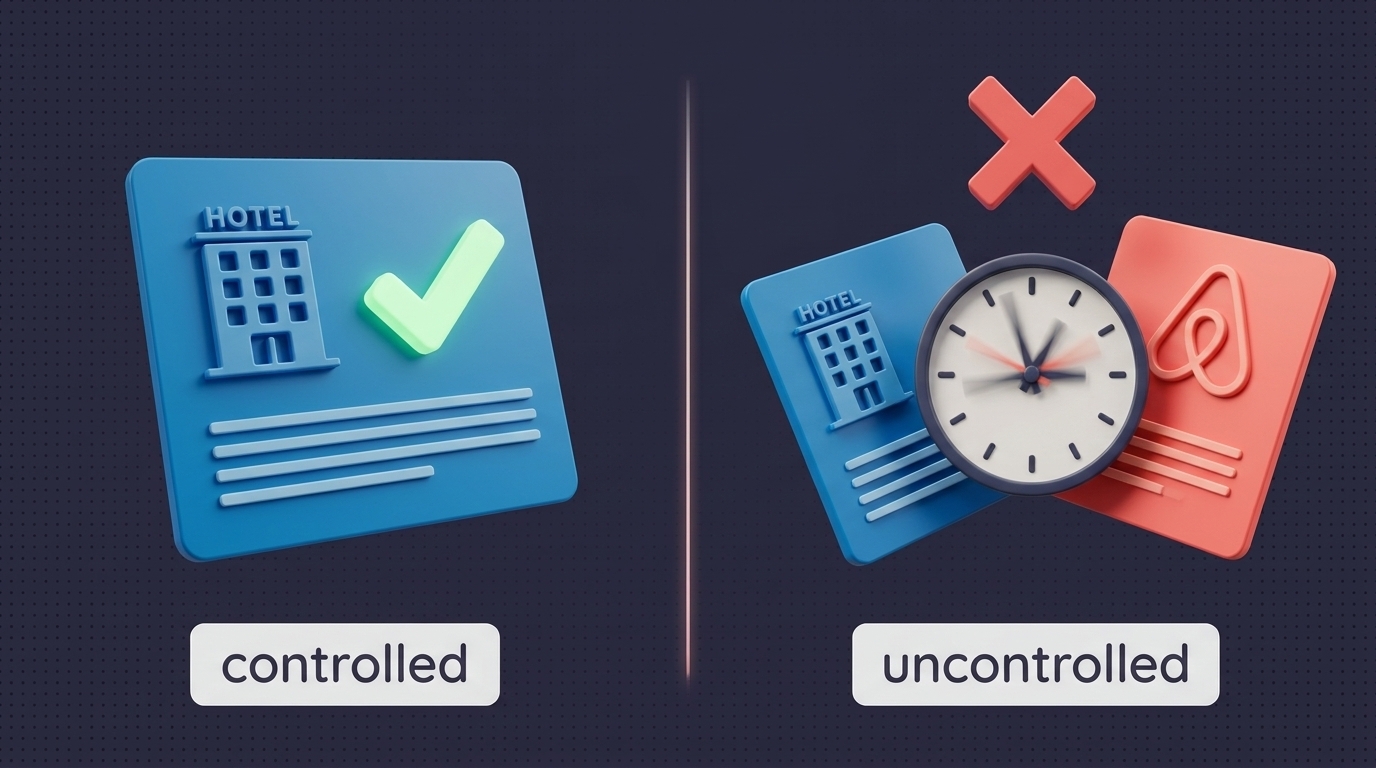
Hotel overbooking used to be a controlled discipline. Revenue managers oversold rooms deliberately, forecast no-shows, and kept a walk procedure ready for the rare night the math missed. Then hotels started listing rooms on Airbnb and VRBO, and a second kind of overbooking appeared: the accidental double booking caused by calendars that don’t talk to each other fast enough. Both get called overbooking, but they behave so differently that the playbook for managing deliberate overselling does nothing to prevent a sync failure.
This guide covers both: why hotel overbooking risk changes the moment your inventory goes live on short-term rental channels, what a double booking actually costs you on each platform, and the prevention architecture that lets hotels run STR distribution without ever walking an Airbnb guest.
Key takeaway: Traditional hotel overbooking is an intentional revenue-management practice built for a closed distribution system. STR channels break that assumption: Airbnb confirms bookings instantly, its iCal calendars refresh only every 3 hours, and a host-side cancellation costs you 10% to 50% of the reservation plus calendar blocks and status penalties. Closing that gap means connecting your PMS or CRS to Airbnb and VRBO through a real-time channel manager; relying on iCal or manual updates leaves an uncontrolled risk on every room you list.
Intentional overbooking vs accidental double bookings: they are not the same problem
| Intentional overbooking | STR-channel double booking | |
|---|---|---|
| What it is | Deliberately selling more rooms than capacity to offset no-shows and cancellations | Two confirmed guests holding the same room because calendars fell out of sync |
| Who controls it | Your revenue team, by forecast | Nobody; it happens in the lag between systems |
| The fix when it goes wrong | Walk the guest per your procedure, often to a partner hotel | Cancel one confirmed booking and absorb the platform’s host-cancellation penalties |
| Where it’s appropriate | Closed distribution you fully control | Nowhere; it must be engineered out |
The distinction matters because the ranking advice on this topic addresses the first column. Overbooking as strategy is a legitimate, taught discipline: Cornell’s hotel school teaches it as protection against no-show revenue loss, and a 2025 study in the International Journal of Hospitality Management found that “overbooking hotels appear to outperform those that don’t” (Schwartz, Webb, Altin, and Riasi, 2025). None of that research contemplated a confirmed Airbnb reservation, which cannot be rejected, walked through a front-desk procedure, or quietly absorbed.
Why hotel overbooking gets worse when you add STR channels
Yield-based overselling assumes one thing above all: when a guest books, your system knows immediately, everywhere. Your CRS holds the single picture of availability, and every channel reads from it.
STR channels break that assumption in three specific ways:
Bookings confirm instantly and bind you. On Airbnb, an Instant Book reservation is confirmed the moment the guest taps. There is no acceptance window in which your team can check the real availability picture. Booking.com states the same mechanic plainly: “when a guest books a stay on our platform, it’s confirmed instantly, and you won’t be able to reject the reservation.”
The sync methods most hotels start with are slow. Airbnb’s own documentation states that an iCal-connected calendar “automatically updates every 3 hours” (Airbnb Help Center). On a high-demand date, three hours is more than enough time for the same night to sell twice. A Saturday night that sells on Booking.com at 2:05 PM is still showing available on an iCal-synced Airbnb listing until the next refresh cycle, and any guest who books it in that window creates a hotel double booking neither side caused. Airbnb’s import logic carries a second subtlety: nights booked on another connected calendar block automatically, but nights you block manually “may or may not be blocked on Airbnb,” depending on the other platform’s settings.
Manual allocation is the biggest failure point. Many hotels pilot STR distribution by blocking a handful of rooms in the PMS and managing the Airbnb calendar by hand. Every manual step is a place where a busy front office, a shift change, or a missed email turns into two guests with one room. This risk is common enough that Booking.com tells its partners that “25% of our partners will get a double-booking during their first year on our platform”, and lists unsynced availability across channels first among the most common causes.
What a double booking actually costs a hotel on Airbnb and VRBO
A double booking that forces a host-side cancellation costs a hotel 10% to 50% of the reservation amount on Airbnb and up to 100% on VRBO, plus calendar blocks and status penalties, and both major platforms explicitly name double booking as a host-responsible cancellation. That penalty regime is where STR channels differ most sharply from the walk procedure: when a hotel oversells through traditional channels it controls the recovery, relocating the guest and covering the night, but when it cancels a confirmed STR reservation the platform’s rules take over.
| Consequence | Airbnb (Host Cancellation Policy) | VRBO (Cancellation Policy) |
|---|---|---|
| Cancellation fee | 10% (30+ days out), 25% (48 hrs to 30 days), 50% (within 48 hrs or after check-in); $50 minimum | 10%, 25%, 50% on the same timing tiers, up to 100% at or after check-in; $50 minimum, “no maximum fee” |
| Payout | No payout for the canceled reservation; already-paid amounts withheld from future payouts | Fee charged against the host |
| Calendar | Airbnb “may apply” blocks on the affected dates | Calendar blocks specifically for double-booking cancellations |
| Listing | Possible listing or account suspension or removal for cancellations without a valid reason | Seven-day listing suspension unless a waiver is approved |
| Status | Superhost requires a cancellation rate under 1% | Premier Host requires an owner-initiated cancellation rate of 0% |
| Visibility | Possible account consequences | “Host cancellations can negatively impact a property’s search result ranking” |
The VRBO Premier Host threshold is worth pausing on: it is zero, so one double booking that forces one cancellation makes the listing ineligible at the next quarterly assessment. Airbnb’s math is barely more forgiving. The Superhost cancellation rate is measured against reservations over the past 12 months, so a hotel listing that takes about 20 Airbnb reservations a month crosses the 1% threshold with just three canceled reservations, which is exactly what one double-booked weekend across a few rooms produces.
Booking.com adds its own wrinkle for hotels distributing there alongside STR channels: you remain responsible for relocating the guest to “accommodations of the same or a better standard” at your cost, and commission on the canceled reservation is waived only if you’re new to the platform or have had four or fewer double bookings in twelve months.
The costs are also asymmetric: a walked guest costs you one night at a partner property and some goodwill, while a canceled Airbnb reservation costs a percentage of the booking, blocked dates you can’t resell, status you can’t quickly rebuild, and ranking signal that compounds. Applying an oversell strategy to inventory that is also live on STR channels therefore guarantees penalties rather than protecting revenue.
How CRS and PMS systems actually sync with Airbnb
Hotel systems connect to Airbnb in one of two ways, iCal calendar links or an API connection through a channel manager, and that choice sets your double-booking exposure. The prevention question reduces to one technical decision: how does your system of record talk to the STR platforms?
iCal: the entry-level connection. iCal links export and import calendar files between platforms. They’re free, simple, and slow by design: Airbnb refreshes them every 3 hours, manual refreshes are rate-limited, and the feed carries availability only. No rates, no reservation details, no guest data. For a single owner with one cabin, that trade-off can be acceptable. For a hotel with room types, rate plans, and length-of-stay rules, iCal cannot even represent the inventory model, let alone sync it safely.
API connections: the professional standard. API-connected software holds a live, two-way line to the platform. Airbnb’s channel manager documentation describes the benefit in its own words: “accurate and real time pricing and availability” and “reduced pricing and availability discrepancies between various online channels.” It’s worth noting who Airbnb names among its preferred channel manager partners: SynXis, Aven Hospitality’s central reservation system, sits first on the list. The infrastructure for hotel-grade STR distribution already exists; many hotels simply haven’t connected it yet.
The hotel-specific gap. A generic STR channel manager syncs calendars between OTAs, which solves the host’s problem but not the hotel’s. Hotels need the sync to originate in the CRS or PMS, because that’s where the truth lives: room-type inventory, BAR and package rates, group blocks, out-of-order rooms. If your distribution partner can’t read SynXis, TravelClick, or your CRS directly and decrement availability the moment any channel sells, the lag still exists; it has just moved into a different system. We covered the SynXis-specific architecture in detail in our SynXis channel manager guide, including why a room type that sells on Airbnb must decrement in SynXis immediately rather than hours later.
How a channel manager prevents hotel double bookings
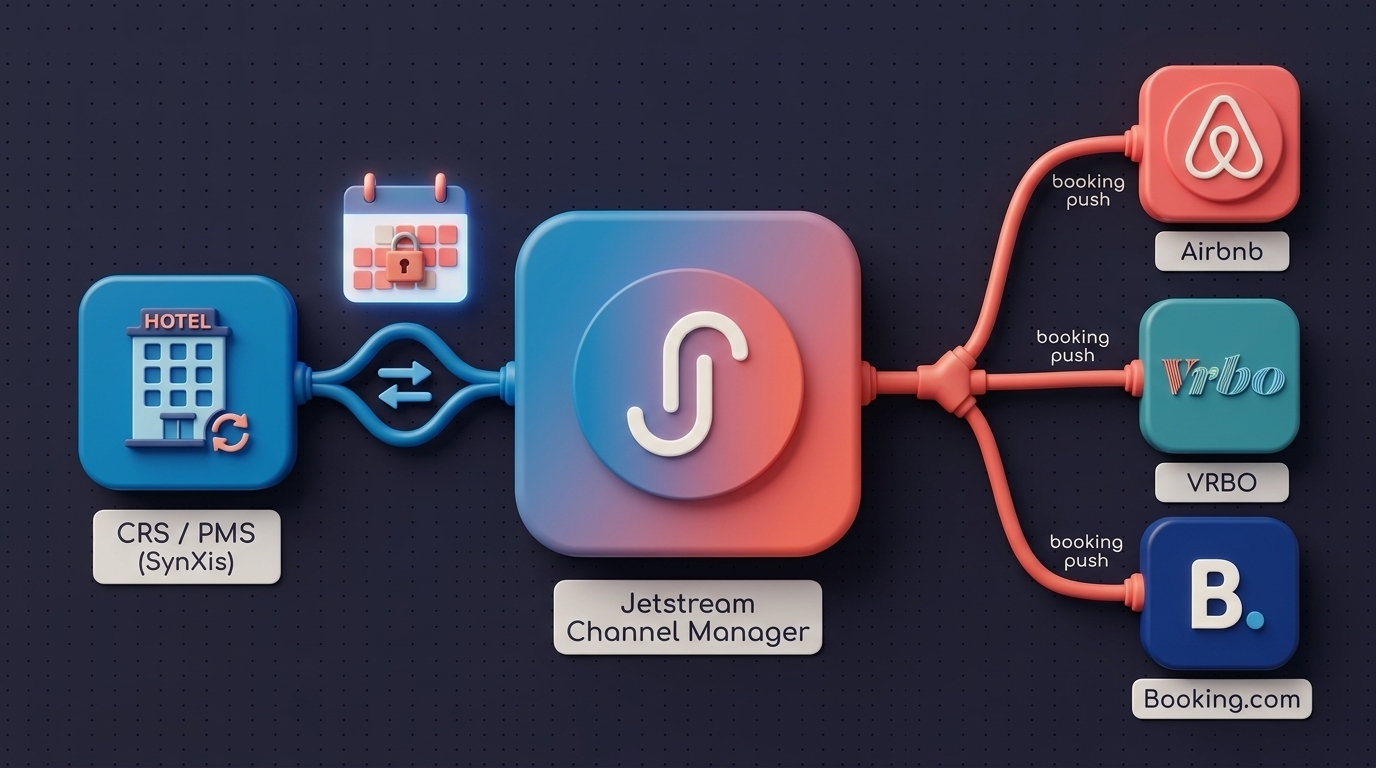
A channel manager purpose-built for hotel-to-STR distribution sits between your CRS/PMS and the STR platforms and does four jobs continuously:
- Reads availability from the system of record in real time. It reads live availability rather than a copy, and it reacts immediately rather than on a refresh cycle, so the channels update whenever the CRS does.
- Decrements everywhere on every sale. A booking on Airbnb pushes back into the CRS automatically and removes the same room-night from VRBO, Booking.com, and every other channel before the next guest can collide with it.
- Translates the hotel inventory model. Hotel rate plans and room types don’t map natively to STR listings. Jetstream’s approach, for example, translates complex hotel rate plans into OTA-compatible formats and uses JSM mapping to combine individual units behind a single room-type listing, so the listing stays live as long as any unit is available, without ever promising a specific unit twice.
- Removes the manual layer. No spreadsheet allocations, no front-desk calendar edits, no human in the sync loop. Your distribution strategy stays a revenue decision, while synchronization runs as infrastructure.
This is the architecture behind Jetstream’s platform: real-time, two-way connectivity with SynXis, TravelClick, D-Edge, IHG CRS, and other systems, with ARI sync and automatic booking push. Vail Resorts’ OTA team described the effect on their operation simply: “Real-time synchronization with SynXis makes all the difference. It eliminates errors and ensures everything is accurate across platforms” (Paige Whippo, Senior OTA Account Manager, Vail Resorts, from our work with Vail Resorts).