Yes, you can list a bed and breakfast on Airbnb. Airbnb explicitly supports “Bed & breakfast” as a property type, right alongside boutique hotels, heritage hotels, and resorts (Airbnb Help Center). For a small B&B that already lives or dies by occupancy, Airbnb is one of the largest pools of ready-to-book demand you can plug into.
The real questions are not whether you are allowed on the platform, but whether your property qualifies, how the economics work, and how you add Airbnb (and Vrbo) without creating a double-booking mess across the channels you already sell on. This guide walks through all three.
If you run a larger property or a portfolio, the mechanics are similar; our guide to listing a hotel on Airbnb goes deeper on the multi-room side, and our pillar guide to Airbnb for hotels covers how hospitality businesses use the platform end to end.
Key takeaway: Airbnb lists “Bed & breakfast” as a supported property type, so a characterful small B&B qualifies easily; Vrbo is stricter and fits only self-contained units with private entrances. Getting listed is the easy part. The work that actually matters is keeping one calendar in sync across Airbnb, Vrbo, your own website, and any OTAs so the same room never sells twice, then pricing each channel so it nets what you need after fees.
Can You List a Bed and Breakfast on Airbnb?
Airbnb opened its platform to hotels and professional hospitality businesses in 2018, and bed and breakfasts have been welcome ever since (SiteMinder). The platform groups B&Bs in the same “hotels and professional hospitality businesses” category as boutique hotels, aparthotels, pensions, and pousadas (Airbnb Help Center).
The main bar to clear is character. Airbnb’s standard is that listed properties “should have a unique, independent environment and style,” with high-quality photos of rooms and common areas, detailed listings, and transparent fees (Airbnb Help Center). That favors exactly the kind of property a B&B already is: independent, characterful, and personal. It works against generic, mass-market chains.
On fees, Airbnb offers hospitality businesses two models: a split fee, where the host pays a smaller percentage and the guest pays a service fee at checkout, or a host-only fee, where the host absorbs the full commission and the guest sees no separate Airbnb charge (SiteMinder). Which model fits depends on how you price against your other channels. Confirm the current percentages directly with Airbnb before you set rates, since platform fees change.
Bed and Breakfast on Airbnb vs. Vrbo: What Qualifies
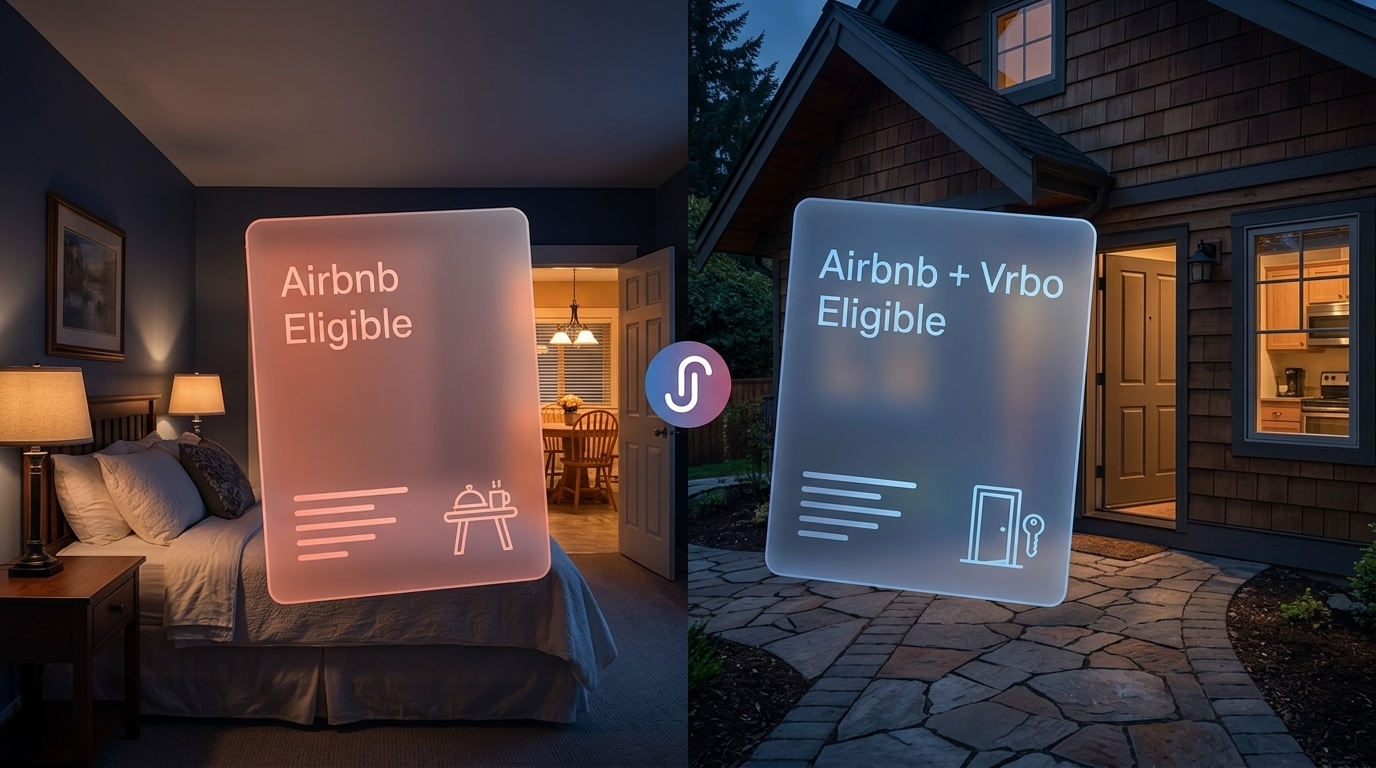
Airbnb and Vrbo reward different property layouts, and the difference decides how much of the STR market a B&B can reach.
Airbnb is the more natural fit. It accepts shared-style hospitality properties, so a classic B&B where guests have private rooms but share a breakfast room or a common lounge is squarely eligible.
Vrbo is stricter. It is built around whole-home stays, where “guests must have exclusive access to all key amenities including kitchens, bathrooms, living areas, and bedrooms,” and self-contained units with private entrances are a core requirement (Hostaway). A traditional B&B with a shared breakfast room would not meet that bar.
That said, plenty of B&Bs have inventory that does qualify for Vrbo: a separate cottage, a converted carriage house, or a suite with its own private entrance and kitchenette. If part of your property is self-contained, you can list those units on Vrbo while listing your standard rooms on Airbnb, and reach both audiences at once. Our boutique hotels on Airbnb guide covers how smaller properties think through this mix.
| Inventory type |
Airbnb |
Vrbo |
| Private guest room with a shared breakfast room or lounge |
Eligible |
Not eligible |
| Self-contained cottage or carriage house with a private entrance |
Eligible |
Eligible |
| Suite with a private entrance and kitchenette |
Eligible |
Eligible |
| Whole unit with exclusive access to kitchen, bathroom, living area, and bedroom |
Eligible |
Eligible |
How to List Your Bed and Breakfast on Airbnb: A Setup Checklist
If you have never distributed beyond your own website and one or two OTAs, here is a practical sequence.
1. Confirm what qualifies where. Map your rooms. Standard rooms with shared common areas go to Airbnb. Self-contained units with private entrances can also go to Vrbo. This tells you how much of your inventory each platform can carry.
2. Get your content ready before you list. Airbnb expects high-quality photos of both rooms and common areas, plus detailed, accurate descriptions and fee transparency (Airbnb Help Center). Strong photography is the single biggest lever on conversion. Our guide to listing boutique rooms on Airbnb covers what good looks like.
3. Decide how you will keep availability in sync. Before you connect a single channel, decide how every channel will share one calendar. This is the decision that prevents double bookings, and it is the one most first-time hosts underestimate.
4. Connect one channel at a time. Do not switch on five platforms in a weekend. Start with Airbnb, confirm the sync works against your existing bookings, then add Vrbo or other channels one at a time.
5. Set channel-specific rates. Build your rates so each channel nets you what you need after its fees, rather than publishing one flat rate everywhere.
6. Monitor the first two weeks closely. Sync delays, rate mismatches, and near-miss double bookings almost always surface in the first 14 days. Watch them, fix them, then let the system run.
Do It Yourself, or Bring in a Distribution Partner?
There are two honest paths onto Airbnb and Vrbo for a small B&B.
The first is to do it yourself. You list directly, buy a channel manager to keep your calendar in sync, learn each platform’s rules, and handle guest messaging and reviews on your own time. For an owner who enjoys the operational side and has the hours, this works.
The second is to bring in a partner who does the distribution for you. This is where Jetstream fits. We take your property and put it on Airbnb and Vrbo, connect it to the systems you already run, keep availability and rates synchronized so double bookings do not happen, optimize your listings, and handle guest services 24/7/365 by phone, email, text, and messaging. You keep running your B&B; we run the distribution.
Neither path is wrong. The question is whether you want to spend your hours learning channel management software or spend them on your guests. If it is the latter, see how Jetstream handles distribution for hotels and small properties.
Listing a bed and breakfast on Airbnb has become one of the most direct ways a small property can fill rooms it would otherwise leave empty. The properties that do well are the ones that list with intent, keep their calendars clean, and treat every guest like the reason they got into hospitality in the first place.
Frequently Asked Questions
Can you list a bed and breakfast on Airbnb?+
Yes. Airbnb supports “Bed & breakfast” as a property type and has welcomed hotels and professional hospitality businesses since 2018. The main standard to meet is character: Airbnb expects listed properties to have a unique, independent environment and style, with high-quality photos and accurate, transparent listings. That suits an independent, characterful B&B well.
Does a bed and breakfast qualify for Vrbo?+
Only partly, in most cases. Vrbo is built around whole-home stays where guests have exclusive access to all key amenities, including the kitchen, bathroom, living area, and bedrooms. A traditional B&B with shared common areas does not meet that bar, but self-contained units, such as a separate cottage or a suite with a private entrance, do qualify. Many B&Bs list their standard rooms on Airbnb and their self-contained units on Vrbo.
How much does Airbnb charge a bed and breakfast?+
Airbnb offers hospitality businesses two fee models: a split fee, where the host pays a smaller percentage and the guest pays a service fee at checkout, and a host-only fee, where the host absorbs the full commission and the guest sees no separate charge. The right model depends on how you price against your other channels. Because platform fees change, confirm the current percentages directly with Airbnb before you set your rates.
Can you list a B&B on both Airbnb and Vrbo at the same time?+
Yes, and for many B&Bs it is the better strategy. Map your inventory first: standard rooms with shared spaces go to Airbnb, while self-contained units can go to both Airbnb and Vrbo. The one requirement is a single synchronized calendar across every channel, so a booking on one platform immediately updates the others.
How do you prevent double bookings when a B&B sells on Airbnb and other channels?+
Keep one source of truth for availability. When a room sells on Airbnb, Vrbo, your own website, or by phone, every other channel needs to update within seconds rather than on a manual upload. A channel manager, or a distribution partner that runs one for you, keeps the calendar synchronized so the same night is never sold twice.