9 min read
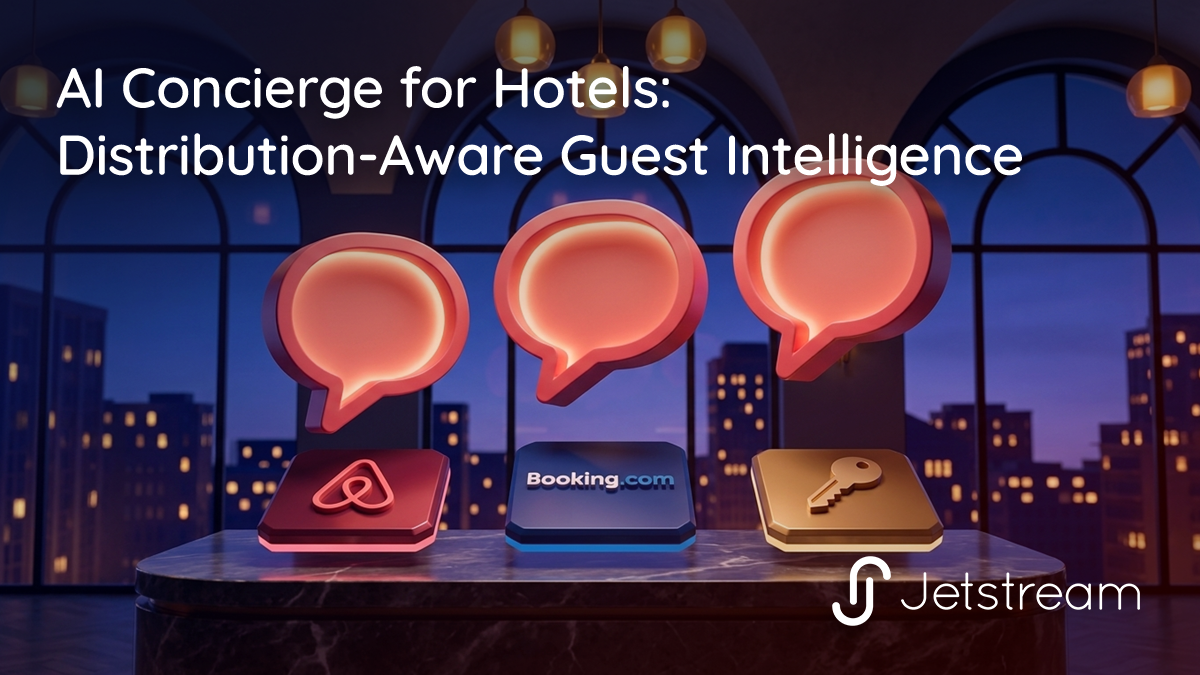
AI Concierge for Hotels: Distribution-Aware Guest Intelligence
Jetstream
Jun 8, 2026 8:38:21 AM
An AI concierge for hotels does something that scripted chatbots never could: it interprets guest intent, acts on live property data, and holds a conversation that adapts in real time. The technology has matured rapidly. 78% of hotel chains now deploy AI systems of some kind, and 65% of global travel leaders identify chatbots and virtual assistants as the most impactful generative AI application in hospitality.
The vendor landscape is crowded. Viqal, chatlyn, HiJiffy, Canary Technologies, Myma.ai, Runnr.ai, and Duve all offer AI-powered guest communication platforms with varying degrees of sophistication. Each connects to your PMS, reads reservation data, and automates a meaningful share of guest inquiries.
Most of these platforms are primarily PMS-centric. While many integrate with PMSs, CRMs, booking engines, and messaging channels, distribution and channel-management data is typically not a first-class source of intelligence within the guest conversation. While many platforms can identify reservation source information through PMS or booking-system integrations, distribution intelligence rarely becomes an active part of the guest conversation. Booking channel, acquisition cost, channel profitability, and broader distribution performance metrics generally remain outside the decision-making context used by today's AI concierges. That gap is what this guide explores, and distribution-aware guest intelligence is where the technology needs to go next.
What Is an AI Concierge (And What It Is Not)
The term "AI concierge" gets used loosely enough that it helps to define what it actually means in a hotel context. A traditional chatbot runs on decision trees: if the guest types "pool hours," the bot returns a canned response. An AI concierge uses natural language processing and large language models to understand what a guest is asking, pull relevant data from connected systems, and generate contextual responses.
The practical difference is measurable: where a chatbot deflects tickets, an AI concierge resolves them. Viqal reports 85% of guest inquiries auto-resolved across its fleet of 140+ properties. HiJiffy's deployment at Leonardo Hotels automated 93% of 281,000 queries. The InterContinental Vienna handles 70%+ of guest inquiries automatically through chatlyn's platform.
These systems do more than answer questions. They extend reservations, calculate pricing adjustments, post charges to guest folios, trigger housekeeping requests, and process upsell offers within the conversation thread. Viqal's platform takes direct PMS actions: extending stays, quoting rates, and updating reservation records without requiring a staff member to intervene.
The evolution from chatbot to AI concierge happened fast. As recently as 2023, most hotel messaging tools were rule-based FAQ deflectors. The jump to LLM-powered systems that can understand context, maintain multi-turn conversations, and take actions inside operational systems represents a fundamentally different capability.
What Modern AI Concierges Actually Do
A hotel AI concierge covers three phases of the guest journey, and the best platforms now span all three with a single thread of context.
Pre-arrival is where the commercial value starts. The AI sends booking confirmations, offers room upgrades and amenity packages, provides check-in instructions, and fields questions about the property. WhatsApp has become the dominant channel for pre-arrival messaging, with platform-level open rates around 98% compared to roughly 20-25% for email. Viqal reports EUR 60 per room per month in incremental upsell revenue (portfolio median) from proactive in-thread offers. At a 100-room property, that translates to EUR 6,000 monthly in revenue that would not have been captured otherwise.
In-stay is where operational efficiency compounds. Guests request room service, ask for local restaurant recommendations, report maintenance issues, and make housekeeping requests, all through the same messaging thread. HiJiffy's deployment at AutoCamp generated over $1.6 million while saving 15% in operational costs. Runnr.ai reports automating up to 95% of guest interactions, with individual hotel deployments reaching over 90% automation within months of launch.
Post-stay closes the feedback loop. The AI solicits reviews, sends rebooking offers, and maintains the relationship through the channel the guest already uses. This matters because hotels have historically missed between 20% and 40% of incoming calls, a problem AI messaging sidesteps entirely by meeting guests in asynchronous channels.
Multilingual coverage is a significant operational consideration given 1.4 billion international tourist arrivals in 2024 (99% of pre-pandemic levels, per the UNWTO). Vendor capabilities vary widely: Viqal claims 200+ languages, Myma.ai supports 100+, chatlyn covers 35+. The quality and cultural accuracy of these translations, not just the language count, matters for guest satisfaction.
Channel coverage now extends across WhatsApp, SMS, webchat, email, and OTA platform messaging (Booking.com messenger, Airbnb messaging). Properties listing on STR platforms face platform-specific response requirements: Airbnb requires 90% of messages answered within 24 hours for Superhost status, with sub-hour response times delivering better search rankings. Vrbo's Premier Host criteria include quick-response metrics with average response times under 2 hours helping for top ranking positions. An AI concierge that covers these channels eliminates the response-time risk that costs visibility on STR platforms.
The Missing Layer: Why Most AI Concierges Operate on Incomplete Data
Every major AI concierge vendor integrates with property management systems. That integration gives the AI access to reservation dates, room type, guest name, contact information, and past stay history. For a concierge focused purely on answering in-stay questions, this is adequate.
For any concierge trying to personalize the guest experience or optimize commercial outcomes, PMS data alone is insufficient.
Here is what PMS data does not contain: where the guest booked, how much it cost to acquire them, which channel performs best for their guest segment, and what the margin looks like on their reservation after distribution costs. A guest who booked directly through your website at full rate and a guest who arrived through an OTA at a 20-25% commission look identical to a PMS-connected AI concierge. So does a first-time Airbnb traveler who found your hotel listed on a short-term rental platform.
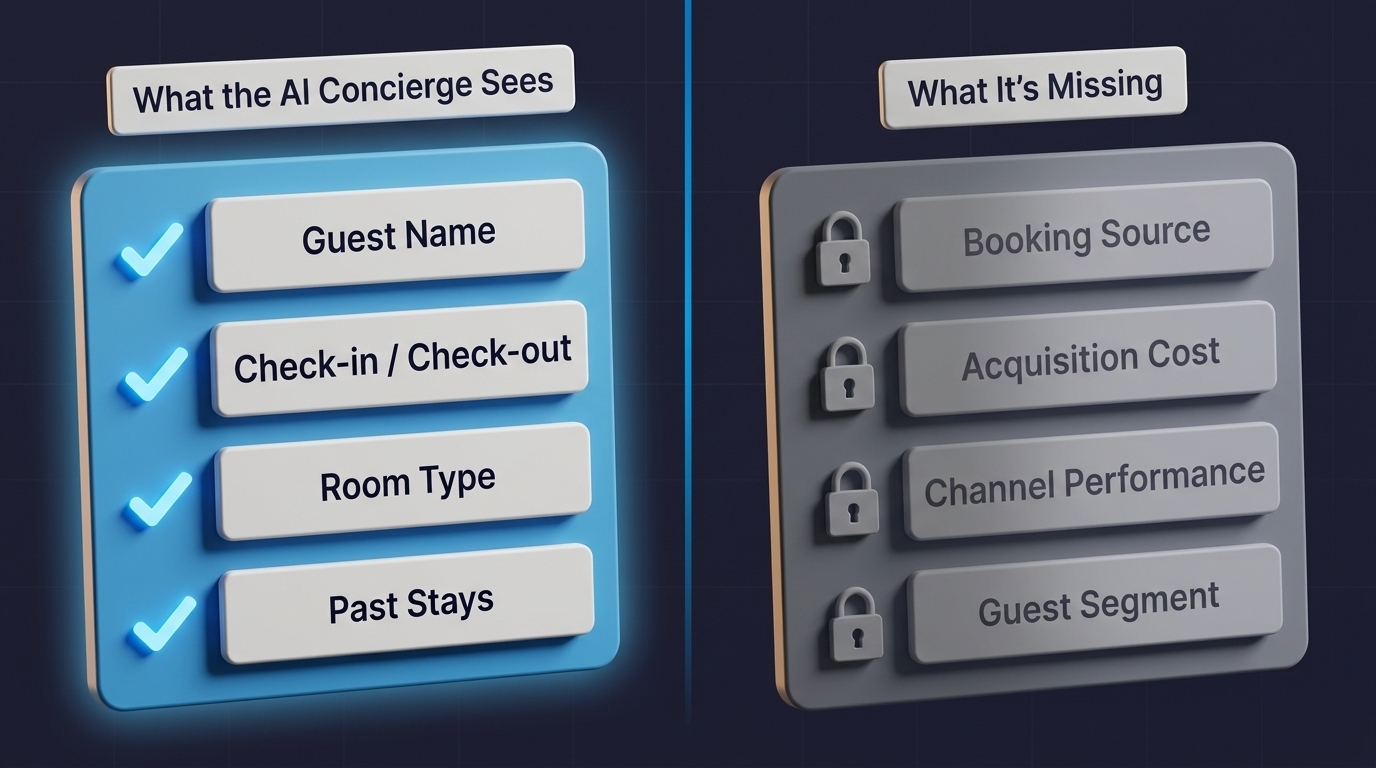
This pattern holds across the major vendor landscape. The leading AI concierge platforms, including Viqal, chatlyn, Canary Technologies, HiJiffy, Myma.ai, Runnr.ai, and Duve (which raised $60 million in Series B funding in December 2025 and manages over 1 million guest journeys per month), all integrate deeply with PMS systems. Many add CRM, booking engine, or POS integrations. Distribution and channel management data, however, is not typically surfaced as active context in the guest conversation.
The BCG/NYU "AI-First Hotels" report identifies this system fragmentation directly: "Nearly half of hoteliers report struggling to access critical information, and four in five spend up to two full workdays stitching together reports just to see a complete picture of their business." The report calls for "a central hub, a customer data platform with cleaned, deduplicated records" that replaces today's maze of disconnected interfaces.
The AI concierge is arguably the system most affected by this fragmentation. It is the one talking to your guests in real time, making upsell recommendations, and shaping the guest's perception of your property. When it operates on a partial view of the guest relationship, every interaction carries less commercial intelligence than it should.
Distribution-Aware Guest Intelligence: The Next Evolution
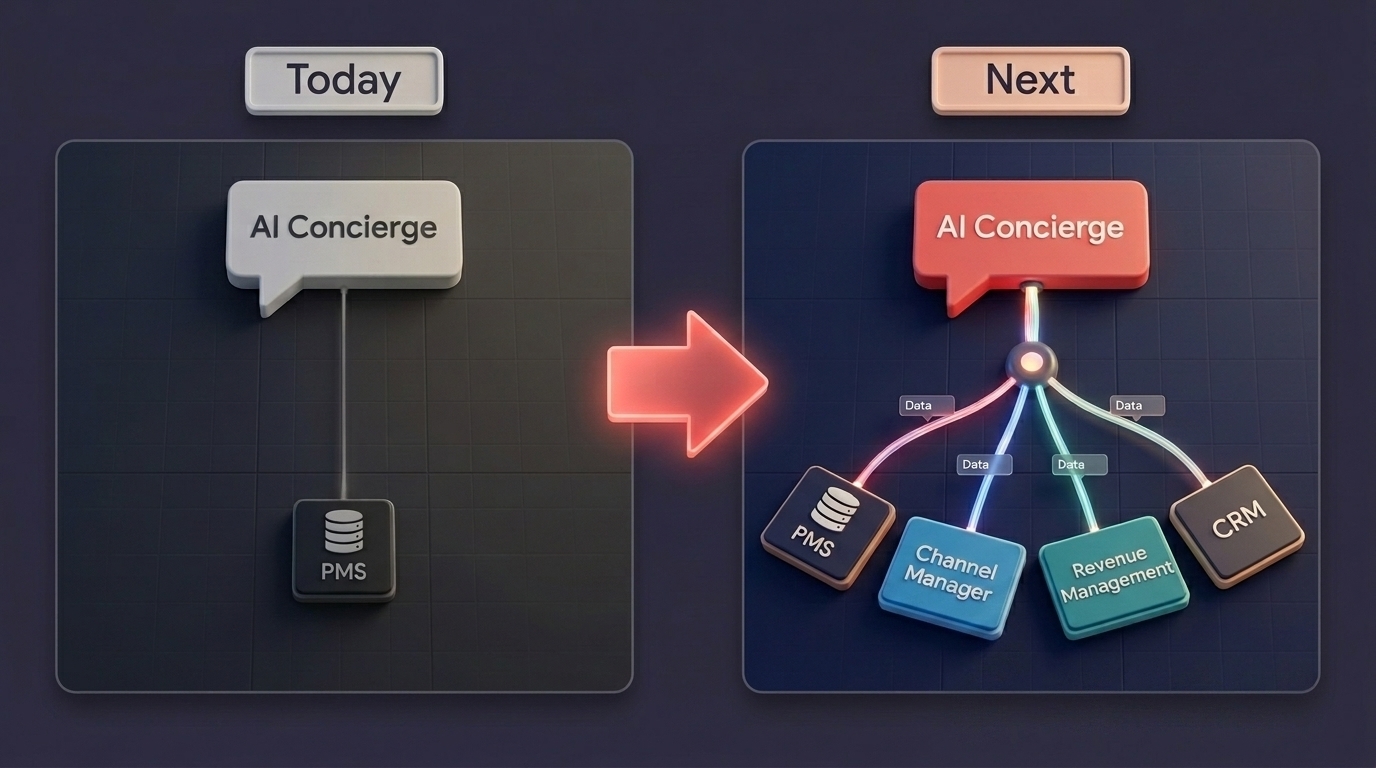
Consider what changes when an AI concierge has access to the distribution layer alongside the PMS.
Booking-source personalization becomes possible. A direct-booking repeat guest receives a welcome message that acknowledges their loyalty and offers an upgrade path designed to reinforce the direct booking habit. A first-time guest who arrived through an OTA channel manager receives a welcome that introduces the property, highlights amenities they may not have seen in the OTA listing, and subtly presents the value of booking direct next time. A guest who booked through Airbnb gets communication tailored to the STR experience expectations they likely have (flexible check-in, self-service orientation, local recommendations), different from what a business traveler expects from a traditional hotel booking on Booking.com.
Revenue context sharpens upsell logic. When the concierge knows the acquisition cost on a reservation, it can calibrate offers accordingly. A direct-booking guest with healthy margins might receive a premium spa package offer. An OTA guest where the margin is already compressed might receive a dining credit designed to drive on-property spend rather than a room upgrade that further thins the margin. The economics of each upsell interaction become visible to the AI for the first time.
Channel performance feedback creates a closed loop. Guest interaction data, including what questions they ask, which upsells they accept, what complaints they raise, and how satisfied they are at checkout, flows back to inform hotel distribution strategy. If guests arriving through a specific channel consistently request late checkout, that insight shapes how the property prices and positions itself on that channel. If Airbnb guests generate higher ancillary spend than OTA guests, that data point informs channel mix decisions. The AI concierge becomes a distribution intelligence sensor, not just a guest communication tool.
This is the layer that AI is evolving across hotel operations: the convergence of guest-facing AI with the operational and commercial systems that drive hotel revenue. The concierge is the most natural convergence point because it already has the guest's attention.
Evaluating an AI Concierge for Hotels: What to Look For
The hotel AI concierge market is maturing quickly. Duve has raised $85 million total. Chatlyn closed an $8.6 million Series A and serves 1,000+ properties across 30 countries. HiJiffy counts 2,600+ hotels worldwide. The market research firms are equally bullish: the global AI in hospitality and tourism market is valued at $3.70 billion in 2025, projected to reach $46.67 billion by 2035 at a 28.9% CAGR.
With that level of investment and adoption, any hotel evaluating an AI virtual concierge hospitality solution should focus less on whether to implement one and more on what to look for.
Integration depth is the most important variable. A PMS-only integration gives you automated guest messaging. A full-stack integration (PMS + channel manager + CRM + revenue management) gives you distribution-aware guest intelligence. Ask vendors specifically: does your platform know where each guest booked, and can it use that information to personalize the interaction? As of mid-2026, the honest answer from every vendor reviewed is no.
Language support and cultural accuracy matter more than vendor-claimed language counts. Supporting 200 languages through machine translation is technically straightforward. Producing culturally appropriate responses that account for regional communication norms, formality expectations, and colloquial usage is harder. Ask for sample conversations in languages your property actually serves, not just the count.
Human escalation logic is what separates a good AI concierge hotel deployment from a frustrating one. The AI should know when it has reached its limits and hand off to a staff member with full conversation context intact. Only 2% of travelers currently allow autonomous AI booking, and 25-32% express interest, which means the human escalation path is still a critical part of the guest experience.
ROI measurement should be specific to your property. Implementation data from a 12-location hotel chain showed $31,000 per location annually in savings, with 50+ calls handled daily per location and a 6.7% transfer rate to human staff. Viqal reports 118 hours per month saved at a 100-room property. These numbers are useful benchmarks, but your results will depend on your property's call volume, staffing model, guest profile mix, and which channels you operate on.
Data ownership is an underexamined question. Guest interaction data, including every question asked, every upsell accepted or declined, every complaint raised, is commercially valuable intelligence. Clarify whether your property owns that data, whether you can export it, and whether it can feed your broader analytics and distribution decisions. If the AI concierge is a black box that processes guest conversations but returns nothing actionable to your commercial strategy, you are leaving value on the table.

Where AI Concierge Technology Is Heading
The current generation of AI concierges operates reactively: the guest asks, the AI answers. The next generation will operate proactively, initiating contextually appropriate interactions based on guest behavior, property data, and commercial signals.
The agent evolution is already visible. Canary Technologies launched AI Agent Studio, combining AI Voice (24/7 phone handling), AI Guest Messaging, and AI Webchat into a unified system. Marriott's AI processes 1.2 million room assignments across its chain in seconds. The progression from answering questions to taking autonomous operational actions is underway.
Interoperability standards are evolving alongside the agents. The Model Context Protocol (MCP) is enabling AI systems to communicate with hotel technology stacks through standardized interfaces rather than custom integrations. Hospitality Upgrade noted the Apaleo MCP server launch as significant precisely because "for decades, hotel technology stacks have remained fragmented, with each new system requiring expensive custom integration work." MCP changes the integration economics: instead of building a bespoke connector for every PMS, channel manager, and revenue system, an AI concierge can speak a common protocol that works across the stack.
The convergence that matters most for hotel operators is the one between guest-facing AI, distribution intelligence, and revenue management. Today these are separate systems with separate data stores and no shared context. The AI concierge does not know your channel economics, your channel manager does not know what guests are saying, and revenue management has no visibility into which guest segments generate the highest ancillary spend.
When these systems share context, the AI concierge becomes something more: a distribution-aware intelligence layer that personalizes guest interactions based on the full commercial picture, feeds guest behavior data back into channel strategy, and closes the loop between how a guest was acquired and how much value they generated across their stay.
The AI skills gap in hospitality (only 2.9% of full-time employees in travel and tourism possess AI skills, compared to 21% in tech and media) means most hotels will depend on their technology partners to build this convergence. The vendors that get there first will define the next era of hotel guest intelligence.
Bringing It Together
The AI concierge market has grown from a curiosity to a core operational tool in under three years. The vendors are well-funded, the adoption rates are climbing, and the ROI data from early implementers is strong enough to justify evaluation at virtually any property size.
The gap worth paying attention to is not in the technology itself. Every major platform handles multilingual guest messaging, automates the majority of routine inquiries, and integrates with PMS systems competently. The gap is in the data these systems can access. An AI concierge that knows everything about a guest's reservation but nothing about how they were acquired, what that acquisition cost, or how their booking channel performs is making every interaction less intelligent than it could be.
Distribution-aware guest intelligence, where the concierge connects to the channel management layer alongside the PMS, is the evolution that turns a communication tool into a commercial strategy asset. Any hotel evaluating an AI concierge for hotels today should ask the distribution question directly: does this platform know where my guests come from, and can it use that knowledge? The answer will separate the current generation from the next one.
Hotels that connect their AI concierge to distribution data can personalize every guest interaction based on booking source, acquisition cost, and channel performance. If you are evaluating how to bring that distribution intelligence into your guest communication stack, Jetstream works with hotels and resorts building exactly that layer.
Posts by Tag
- Channel Distribution (75)
- Marketing (71)
- Hotel Trends & Advice (59)
- Technology (53)
- Real Estate (27)
- Blog (6)
- Case Study (5)
- Passive Income Ideas for REALTORS® (5)
- Boutique Hotel Owners (4)
- Property investors (4)
- Airbnb (1)
- Blog (1)
- Hotel and resort operators (1)
- Property Management (1)
- Real Estate Brokers (1)
- Revenue Management (1)
- Short term rentals (1)
- Tools and Technology (1)
- Travel (1)
- Vacation Rental Platforms (1)
- featured talks (1)
Related Posts