8 min read

AI Search Optimization for Hotels and STR Listings

How AI search optimization changes hotel discovery from ranked links to curated AI recommendations.

AI Search Optimization for Hotels and STR Listings

When a traveler asks ChatGPT to recommend a boutique hotel in Asheville, the model skips the ten blue links and names three to five specific properties directly. Your hotel needs to be on that shortlist, because travelers who use AI search rarely look further. This new reality, where AI search optimization determines which hotels get recommended, is reshaping how properties are discovered, evaluated, and booked.

The shift is already measurable. ChatGPT now serves over 800 million weekly users processing roughly 2.5 billion prompts per day, and Google AI Overviews appear on 25.11% of Google searches, up from 13.14% in March 2025. Nearly four in ten U.S. travelers have used generative AI tools to research travel in the last twelve months, an eleven-point increase year over year, according to Phocuswright. By 2026, that number has climbed to 56% of travelers reporting AI use for travel planning.

These travelers skew younger, earn higher household incomes, and take more trips, including international travel. They are exactly the segment hotel operators want to reach.

For operators who have spent years refining their SEO strategy, the rules are changing. AI is evolving how hotels reach their guests, and understanding what drives AI recommendations is no longer optional.

How AI Search Is Changing Hotel Discovery

Traditional search operates on a ranking model. A traveler types a query, Google returns a list of pages sorted by relevance signals, and the traveler clicks through several options before making a decision. The hotel's goal under this model is straightforward: rank on page one.

AI search works differently. When a traveler asks Perplexity for the best hotels near Yellowstone with a hot tub under $200, the AI synthesizes information from dozens of sources, evaluates the consensus, and delivers a curated answer. As Nokumo's 450-query study across four AI models documented, AI search is binary: a property is either recommended or invisible.

The implications run deeper than just visibility. Kayak launched a fully chat-based agentic booking experience in October 2025. Booking.com integrated directly into ChatGPT's App Directory in early 2026, meaning travelers can now complete a hotel reservation inside the chat without ever loading a search results page. In March 2026, Lighthouse launched the first direct booking app for hotels inside ChatGPT, with brand-verified content, live rates, and one-click direct booking links.

These are live products handling real bookings, and the distance between "traveler asks a question" and "booking is confirmed" is collapsing into a single conversational interface.

What LLM Visibility Means for Hotel Distribution
AFH-2-Inline2-C3

Understanding how large language models select which properties to recommend requires thinking about the problem from the model's perspective. LLMs are trained on publicly available content: your website, your listing descriptions, your reviews, your schema markup, your presence across OTA platforms and directories. The quality, specificity, and structure of that content directly affects whether a model will cite your property.

Nokumo's research quantified the factors that differentiate AI-cited properties by effect size. The strongest signals were URL quality (d=0.60), trust signals (d=0.50), and content quality (d=0.36). Technical SEO, booking funnel quality, schema completeness, and content completeness followed in descending order. The takeaway, as Nokumo framed it: AI models favor properties that write clearly, build trust, and structure URLs well.

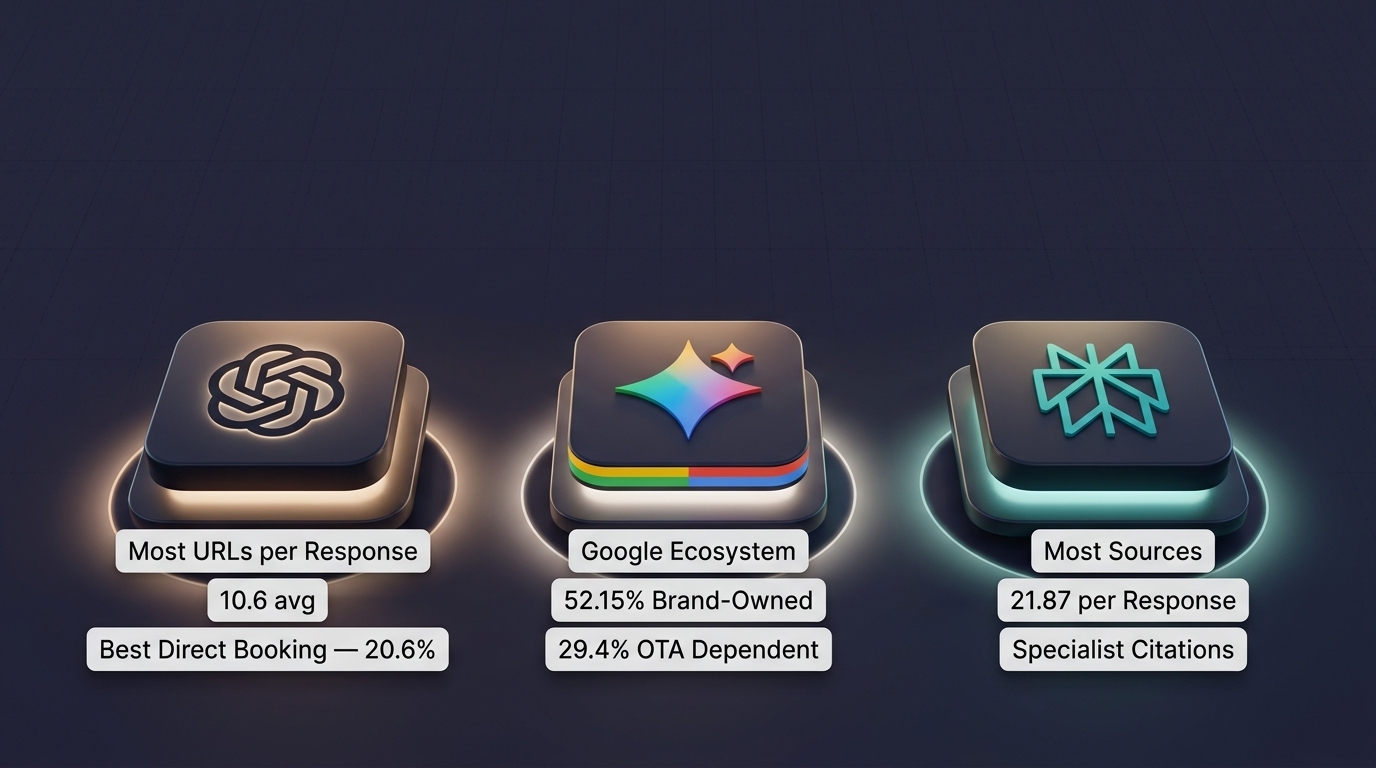
Each AI platform also behaves differently in how it cites sources. A Yext analysis of 6.8 million citations found that Gemini acts as a stricter version of Google, with 52.15% of its citations coming from brand-owned websites. ChatGPT rewards distribution breadth, pulling heavily from third-party directories and review aggregators. Perplexity rewards specialization, citing an average of 21.87 sources per response.

GPT-5 (ChatGPT) produces the longest responses at 439 words on average, cites the most URLs per response (10.6), and offers the best direct booking outcomes with a 20.6% direct booking score. Gemini, meanwhile, has the highest OTA dependency at 29.4%, which is especially significant because Gemini is integrated into Google Search and is the AI model most travelers encounter first.

One statistic frames the distribution challenge clearly: about 85% of brand mentions in AI search originate from third-party pages, not from the brand's own domain. Your website matters, but your presence across the broader web, in review platforms, OTA listings, directories, and industry coverage, matters more for AI visibility than it does for traditional SEO.

There is a structural advantage here for hotels operating across both traditional and STR distribution channels. Hotels with presence on Booking.com, Airbnb, Vrbo, Google Business Profile, and their own direct booking website are creating exactly the kind of multi-source consensus that AI models use to build confidence in a recommendation. Properties that exist on only one platform are at a disadvantage. Nokumo's data showed that Booking.com appeared in 95.3% of all 450 queries tested, accumulating 2,962 total citations and 14.5% of all URLs. For any property not on Booking.com, AI models have near-zero probability of citing them.

A sound hotel distribution strategy has always been about reaching guests where they search. AI search makes multi-channel presence a prerequisite for being recommended at all.

Structured Data and Schema Markup for Hotels
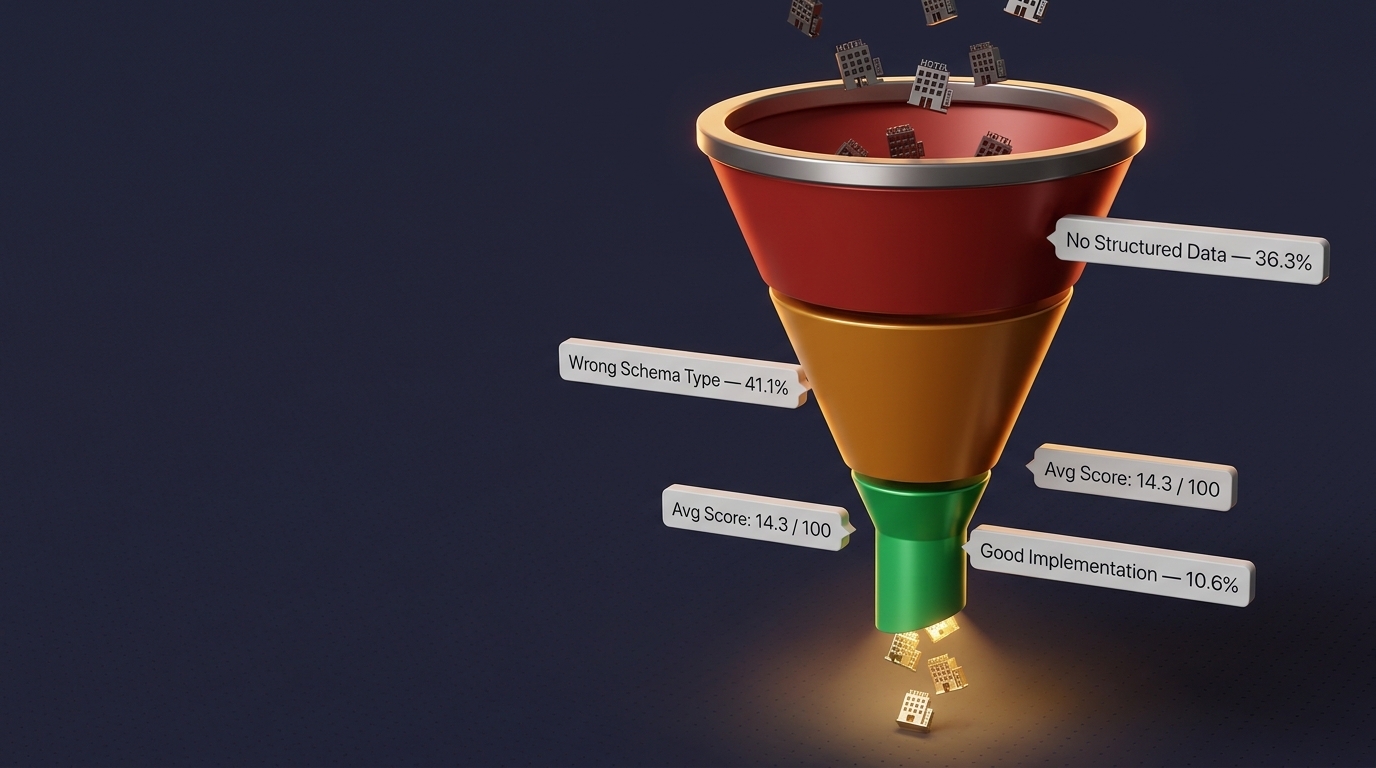
Funnel showing how few hotels have proper schema markup, with only 10.6% achieving good implementation out of 121,425 studied.

Schema markup is the machine-readable layer that tells search engines and AI systems what your website content actually means. For hotels, the relevant Schema.org types include Hotel (a specific subtype of LodgingBusiness), HotelRoom for each room category, FAQPage, Review, AggregateRating, and Offer. Google's own developer documentation specifies Hotel, LodgingBusiness, and HotelRoom schema as the validation layer for AI Overviews and Hotel Ads.

JSON-LD is the preferred format, easier to implement and maintain than alternatives because it does not require modifying your page's HTML structure. You add a script block to the page header, and the structured data lives independently from the visible content.

The problem is that almost nobody has done this well. Hotelrank.ai's 2026 study of 121,425 hotel homepages across seven countries found that 36.3% have no structured data at all. Among the 55.8% that have JSON-LD, 41.1% use the wrong schema type (Organization or LocalBusiness instead of Hotel). Only 10.6% of hotels have what Hotelrank considers a good implementation. The average schema score across all reachable properties is just 14.3 out of 100.

Critical fields are rarely implemented: aggregateRating sits at 12.5% adoption, amenityFeature at 7.7%, and geo coordinates at 18.8%. These are exactly the data points an AI system needs to answer a query about hotels near a specific location with certain amenities and strong reviews.

Scoring above 50 on Hotelrank's assessment puts a hotel in the top 10.6%. That is a remarkably low bar, and it represents a genuine competitive opportunity. When AI models need structured facts to answer complex queries about hotels with specific amenities in a specific price range, properties with complete schema markup are the ones that get included in the answer. Without these markers, the model may exclude your property to avoid providing inaccurate information.

For STR operators entering AI search optimization, the picture is even starker. Nokumo's audit of 1,337 accommodation properties found that 60.8% have no schema markup of any kind, and only 7% implement Hotel or LodgingBusiness schema. Hotels with even basic schema implementations are operating with a structural advantage that most of the competitive landscape has not yet addressed.




AI Search Optimization in Practice: Preparing Your Hotel

AI search optimization for hotels (sometimes called Generative Engine Optimization, or GEO) goes beyond schema markup. It encompasses every signal that AI models use to evaluate whether your property deserves a recommendation. The foundational GEO study by researchers at Princeton, Georgia Tech, the Allen Institute for AI, and IIT Delhi tested 10,000 queries across multiple generative engines and found that adding statistics was the single most effective optimization strategy, improving visibility by up to 40%. Pages ranked fifth in traditional search saw a 115% visibility increase in AI responses when they added proper citations and authoritative tone.

Here is what that means in practical terms for hotel operators:

Content quality and specificity. AI models interpret the meaning behind your descriptions rather than counting keyword repetitions. They look for consensus and structured facts to verify that your reviews back up your marketing claims. A listing description that says "beautiful hotel in a great location" gives an AI model nothing to work with. A description that specifies your distance from landmarks, names your amenities with detail, and describes what makes your property distinctive gives the model concrete facts it can match against traveler queries.

Content placement matters. Beyond Booking's analysis found that 44.2% of all LLM citations come from the first 30% of a page's text. The most important information about your property, including distinctive amenities, location context, guest experience differentiators, should appear early on your website and listing pages.

Cross-platform consistency. Your Airbnb listing, your website, your Google Business Profile, and your Booking.com page should tell the same story with the same facts. AI models draw from multiple sources to build confidence in their recommendations. Contradictory information (different room counts, inconsistent amenity lists, mismatched pricing narratives) creates uncertainty that can cause a model to skip your property entirely.

Review signals. AI models weight recent, high-quality reviews as trust signals. Nokumo's research ranked trust signals as the second strongest factor (d=0.50) in differentiating AI-cited properties. Review volume, review recency, and the substantiveness of the reviews all contribute. Encouraging detailed guest reviews (not just star ratings) and responding to reviews consistently creates the kind of trust signal pattern that AI models recognize.

Entity optimization. Google Business Profile is the cornerstone of local entity optimization and directly influences appearance in local search results, hotel pack listings, and Google Maps. For AI systems, a complete and accurate GBP serves as a trusted verification source. Independent hotels actually receive more URL citations (11.8%) than hotel chains (4.3%), according to Nokumo's research, which suggests that distinctive, well-documented properties can compete for direct AI traffic regardless of brand scale.

What Hotels Should Do Now

The gap between AI-visible and AI-invisible properties is wide, but the actions required to close it are concrete. Nokumo's audit found that only 76 of 1,337 tested properties (5.7%) were detected in any AI model response. The vast majority of accommodation websites are invisible to AI-powered search. That means early movers have a genuine window of advantage.

This Week: Audit and Baseline

  • Review your website's current schema markup using Google's Rich Results Test. Note whether you have Hotel or LodgingBusiness schema, and whether critical fields (aggregateRating, amenityFeature, geo, priceRange) are populated.
  • Audit your listing descriptions across Airbnb, Vrbo, Booking.com, and your website for consistency. Flag any contradictions in room counts, amenities, or property descriptions.
  • Check your Google Business Profile for completeness: photos, amenity list, hours, contact information, and recent review responses.
  • Read through your first-party website with fresh eyes. Does the first 30% of your homepage and key landing pages contain specific, factual information about your property, or does it lead with generic hospitality language?

30 to 60 Days: Implement and Optimize

  • Implement or upgrade Hotel schema markup on your website using JSON-LD format. Include Hotel type, HotelRoom for each room category, AggregateRating, amenityFeature with specific amenity names, geo coordinates, and Offer with priceRange. Validate with Google's Rich Results Test after implementation.
  • Rewrite listing descriptions across platforms to lead with specific, factual content. Name your amenities, specify distances to landmarks, describe your guest experience with concrete details rather than superlatives.
  • Launch a review generation and response protocol. Respond to every review (positive and negative) within 48 hours. Encourage guests to leave detailed reviews that mention specific aspects of their stay.
  • Ensure your hotel distribution strategy covers the major platforms where AI models source recommendations: Booking.com, Google, Airbnb, and Vrbo at minimum.

3 to 6 Months: Build for the Long Term

  • Implement FAQPage schema on your website with specific, query-matching questions about your property, your location, and your amenities. These map directly to the kinds of questions travelers ask AI systems.
  • Evaluate your distribution infrastructure for AI-era readiness. Consistent, accurate data across channels (rates, availability, room descriptions, photos) creates the multi-source agreement that AI models reward. Hotels operating on platforms like Airbnb and Vrbo alongside traditional OTAs are building a broader citation footprint.
  • Track emerging metrics that indicate AI-driven traffic: direct referral patterns from AI platforms, branded search volume growth, and query-based analytics that show travelers arriving with specific intent.
  • Monitor your property's appearance in AI search by periodically querying ChatGPT, Gemini, and Perplexity with the kinds of questions your target guests would ask. Document which properties appear in the responses and what sources the models cite.

What to Track

AI search analytics are still developing as a discipline. Google Search Console does not yet separate AI Overview clicks from organic clicks in most reporting. Track these proxies:

  • Direct traffic and branded search volume (growth may indicate AI-driven awareness)
  • Referral traffic from chat.openai.com, perplexity.ai, and Google Discover
  • Changes in your property's appearance when querying AI platforms directly
  • Schema markup validation scores over time (Hotelrank or equivalent tools)
  • Review volume and response rate across platforms


The Shift That Matters

The hotel industry has navigated distribution disruptions before, from the rise of OTAs in the 2000s to the emergence of STR platforms over the last decade. AI search is the next layer, and it rewards a different set of signals than either of those previous shifts. Properties that invest in structured data, content quality, cross-platform consistency, and multi-channel distribution will earn AI recommendations, while those relying on a single channel or treating their website as a static brochure without machine-readable data risk disappearing from AI-powered search entirely.

The hotel industry is investing accordingly: 58% of hoteliers plan to devote upwards of 10% of their IT budget to AI in 2026, with hotel discoverability identified as a strong area for impact. More than 60% of travel businesses are already experimenting with or scaling agentic AI.

The window for early-mover advantage is open, and the data on adoption gaps (36.3% of hotels with no structured data, only 5.7% visible to AI models) makes the opportunity clear. Hotels that act on this now will be the ones recommended when it matters.

Hotels that distribute across both traditional and short-term rental channels are already building the multi-source presence that AI models reward. If you are evaluating how your property's distribution infrastructure positions you for AI-driven discovery, Jetstream's team works with hotels and resorts navigating exactly this transition.