Most guides to AI in the hospitality industry are written from the outside: consultants cataloging trends, vendors describing features. This guide takes the operator's seat. Jetstream runs distribution for hotels and resorts and leans on AI every day to monitor channel connectivity, draft listing content, and triage inbound messages, so what follows is less a catalog of what AI could theoretically do and more a map of what it is actually doing across hospitality in 2026, where it earns its keep, and where it still falls short.
Key takeaway: AI in the hospitality industry has moved from pilot projects to budgeted line items. The market was valued at $16.33 billion in 2023, and 82% of hotels plan to expand AI use in 2026. The applications that pay back fastest are guest messaging, revenue management, and the least-discussed category of all, distribution intelligence. The most common way hotels waste money on AI is buying tools before their underlying data is ready to feed them.
The State of AI in Hospitality: 2026 by the Numbers
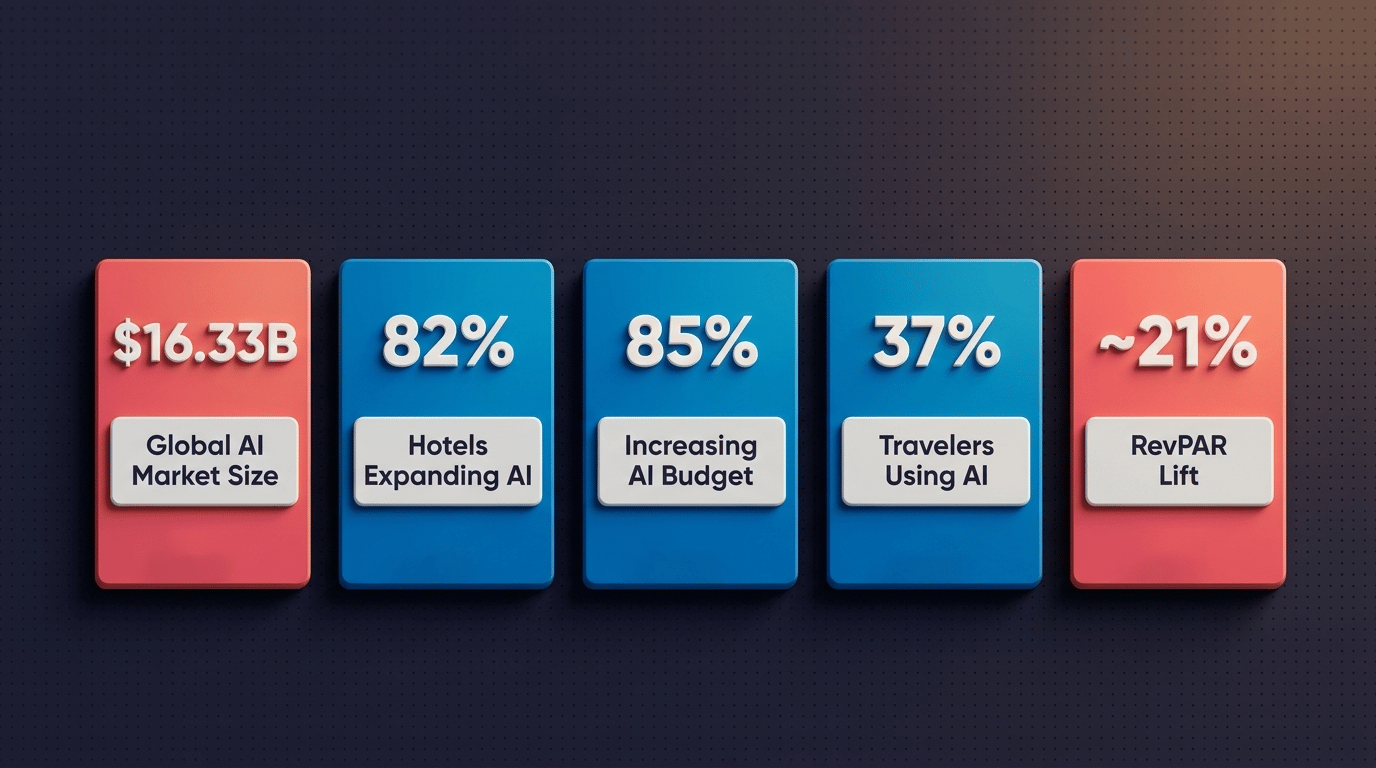
Artificial intelligence in hospitality is now a budgeted priority rather than an experiment. The global market for AI in hospitality was valued at $16.33 billion in 2023 and is projected to reach $70.32 billion by 2031, a compound annual growth rate of 20.36%, according to Kings Research. Market-size projections differ widely by research firm and methodology, so that figure is best read as one credible estimate rather than a settled number. The spending behind the growth is easier to verify: in a survey of more than 400 hotel technology decision-makers by Canary Technologies, 82% said they expect to expand AI use in 2026, and 85% plan to allocate at least 5% of their IT budget to AI tools.
| Metric | Figure | Source |
| AI in hospitality market size | $16.33B (2023), projected $70.32B by 2031 (20.36% CAGR) | Kings Research |
| Hotels expanding AI use in 2026 | 82% | Canary Technologies |
| Hotels allocating 5% or more of IT budget to AI | 85% | Canary Technologies |
| Travelers using AI tools to plan and book trips | 37% | NYU SPS / BCG |
| Hotels (North America) reporting staffing shortages (2025) | 65% | NYU SPS / BCG |
| RevPAR uplift from AI pricing (84 independent hotels) | about 21% | Lighthouse (vendor self-report) |
These AI hospitality industry trends describe an industry in transition, but adoption rates do not tell an operator which applications actually deliver a return. AI adoption in hotels accelerated through 2026; the harder question is where it pays back, and that is what the rest of this guide is about.
Guest Experience and Personalization
AI's most visible role in hospitality is in guest communication, and it is where operators report the most impact. In the Canary Technologies survey, 58% named guest communications the area where AI is making the biggest difference, and just over half (51%) said they are already piloting or have adopted AI tools. Messaging agents handle common questions around the clock, concierge agents manage recommendations and upsells, and real-time translation lets a front desk answer a guest in their own language.
In practice the gain is less hand-off than assist. Kirsten Collins, who runs guest services at Jetstream, describes AI's day-to-day value as pulling the relevant property information into a ready-to-review draft so a team can respond far faster than it could by hand, with every message still passing a human eye before it reaches the guest. That review step is where the value compounds, because each correction the team makes feeds back and sharpens the system over time. The mistake she sees operators make is assuming most guest messages are simple enough to hand over completely. They are not: complaints, cancellations, and refunds are too high-stakes to automate, and no two guest situations are the same. The teams winning with AI in guest communication are not the ones who switched it on and walked away, but the ones who never stopped refining it.
Personalization is the next layer, and this is where the distribution context matters more than most vendors admit. A recommendation engine that knows a guest's booking source can treat them appropriately: a repeat direct-booking guest and a first-time traveler who arrived through an OTA are different relationships, and the data that distinguishes them lives in the distribution layer, not the property management system alone. The deeper mechanics of guest-facing agents are their own topic, covered in our work on the AI concierge for hotels.
Revenue Management and Dynamic Pricing
Revenue management is the category with the clearest and fastest return. AI-driven pricing engines ingest demand signals, competitor rates, booking pace, and local events to adjust prices continuously, a job that outruns any human revenue manager updating spreadsheets by hand. Lighthouse reports that across a study of 84 independent hotels, properties using its AI pricing saw RevPAR rise about 21% after implementation. That is a vendor self-reported figure, so weigh it against your own market rather than treating it as a guarantee, but the direction is consistent across the category.
What a figure like that does not capture is the condition attached to it. Sarah Ali, who leads revenue management at Jetstream, is direct that AI pricing is not a set-it-and-forget-it button. What it realistically delivers, in her experience, is faster reaction times, steadier pricing consistency, and the ability to surface demand patterns no one could monitor manually at scale. The hotels that see the strongest return treat it as decision support rather than a replacement for revenue management, pairing it with good data, disciplined execution, and a team that knows how to turn an insight into an action.
The complication AI handles well is cross-channel pricing. Pricing a room for Airbnb is not the same exercise as pricing it for Booking.com or the direct site: the fee structures, guest expectations, and length-of-stay patterns differ, and a price that is optimal on one channel can be wrong on another. Managing that divergence by hand across a dozen channels is where mistakes creep in, and it is precisely the kind of high-volume, rule-based, data-rich work that AI does without fatigue.
Distribution Intelligence: The Category Nobody Else Covers
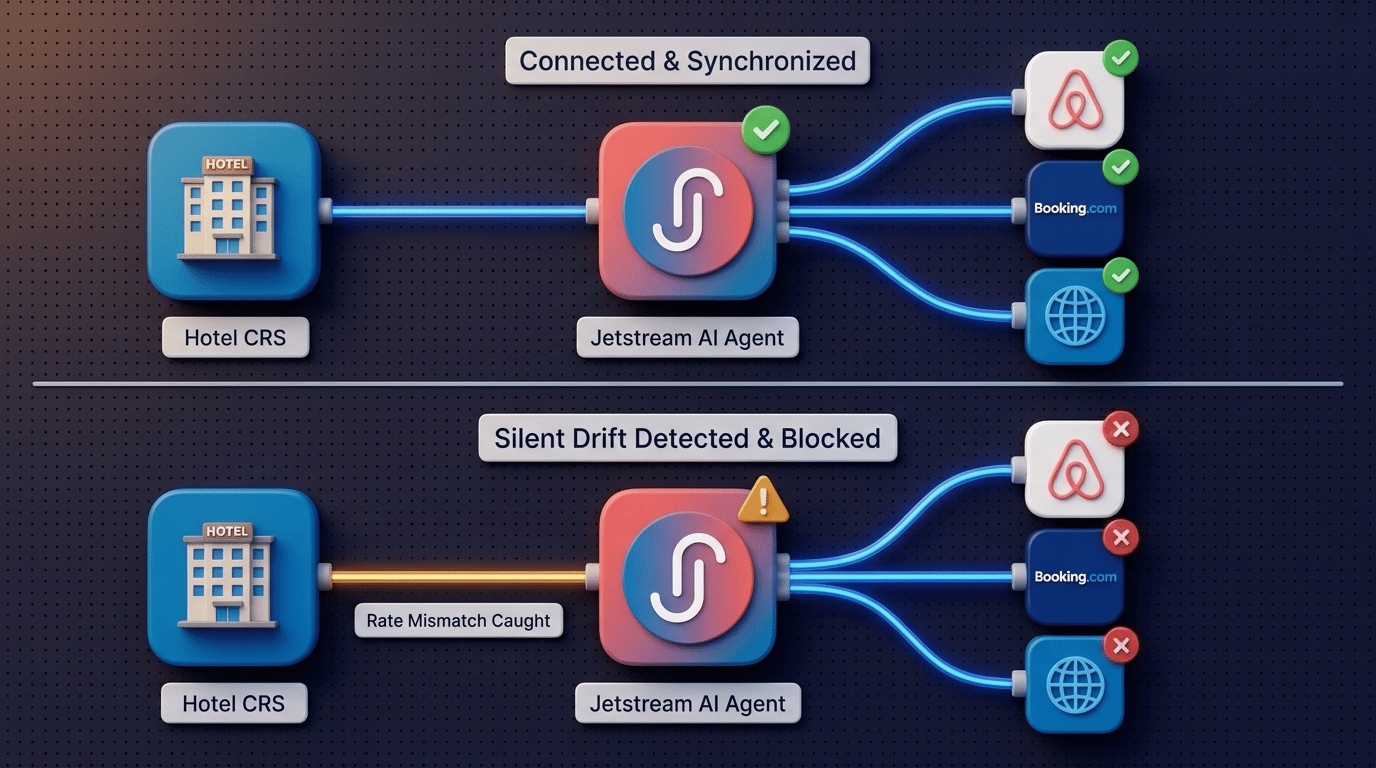
Most AI-in-hospitality guides stop at guest service and pricing. The category they miss is the one closest to revenue that is already booked: distribution intelligence. A connected channel and a correctly working channel are two different things, and the gap between them is where bookings quietly go wrong. A rate updates on one OTA but not another, a room type stops mapping correctly, a restriction applies unevenly, and nobody notices until a guest is walked or a reservation arrives at the wrong price.
Fergus Hudson, who builds Jetstream's distribution error-reporting tools, describes what that monitoring actually watches for:
"The misconfigurations that cost the most are rarely dramatic. A misconfigured rate type or promotion, duplicate fees flowing through simultaneously, a tax rate that hasn't been updated evenly across channels. Each one looks fine in isolation, the booking still arrives, but the payout is wrong, or the guest is charged twice, impacting downstream teams and the guest experience. That is what we are auditing for."
This is the layer where AI agents monitor connectivity continuously, detect booking errors, and resolve or escalate sync failures before they reach a guest. It is also where a coherent hotel distribution strategy becomes enforceable rather than aspirational, because the system is watching every handoff between the property's source of truth and the channels selling its rooms. The operational AI agents that do this work are worth understanding in their own right, which is the subject of our guide to AI agents for hotels. For a company like Jetstream, distribution is the daily job, and this monitoring layer is exactly what we are building into it.
Operations and Workforce Optimization
AI's least glamorous applications deliver some of its most consistent returns. NYU SPS and BCG report 20% faster room cleaning through AI-synchronized housekeeping schedules and roughly 50% food waste reduction within eight months of adopting AI-enabled tracking. The pressure driving that adoption is real: the same research found that, in North America, 65% of hotels reported staffing shortages in 2025 and labor costs rose 11.2% year over year. Beyond the front of house, the same pattern holds in energy management and predictive maintenance, where AI reads sensor and usage data to trim utility costs and flag failing equipment before it breaks, unglamorous wins that compound quietly across a portfolio.
The workforce question cuts both ways. The same NYU and BCG research notes that only 2.9% of travel and tourism employees have AI skills, compared with 21% in tech and media, even as AI-skilled hospitality roles grow nearly 5% a year. Voice AI is filling some of the gap on the front line, where hotels have historically missed between 20% and 40% of incoming calls according to industry reporting. At Jetstream, AI already handles a growing share of our own back office, from drafting listing content to triaging inbound guest and lead messages, which is the same shift we watch operator teams make as they free people for the work that genuinely needs a human.
AI Search and the Future of Hotel Discovery
How travelers find hotels is changing as fast as how hotels run them. NYU SPS and BCG report that 37% of travelers already use AI large language models embedded in online travel sites to plan and book trips, a shift the researchers call the move into an "ask and book" era. The practical consequence for operators is that being findable is no longer only about ranking on Google; it is increasingly about being accurately represented to the AI tools travelers ask for recommendations.
The connective tissue for that shift is MCP, the Model Context Protocol that Anthropic open-sourced in November 2024 as an open standard for connecting AI assistants to the systems where data lives. In hospitality, MCP is being used to expose hotel rates, availability, and inventory to AI platforms through a single interface. Cendyn, Aven Hospitality (the company behind the SynXis central reservation system), Lighthouse, RateGain, and Agentic Hospitality have all announced MCP-based pipelines, most launching through 2026. The same standard that puts a hotel's rates in front of an AI booking assistant is also what lets distribution-monitoring agents act across channels, which is why getting hotel data clean and structured now matters more than picking any single AI search tactic. For operators, the practical step is mundane but decisive: keep your rates, descriptions, and availability structured and accurate at the source, because an AI assistant can only recommend what it can read correctly. The discovery side of this shift is covered in our piece on AI search optimization for hotels.
Implementation: What Actually Works and What Does Not
The honest practitioner answer is that most AI value comes from a few unglamorous applications, and most AI disappointment comes from buying ahead of readiness. Start where the return is fastest and measurable: guest messaging and revenue management have the shortest path to impact because they sit on data hotels already have. Distribution intelligence belongs on that same short list, and it is the one most operators overlook: an agent that watches channel connectivity and rate mapping in the background catches the sync failures and parity breaks that quietly leak revenue for weeks, and it pays for itself by preventing errors rather than adding another workflow. The shiny-object trap is the tool that demos beautifully but needs six months of integration before it does anything, by which point the budget and the patience are gone.
The sobering context is worth keeping in view. Industry analyses compiled by Hospitality Upgrade cite an MIT finding that roughly 95% of enterprise generative AI efforts showed no measurable profit-and-loss impact, and a Gartner expectation that about 40% of agentic AI projects started in recent years will be scrapped by 2027. The common thread in the failures is rarely the model; it is data readiness. The NYU and BCG research found that nearly half of hoteliers struggle to access the information they need, and AI is only as good as the data it can reach. Before buying, an operator should be able to answer one question honestly: is our data clean, connected, and current enough for a tool to act on it?