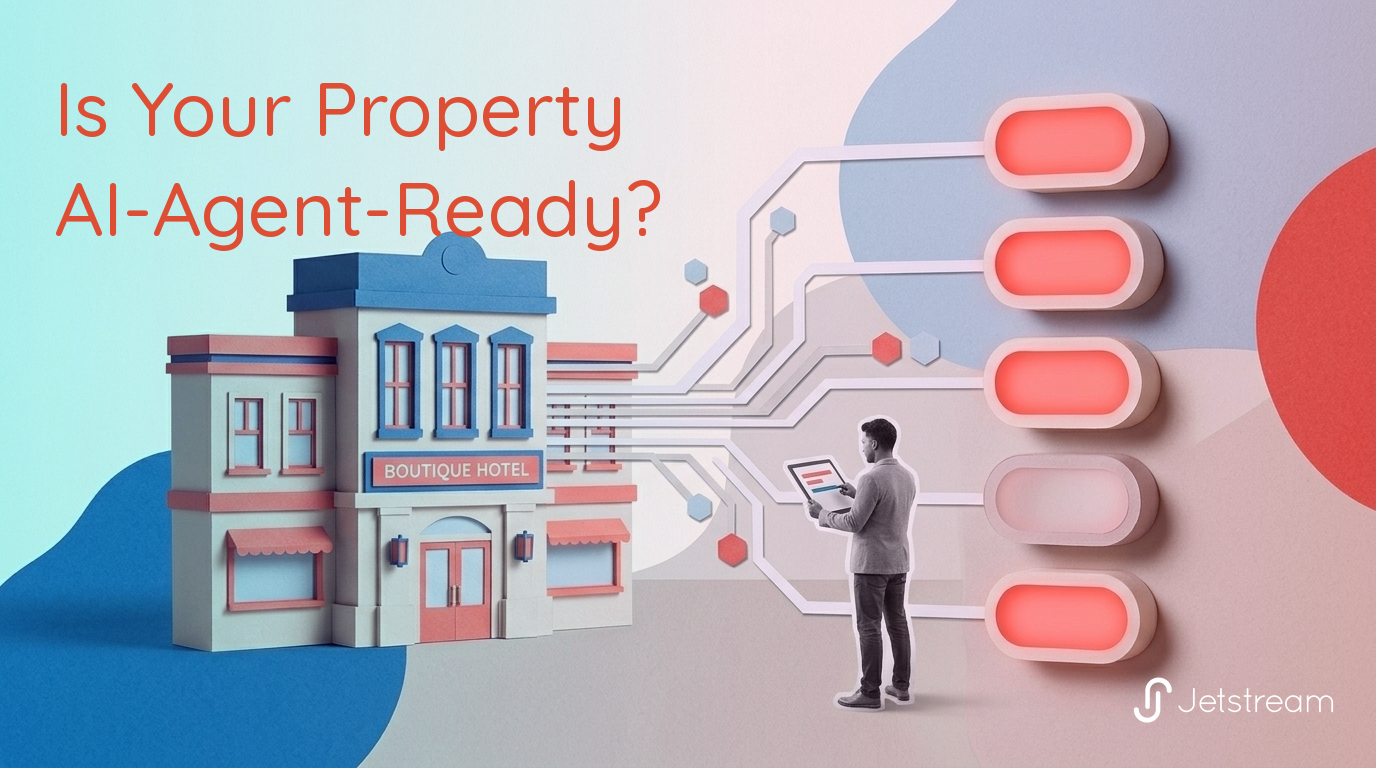
Ask ten hotel vendors what AI does for revenue management and you'll hear ten versions of the same answer: it forecasts demand, it prices dynamically, it segments guests. All of it is real. But an AI system can calculate the perfect rate for a Tuesday in March, and that rate still only earns money on the channels where your rooms are actually listed, in a format those channels can display. For a hotel that has added Airbnb and VRBO to its mix, the pricing engine and the distribution layer are two halves of one machine, and most coverage of AI revenue management ignores the second half entirely.
This guide covers what AI genuinely does in hotel revenue management today, where its limits are, and why distribution reach is the quiet constraint that decides whether an AI-optimized price ever reaches a paying guest.
Key takeaway: AI in hotel revenue management has moved from rules-based systems to learning systems that forecast demand, recommend prices, and adjust rates in real time from many more signals than a human can track. But a price is only as good as the channels it reaches. If your inventory is missing from a demand channel, or your rates fall out of parity across channels, the AI is optimizing against an incomplete market. Getting hotel rooms and rate plans onto every relevant channel cleanly and in sync is the distribution work that makes AI pricing pay off, and it is a different job from the pricing itself.
What AI revenue management means for hotels
AI in hotel revenue management is the use of machine learning to forecast demand, recommend or set room rates, and manage inventory across channels, drawing on far more data than a rules-based system or a human analyst could weigh at once. Where legacy revenue management ran on spreadsheets and static pricing rules, today's systems learn from patterns and act on them.
Lighthouse, a revenue-management technology vendor, frames the shift plainly: the discipline "has evolved well beyond spreadsheets and static pricing rules," and AI "has gone from showing you the data, to recommending what to do with it, to acting on it." That progression, from reporting to recommending to acting, is the real change. The rate recommendation you get today is built by "analyzing multiple inputs simultaneously, including historical performance, booking pace, competitor rates, market demand signals and segmentation behavior," in Lighthouse's description.
What AI actually optimizes
Three functions do most of the work, and they're worth separating from the marketing gloss.
Demand forecasting. AI reads early demand signals, search activity, travel intent, market trends, before they show up in confirmed bookings, so pricing can move ahead of the curve rather than reacting to it. The consultancy ZS notes that AI "can identify subtle patterns and correlations that human analysts might miss, such as the influence of social media sentiment on booking trends or the relationship between local events and room demand."
Dynamic pricing. This is the headline capability: real-time rate adjustments based on many factors at once. ZS describes processing "vast datasets, including historical sales, competitor pricing, market trends and weather patterns" to generate individualized pricing recommendations, including "real-time adjustments, such as adjusting rates for specific travelers when a large group booking is detected."
Segmentation. AI groups guests and booking behaviors more finely than manual analysis, which sharpens both pricing and targeting.
The limits matter as much as the capabilities. These systems need clean, connected data to work, and their output is only as useful as the market it can act on. A model can't price for a channel it has no visibility into, and it can't fix a rate that never reaches a listing, which is the part the standard coverage skips.
Why distribution is the missing half of AI pricing
Here is the through-line most articles on this topic never draw: an AI pricing recommendation converts to revenue only on channels where your inventory is actually listed and your rate can actually display. The pricing tool sets the number, and something else has to carry it to the market.
This isn't a Jetstream talking point; it's core revenue-management logic. Lighthouse calls optimizing your channel mix "a core driver of hotel revenue performance," with the goal being "to balance occupancy, acquisition cost and profitability." It also warns that "ignoring short-term rentals as competitive pressure can distort ADR expectations," and that hotels should "include alternative accommodation supply in market analysis." Airbnb and VRBO are now demand channels where an entire traveler segment searches first, and a hotel absent from them has handed its AI a smaller market to optimize against.
Rate parity is the other half of the same problem. When rates drift out of alignment across channels, or unauthorized resellers undercut your official price, the pricing strategy weakens no matter how good the model behind it is. Lighthouse: "when unauthorized resellers undercut official rates, it weakens your pricing strategy, damages direct booking conversion, reduces control over the market." Our guide to rate parity and multi-channel distribution goes deeper on why parity is a precondition for pricing to work, not a nice-to-have.
This is where distribution technology sits relative to AI pricing, and the two do not compete. An RMS or pricing engine decides the rate. A distribution layer gets that rate, and the underlying inventory, onto every relevant channel in a format the channel can use. Jetstream is the second kind of system: it connects to a hotel's PMS or CRS with real-time, two-way sync and distributes across Airbnb, VRBO, and other platforms, with the hotel retaining full control of pricing. Its rate-plan translation, "proprietary technology that translates complex hotel rate plans into OTA-compatible formats," exists precisely because a hotel rate plan often can't display natively on an STR platform, and an AI price that can't render is a price that can't sell. When Vail Resorts resolved a longstanding rate-parity issue with the Jetstream team, Airbnb booking pace rose 120% in 30 days, and the pricing model never changed; the price simply reached the channel cleanly at last. (More on that partnership in our Vail Resorts case study.)
What good data looks like
AI revenue management runs on data, and the quality of the inputs caps the quality of the output. The systems above lean on a few categories: booking history and pace, channel-level performance (how each OTA and direct channel actually converts and at what acquisition cost), competitor rates, and market and event signals. The distribution angle shows up here too. Channel-level performance data only exists if you're actually selling across those channels and capturing the results, which means measuring net revenue after distribution costs, not just gross. Lighthouse's phrasing is worth adopting internally: "measure NRevPAR, not just gross RevPAR, to understand true profitability."
How to evaluate an AI revenue approach
If you're weighing an AI pricing tool, the questions that matter are less about the algorithm and more about the stack around it. Does it integrate with your PMS or CRS, so recommendations act on live inventory? Can the rates it produces actually reach every channel you sell on, including STR platforms, in a displayable format? Does it give your revenue manager transparency into why it's recommending a price, or is it a black box? And does the rest of your distribution stack keep those rates in parity once they're out in the market? A brilliant pricing engine bolted onto a distribution setup that can't reach half your demand is a half-used tool.
Getting started without replacing your revenue manager
AI in revenue management is augmentation, not replacement. The most defensible reading of the current evidence is that these systems free revenue managers from mechanical work rather than making the role obsolete: a study by ZS and HSMAI in the Americas found that revenue managers spend 51% of their time on activities that do not directly generate revenue. Handing the pattern-crunching and rate-monitoring to a machine returns that time to strategy, relationships, and the judgment calls that models still handle poorly, complex market dynamics, unexpected events, and the trade-offs no dataset fully captures.
So the sensible path is incremental: let AI handle forecasting and rate recommendations, keep human judgment on strategy, and make sure the distribution layer underneath can actually execute the prices your team and your tools produce.
The distribution half is the half you control
AI has genuinely changed hotel revenue management, from reporting to recommending to acting, and the pricing capabilities are real. But the industry conversation treats pricing as if the rate, once set, simply works. It doesn't. A price earns only where your rooms are listed and your rates hold parity, which makes distribution the quiet determinant of whether AI pricing pays off at all. Get your inventory onto every channel your guests search, keep it in sync and in parity, and the AI has a full market to optimize against instead of a partial one.
That distribution layer is what Jetstream builds for hotels and resorts: real-time connectivity to your PMS or CRS, rate-plan translation, and full-service distribution across Airbnb, VRBO, and beyond, with you keeping control of pricing. If AI pricing is on your roadmap, it's worth making sure your rooms can actually reach the demand first. Talk to our team.
Frequently asked questions about AI in hotel revenue management
What does AI actually do in hotel revenue management?
+
It forecasts demand from early signals, recommends or sets room rates dynamically, and segments guests, all by analyzing far more inputs at once than a human or a rules-based system could: historical performance, booking pace, competitor rates, market demand, and event signals. In practice it has moved from reporting data, to recommending actions, to acting on them automatically.
Can AI replace a revenue manager?
+
No, and the better framing is augmentation. AI handles the mechanical work, forecasting, rate monitoring, pattern detection, which frees the revenue manager for strategy and judgment calls that models handle poorly, like complex market shifts and unexpected events. A ZS and HSMAI study found revenue managers spend 51% of their time on activities that don't directly generate revenue; AI is best aimed at reclaiming that time, not the role.
How does AI pricing handle distribution across OTAs and STR channels?
+
It largely doesn't, and that's the gap. Pricing tools set the rate; a channel manager or distribution layer carries that rate and the underlying inventory to each channel. If your rooms aren't listed on a demand channel like Airbnb or VRBO, or your rate can't display there in a compatible format, the AI's optimized price never reaches that market. Distribution is a separate job from pricing.
What data does an AI revenue management system need to work?
+
Clean, connected data across a few categories: booking history and pace, channel-level performance (conversion and acquisition cost per channel), competitor rates, and market and event signals. Because channel-level data only exists if you're genuinely selling and measuring across those channels, it helps to track net revenue after distribution costs (NRevPAR), not just gross RevPAR.
How is AI revenue management different from a traditional RMS?
+
Traditional revenue management ran on preprogrammed rules and static pricing logic. AI-based systems learn from data, incorporating unstructured signals like local events and sentiment that rule-based systems can't weigh, and they adjust in real time. The practical difference is that a rules-based system tells you what happened, while a learning system recommends what to do and can act on it.