The hotel industry spent years watching AI from a distance. Chatbots answered basic guest questions. Dynamic pricing tools adjusted rates overnight. Most of the technology felt incremental, useful in theory but rarely transformational in practice.
That is changing. AI for hotels has moved from experimental add-on to operational layer, and the shift is measurable. According to a 2026 Navigating AI report from Canary Technologies, 82% of hotels expect to expand their AI usage over the next year, and 85% plan to allocate at least 5% of their IT budget to AI tools. The question for hotel operators is no longer whether to invest, but where to start.
This guide breaks down what AI for hotels actually means in 2026, where the technology delivers the most value, and how to evaluate which AI capabilities belong in your distribution and operations stack.
What AI for Hotels Actually Means in 2026
AI in the hotel industry covers a broad range of technologies: machine learning models that forecast demand, natural language processing that powers guest messaging, computer vision that analyzes property photos, and recommendation engines that personalize upselling. The common thread is software that learns from data and improves its outputs over time without being explicitly reprogrammed for each scenario.
For hotel operators, the practical definition is simpler. AI for hotels means technology that takes over repetitive, data-intensive decisions so your team can focus on strategy and guest relationships. Rate adjustments at 2 AM. Flagging a booking error before it becomes a guest complaint. Drafting a response to a guest inquiry in the right language within minutes of receipt.
The global AI in hospitality market was valued at $16.33 billion in 2023 and is projected to reach $70.32 billion by 2031, growing at a compound annual growth rate of 20.36%, according to Kings Research. The growth reflects an industry-wide recognition that the operational complexity of modern hotel distribution has outpaced what manual processes and traditional software can handle.
How Hotels Are Using AI Today
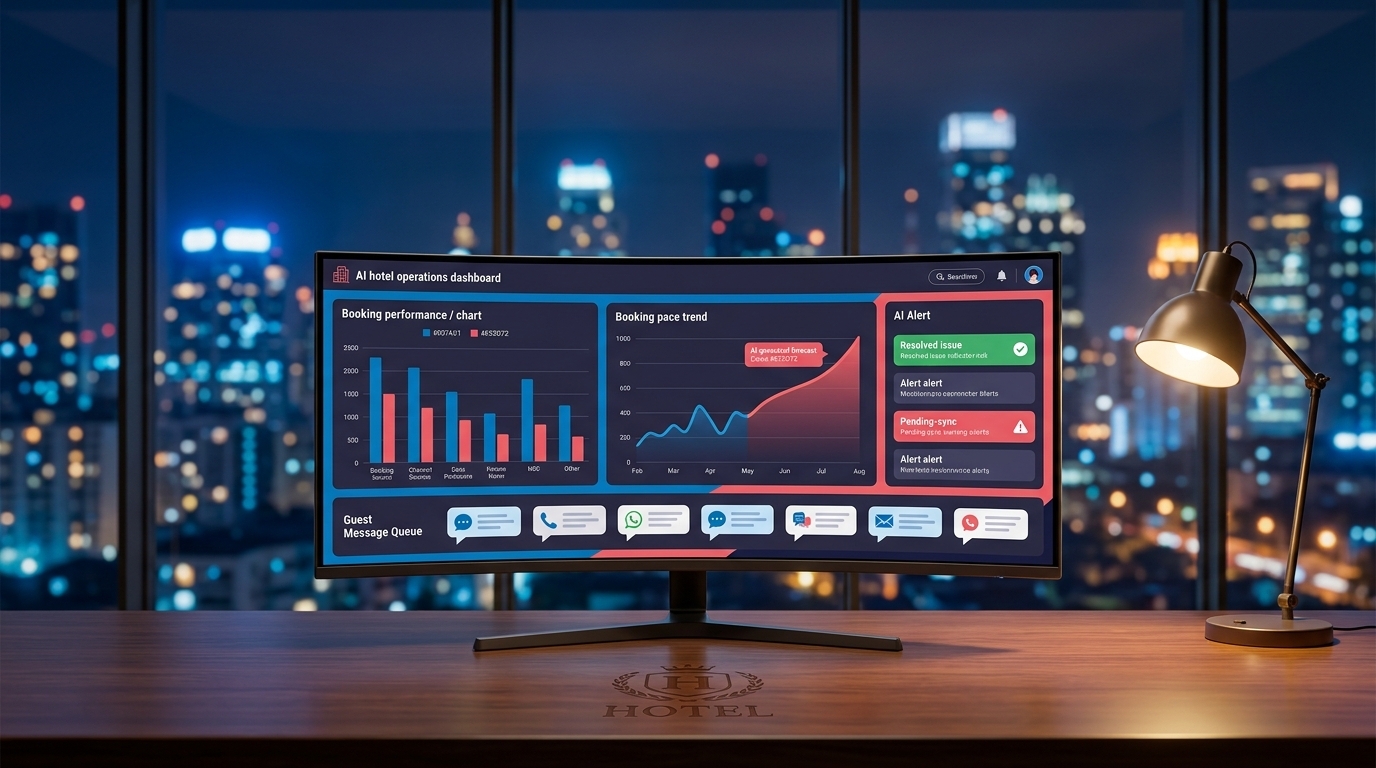
AI applications in hotels cluster around five operational areas. Some are mature and widely adopted. Others are emerging and likely to define the next wave of competitive advantage.
Guest Communication and Messaging
This is the most widely adopted category. In Canary Technologies' 2026 research, hoteliers using AI most commonly report saving staff time and higher guest satisfaction among the benefits, and guest messaging is the most visible everyday application. The appeal is straightforward: guests expect rapid responses regardless of time zone or channel, and AI handles the volume that human teams cannot staff around the clock.
Modern AI messaging goes beyond scripted chatbots. Systems like unified inboxes aggregate guest messages from Airbnb, Vrbo, Booking.com, email, and SMS into a single interface, then draft contextual responses using property-specific knowledge bases. The best implementations keep a human in the loop for complex situations while handling routine inquiries (check-in times, parking directions, Wi-Fi passwords) autonomously.
For hotels distributing across both traditional OTAs and STR platforms like Airbnb and Vrbo, unified messaging is especially valuable. Each platform has its own messaging interface and response time expectations. Airbnb's algorithm factors response speed into search ranking, and a unified AI inbox prevents the operational fragmentation that comes with managing five different communication channels manually.
Revenue Management and Dynamic Pricing
AI-driven revenue management represents the highest-ROI application for most hotels. Traditional revenue management relies on historical data and rule-based pricing. AI models ingest real-time signals: competitor rates, local event calendars, weather forecasts, booking pace, cancellation patterns, and channel-specific demand curves.
The results are measurable. Hotels using AI-powered dynamic pricing report an average RevPAR increase of 21%, according to Lighthouse (formerly OTA Insight), based on a study of 84 independent hotels using its AI pricing over at least 12 months. The improvement comes from granularity: AI adjusts rates across room types, channels, and booking windows simultaneously, capturing revenue that static or manually updated pricing leaves on the table.
For hotels operating across both traditional OTAs and STR channels, AI revenue management adds another dimension. Pricing strategy on Airbnb differs fundamentally from Booking.com or Expedia. Length-of-stay patterns, guest demographics, and competitive sets are different. AI tools that optimize across all distribution channels, rather than treating each one in isolation, capture the full revenue opportunity.
Channel Management Intelligence
This is the category where the gap between what exists and what hotels need is widest. Most channel management software today provides connectivity: it pushes rates and availability to OTAs and pulls reservations back to the PMS. The pipes work. What is missing is intelligence on top of those pipes.
AI-powered channel management adds a monitoring and detection layer. It watches for booking errors, sync failures between PMS and channel manager, rate parity violations across channels, and mapping inconsistencies that cause the wrong room type to appear on the wrong platform. These are problems that commonly result from API misconfigurations, time zone mismatches, or delayed sync cycles, and they can go undetected for days or weeks without an intelligent monitoring layer.
The cost of silent distribution failures is significant. A rate parity violation on Airbnb means a guest pays less than they would through your direct booking channel, eroding your margin. A sync failure means rooms show as available when they are already sold, leading to overbookings. A mapping error means a guest books a king suite and arrives to find a standard double. Each of these problems damages revenue, guest satisfaction, and your property's reputation on the platform.
AI tools that wrap your distribution infrastructure with proactive monitoring, automated alerts, and even self-healing error resolution represent the next frontier for ai hotel management. The technology already exists for booking error detection and connectivity health monitoring. The question is whether your current distribution stack includes it.
Content Optimization
AI-powered listing optimization is gaining traction as hotels expand onto STR platforms. Writing effective Airbnb and Vrbo listings requires a different skill set than writing OTA descriptions. Platform algorithms reward specific content patterns, photo quality, and keyword relevance in ways that traditional hotel marketing teams may not intuitively understand.
AI tools for hotels in this category analyze top-performing listings, identify content gaps in your property descriptions, suggest title and description improvements based on search behavior, and even generate listing content tailored to each platform's ranking algorithm. For hotels managing dozens or hundreds of room types across multiple channels, automated content optimization removes a bottleneck that manual copywriting cannot scale past.
Operational Automation
Beyond revenue and distribution, AI is streamlining hotel operations. Predictive maintenance models flag HVAC or plumbing issues before they cause guest complaints. Housekeeping optimization tools schedule cleaning crews based on actual checkout patterns rather than fixed rotations. Energy management systems adjust lighting and climate controls based on occupancy data. A 2025 Mews report positions 2026 as the year hotels must embrace operational AI or risk falling behind competitors who have automated these functions.
The Distribution Intelligence Gap

Most conversations about AI for hotels focus on the front desk: chatbots, concierge apps, digital check-in kiosks. These applications are visible and guest-facing, which makes them easy to market and easy to fund.
The distribution stack, the infrastructure that connects your PMS to every booking channel and manages rates, availability, and reservations across them, gets far less attention. Yet it is where the largest operational risks and revenue leakage hide.
Consider the operational reality for a hotel distributing rooms on Booking.com, Expedia, Airbnb, and Vrbo while managing direct bookings through a website. Each channel has its own inventory rules, content formats, fee structures, and guest communication expectations. The channel manager synchronizes rates and availability. The PMS records reservations. Between those two systems, a lot can go wrong silently.
A rate update fails to push to one channel. An availability sync runs ten minutes behind, creating a double-booking window. A room type mapping drifts out of alignment after a PMS update. A cancellation on one platform does not free up inventory on the others quickly enough. These failures compound. They cost revenue. They generate guest complaints that damage your property's algorithmic ranking on each platform.
Traditional channel managers do not catch these problems proactively. They move data. AI-powered distribution intelligence monitors the data as it moves, detects anomalies, flags issues before they reach the guest, and in some cases resolves them automatically. For hotels expanding into STR distribution, where the operational complexity doubles and the margin for error shrinks, this intelligence layer is the difference between a distribution strategy that scales and one that creates more problems than it solves.