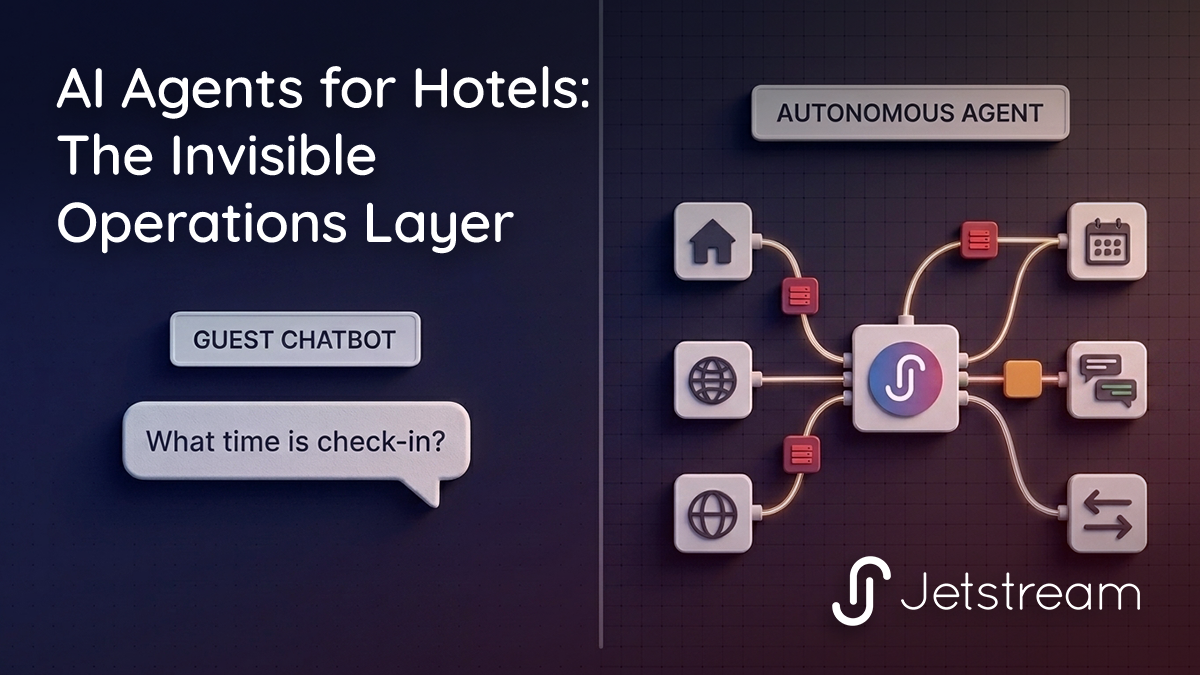
AI Agents for Hotels: The Invisible Operations Layer
Search "AI agent for hotels" today and almost every result points at the front desk: a voice agent that answers the phone, a messaging agent that handles guest questions, a concierge that recommends a restaurant. Those agents are real and useful, but they are also the smallest part of the story. The AI agents with the most direct impact on a hotel's revenue are the ones a guest never sees, the ones working in the background of distribution, catching the booking error before it becomes a double-booking and flagging the channel that quietly stopped syncing three days ago.
This guide defines what an AI agent for hotels actually is, sorts the market into three practical categories, and makes the case for the category nobody is talking about: the invisible operations layer.
Key takeaway: An AI agent for hotels is software that can perceive a situation, decide what to do, and act on it without waiting for a prompt. Most hotels meet AI agents at the guest-facing edge, but the highest-leverage agents run distribution operations behind the scenes, where a single undetected sync error can cost more than a month of front-desk efficiency gains.
What Makes an AI Agent Different from a Chatbot?
An AI agent completes tasks; a chatbot answers questions. A chatbot waits for a prompt and returns a response. An AI agent perceives its environment, decides on a course of action, and executes a multi-step task to reach a goal, with limited or no human supervision. IBM defines an AI agent as a system that autonomously performs tasks by designing its own workflow and using available tools, which is the line that separates an agent from a model that only generates text (IBM, "What Are AI Agents?").
The channel manager SiteMinder frames the hotel version of this distinction well. Generative AI, it notes, "can hand you the plan, agentic AI can carry it out," describing an agent as "a digital asset that can plan, execute, and complete multi-step tasks without needing your constant supervision" (SiteMinder, "Agentic AI for Hotels"). In a hotel context, the difference is concrete. A chatbot tells a guest the check-in time. An agent notices that a reservation arrived from an OTA with a rate that does not match the property's rate plan, opens a correction, and updates the records before anyone checks in.
| Capability | Chatbot | AI Agent |
| Trigger | Responds when prompted | Acts on its own when it detects a condition |
| Scope | Single question, single answer | Multi-step task from start to resolution |
| Hotel example | Tells a guest the check-in time | Detects a mismatched rate, corrects the reservation, updates the record |
| Human role | Drives every interaction | Reviews outcomes and handles exceptions |
The Three Categories of AI Agents for Hotels
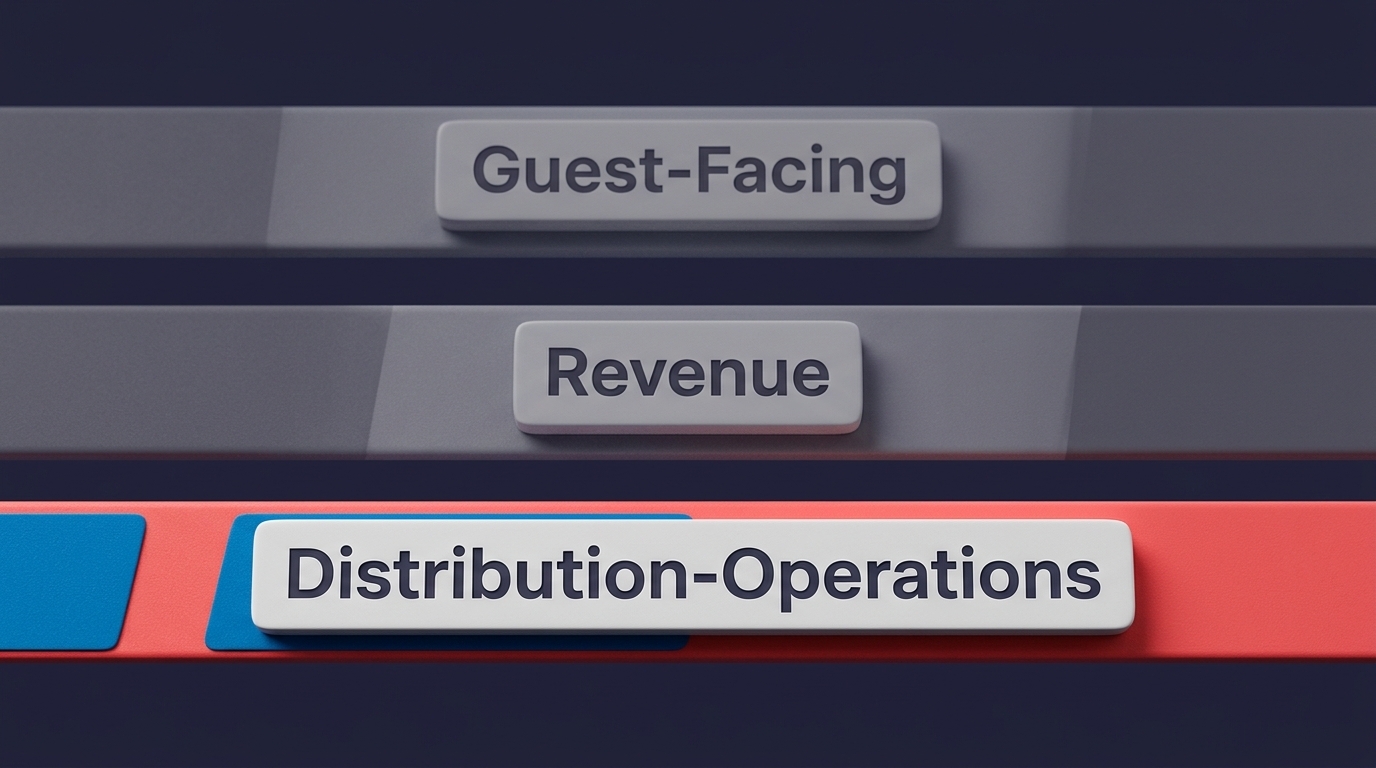
Hotel AI agents fall into three working categories: guest-facing agents, revenue agents, and distribution-operations agents. Most coverage of "AI agents for hotels" describes the first category and stops there. Sorting the market this way makes it easier to see where a hotel is already well served and where the real gap sits.
Guest-facing agents handle the conversations a guest has with the property. Lance, a Y Combinator company, builds voice, SMS, email, and vision agents that it says "run hotel operations" across more than 50 hotels including Marriott, Hilton, and Hyatt brands (Y Combinator, Lance). This is the category most operators picture first, and it is genuinely crowded with capable vendors.
Revenue agents forecast demand and shape pricing. Cloudbeds positions its Signals product as an AI layer for revenue intelligence and demand forecasting (Cloudbeds AI). These agents have a measurable, well-understood return, which is why revenue and pricing use cases tend to deliver ROI quickly.
Distribution-operations agents monitor the plumbing that connects a hotel to its channels. They watch for rate-parity drift, mapping inconsistencies, sync failures, and booking anomalies, and they resolve them before a guest is affected. This is the category no page-one search result for "AI agent for hotels" currently owns, and it is the one most directly tied to protecting revenue that is already booked. The rest of this guide focuses there.
Distribution AI Agents: The Revenue Hotels Lose to Sync Errors
Distribution-operations agents protect revenue by catching channel problems that humans tend to find only after a guest complains. Most sync failures are not dramatic outages. They are quiet drift: a rate that updated on one OTA but not another, a room type that stopped mapping correctly, a restriction that applied unevenly across channels. As one industry analysis of channel-manager errors put it, these problems come "from mapping drift, manual OTA edits, uneven restrictions, and mismatched policies, not from technical failures," and they produce "double bookings, inaccurate rates, guest dissatisfaction, and staff downtime spent fixing errors" (Small Business CEO, "Sync or Sink").
The cost of these errors is rarely visible on a report, because the booking that never should have happened and the guest who was walked do not show up as a line item labeled "sync failure." A distribution-operations agent changes the timing. Instead of a revenue manager discovering on Monday that one OTA showed availability all weekend after the last room sold, the agent flags the discrepancy when it happens, diagnoses the likely cause, and either resolves it or routes a clean ticket to the right person. The same logic applies to the way hotel rate plans often break when they reach Airbnb and VRBO: an agent that understands the structure of a rate plan can spot the translation error before it goes live.
"Connected" and "working correctly" are two different states, and only one of them is easy to monitor by hand. An agent watches the second one continuously, which is where hotel AI automation tends to pay for itself fastest, because the work is repetitive, unforgiving, and easy to let slide.
How MCP Connects Hotel Systems to AI Agents
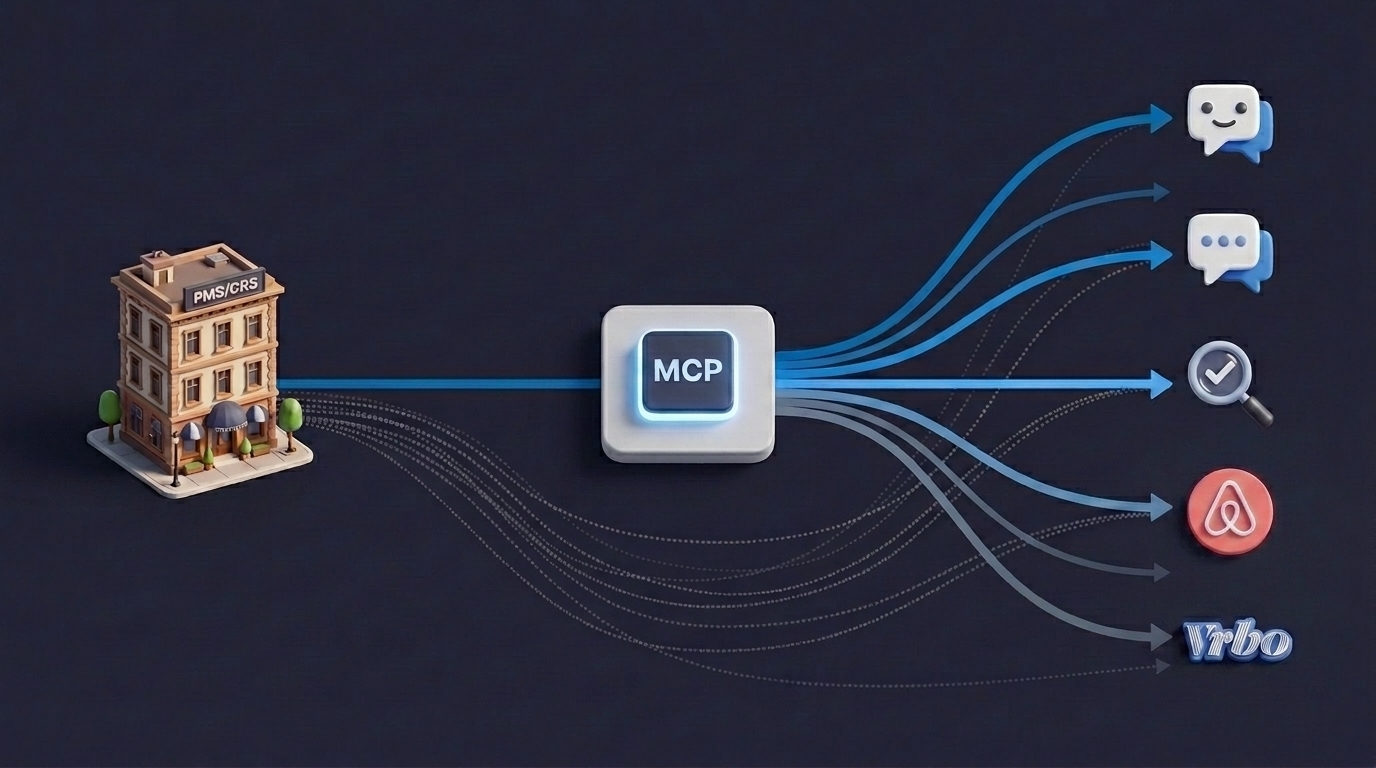
MCP, the Model Context Protocol, is the open standard that lets AI tools connect to a hotel's live data through one interface instead of a custom integration for each. Anthropic open-sourced MCP in November 2024 as "a new standard for connecting AI assistants to the systems where data lives," built to replace fragmented integrations with a single protocol (Anthropic). What MCP for hotels really changes is the layer through which a property can expose its rates, availability, and inventory to AI platforms without rebuilding a connection for every tool.
The hospitality industry is building this infrastructure quickly. Cendyn launched AI Connect to push hotel availability, rates, and inventory into AI search platforms such as ChatGPT, Claude, and Gemini through MCP (Travel Daily News). Aven Hospitality, the company behind the SynXis central reservation system, announced MCP enablement embedded directly in its CRS and booking engine, with an early access program beginning in the second quarter of 2026 (PR Newswire, March 2026). Lighthouse built its Connect AI offering on an MCP server so that AI agents can reach current rates and availability (Lighthouse). RateGain introduced an MCP integration for its booking engine (RateGain), Sabre, PayPal, and Mindtrip announced an agentic booking pipeline planned for the second quarter of 2026 (Hotel Management), and Agentic Hospitality launched a TravelOS MCP server that connects to a hotel's CRS and PMS so inventory originates from the system of record (Hospitality Net).
Most of this coverage frames MCP as a discovery and booking channel, a way to get a hotel's rates in front of travelers who increasingly start their trip planning inside AI tools. That framing is correct as far as it goes, but it misses what the same protocol enables behind the scenes. The interface that exposes inventory to a booking agent is also the substrate a distribution-operations agent needs to act across channels on its own. MCP is still early, with most programs in beta or launching through 2026, so the practical move for operators today is to get their data clean and structured now, before AI-driven distribution becomes routine.
How to Evaluate an AI Agent for Your Hotel
Start by deciding which category solves your most expensive problem, then check whether the agent reaches the systems it needs to touch. A guest-facing agent that shortens response times is valuable for a property drowning in inbound messages. A distribution-operations agent is the better first investment for a property with complex inventory across many channels, where the cost of an undetected error is high. The categories are not mutually exclusive, but the order you adopt them in should follow your biggest leak.
Integration depth is the question most evaluations skip. An agent that only sees the PMS cannot resolve a problem that lives between the channel manager and an OTA. Ask what systems the agent connects to and whether it can act across them, not just read from one. Platforms like Canary Technologies' Agent Studio let hotels build and configure their own agents from templates (PR Newswire, Canary Agent Studio), which suits teams with the appetite to build; purpose-built agents suit teams that want a specific operational problem solved out of the box.
Finally, match the metric to the category. A guest-facing agent is measured on response time and resolution rate. A distribution-operations agent is measured on prevented errors, recovered revenue, and connectivity uptime. Holding one to the other's scorecard is how good agents get judged as failures.